
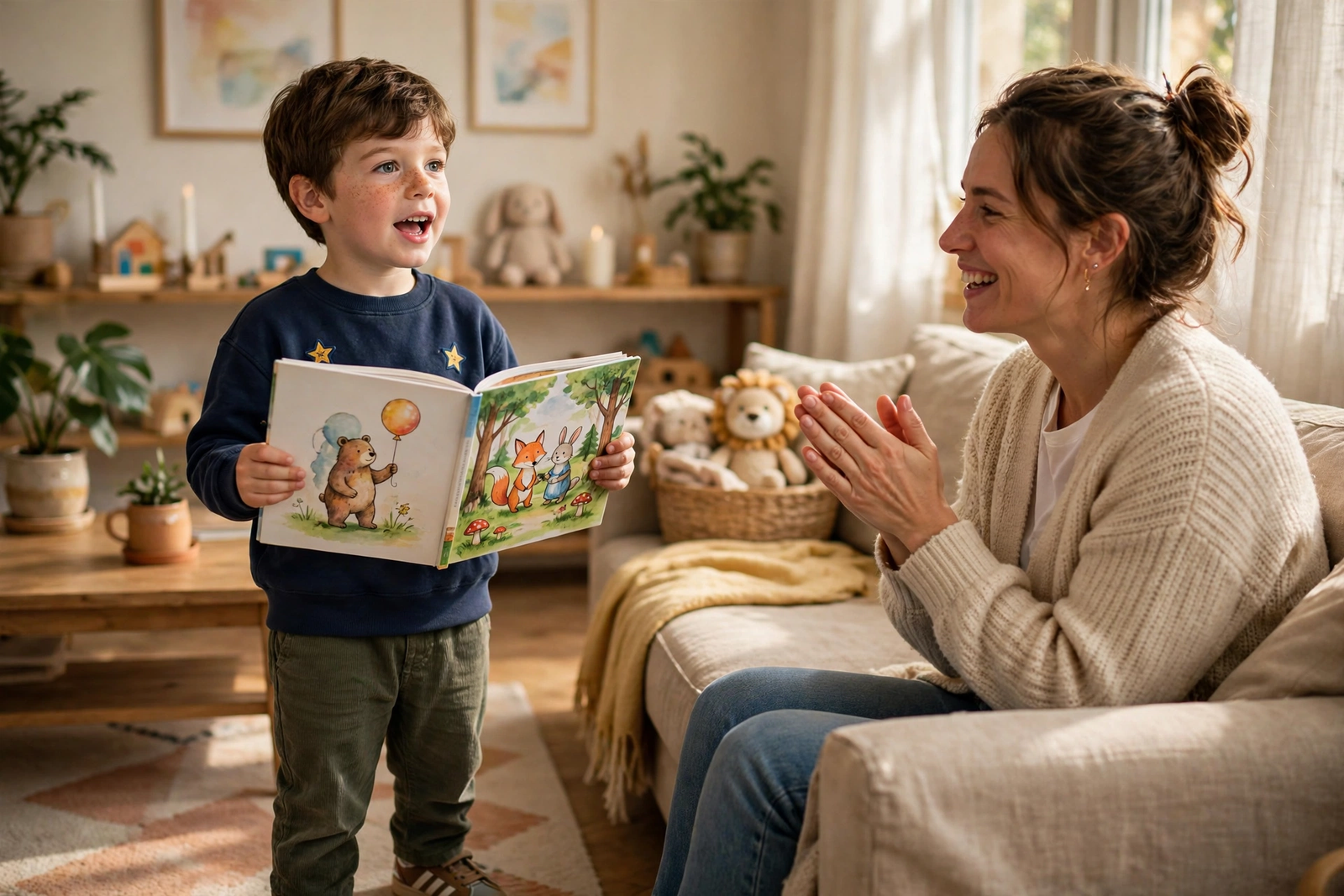
Your child brings home an English reader, opens it, and looks at you. You look at the page. Some of the words are easy. Some of them you are not quite sure how to say. In that small moment, a lot of parents quietly decide that helping their child read English aloud is somebody else’s job. It is not. This routine works even if your English is basic — because your job is not to be the teacher. Your job is to be the audience, and that is all it takes to help your child read English aloud.
Reading aloud is how children turn letters into language. When a child reads a sentence out loud, they practise sounds, rhythm, and meaning all at once — and build the confidence to speak English in front of other people. A parent who listens warmly, even without perfect English, gives a child something no app can: a safe person to read to.
Start with the right book
The single biggest mistake is starting with a book that is too hard. A child who stumbles on every third word is not learning to read — they are learning to dread reading. The right book is one your child can read with about nine words out of ten correct. An easy book read with joy teaches far more than a hard book read with tears.
Look for books with short sentences, lots of repetition, and pictures that help tell the story. Rhyming books are wonderful at this age, because the rhyme gives the child a clue about the next word. And let your child choose.
A 10-minute routine to help your child read English aloud
Same time, same place, every day. Ten minutes, no more. Here is the shape that works for most families:
| Minutes | What happens | Why it works |
|---|---|---|
| 0–2 | Look at the pictures together and talk about them | Predicting the story makes the words make sense |
| 2–8 | Your child reads aloud, you listen and follow along | Real practice, at their pace |
| 8–10 | Talk about the story: one favourite part, one question | Meaning, not just sounds |
That first step matters more than it looks. When a child talks about the pictures first, they already know what the story is about, so the words on the page are not a mystery to solve — they are the words for a story they already half-know.
During the reading itself, sit close, follow the words with your finger, and let your child set the pace. If they read slowly, that is fine — speed comes later. What matters now is that reading aloud feels safe and ordinary, like brushing teeth.

What to do when your child gets stuck
Every child gets stuck. What you do in the next five seconds decides whether they keep trying or shut down. Do not jump in with the word immediately — that teaches them to wait for rescue. Try these in order:
First, wait. Count silently to five — children often work it out if you give them a breath. Second, point to the picture and ask, “What do you think is happening here?” The picture usually gives the word away. Third, say the first sound of the word and let them finish it. Fourth, if they are still stuck, just tell them the word, smile, and let them carry on. Then read that sentence together once more, so the word gets a second chance.
How to help when your own English is basic
Here is the honest truth: your English does not need to be good for this to work. It needs to be good enough to listen, encourage, and ask questions — a much lower bar than most parents think.
Use the audio that comes with many children’s readers. Play the sentence, let your child hear it, then let them read it. Or use your phone’s read-aloud feature on a picture book app, or a short video of a native speaker reading the same story. Your child hears the correct sounds from the recording; you provide the lap, the attention, and the applause.
Learn the week’s words together. Before reading time, pick five words from the book and learn them side by side — look them up, say them together, laugh at the hard ones. When your child sees you learning too, reading stops being a test they take alone and becomes something your family does together. And if your child corrects your pronunciation, let them — nothing builds a child’s confidence like teaching a parent something.
Build the habit, not the pressure
Reading aloud works through repetition across weeks, not through one heroic evening. Keep the books where your child can reach them, not on a high shelf. Keep a special reading spot — a corner with a cushion and a lamp makes ten minutes feel like an occasion, not a chore. Keep a simple record together: a star on the calendar for every evening you read, and a small celebration every ten stars.
And keep it short. If ten minutes turns into a battle, stop at five. A short, happy session today is worth more than a long, tearful one, because tomorrow your child will still want to come back. You are not trying to finish a book tonight. You are trying to raise a child who, in a year or two, picks up a book on their own — because reading has always felt safe, warm, and a little bit fun.
Quick Quiz
Test yourself on helping your child read English aloud. Click an answer to see if you are right — your score is at the top.
Score: 0/5
1. A right book is one your child can read with about how many words correct?
2. What happens first in the 10-minute routine?
3. When your child gets stuck on a word, what should you try first?
4. Should you correct every mistake your child makes?
5. If ten minutes turns into a battle, what does the post advise?
Quick answers
My English is basic. Can I really help my child read English aloud?
Yes. Your role is listener, encourager and reading partner — not pronunciation teacher. Use the audio that comes with the book for correct sounds, and give your child your attention, your patience, and your praise. That is what they need most.
What if my child refuses to read aloud?
Start smaller. Let them read one page, or one sentence, and you read the rest. Or take turns: one page you, one page them. Many reluctant readers relax once the pressure of “reading the whole book” is gone.
Should I correct every mistake my child makes?
No. Correct only the mistakes that change the meaning, and do it gently by repeating the sentence correctly yourself. Constant correction makes children afraid to try. Fluency and confidence come first; accuracy catches up with practice.
Your child does not need a perfect English speaker sitting beside them. They need someone who shows up every evening, listens like the story matters, and claps when they reach the last page. That is a routine any parent can build — starting tonight. For more gentle reading practice, stories, and songs made for young learners, visit our English programme, where every lesson is designed to be enjoyed together, parent and child side by side.