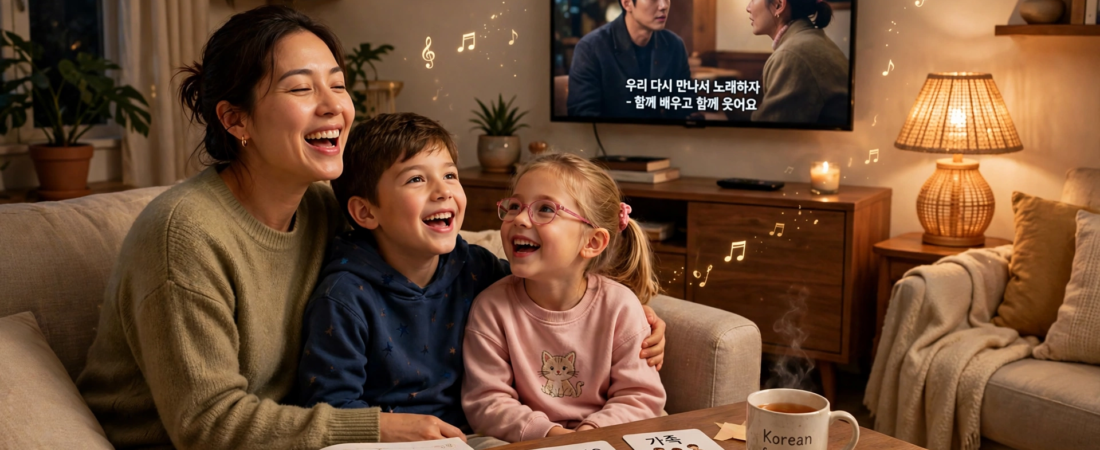
Your child hums a Korean song in the shower. You catch yourself humming it too, and neither of you knows what the words mean yet. That is the easiest doorway into Korean you will ever find, and it is already open in your living room. K-drama OSTs, the soundtracks of Korean dramas, are slow, clear, and full of feelings your whole family already understands: love, missing someone, starting over, saying good night. This post gives you 10 of the easiest OSTs to learn and sing along to, with the Korean words inside them, so your next family movie night doubles as a Korean lesson nobody has to be dragged to.
Why K-drama OSTs teach Korean better than a worksheet
A worksheet asks a child to memorize. A song asks a child to sing, and the memorizing happens on its own. OST singers pronounce every syllable slowly because the emotion has to land. The chorus repeats the same short line three or four times, which is exactly how a young brain likes to learn a new sound. And because the song belongs to a story your child already loves, the words come attached to a scene: a rainy street, a first snowfall, a goodbye at an airport. That picture holds the meaning in place long after a flashcard would have slipped away.
Parents ask me if this really counts as studying. It does, and here is why. Listening to a song trains the ear to hear Korean sounds. Singing along trains the mouth to make them. Looking up one or two words per song trains the habit of learning from real life instead of from a book. Ten songs, one or two words each, is twenty words your child will actually remember, because each one has a tune and a story attached. That beats a hundred words on a list every time.
A quick note on how to use this list. Play one song a day, not all ten at once. Listen first without worrying about the words. Then sing the chorus together, badly and loudly, because that is the fun part. Then pick one Korean word from the song and use it at home that day. By the end of the week your family will have a small shared vocabulary, and your child will have a reason to ask for the next song.
How to learn each song in 3 steps
If you only listen for fun, the vocabulary drifts past your ears and disappears. To learn for real, follow these 3 steps with each song. Step 1: listen to the whole song once, just to feel the melody and guess whether the song is sad or happy. Step 2: memorize the memorable line from the song — read the romanization, understand the meaning of each word, then sing along 3 times. Step 3: look the line up again in the full lyrics, see where it sits in the song and what the character is feeling at that moment. When vocabulary is tied to a scene you’ve watched, you remember it far longer than words learned from a book.
One small note: song lyrics can use poetic language — they’re not always everyday speech. This post will point out clearly which words you can use in daily conversation and which ones are only beautiful in poetry. If you can tell the two apart while learning through soundtracks, your Korean will be both lovely and practical.
Three songs from Descendants of the Sun
Descendants of the Sun (2016) gave us some of the most singable Korean songs ever written for television. The melodies are gentle, the choruses are short, and the words are the simplest feelings in the language.
1. “Everytime” by Chen and Punch
This is the song that plays when the two main characters keep bumping into each other, and the chorus is so easy that children pick it up after one listen. The word to take home is 사랑해요 (saranghaeyo), which means “I love you.” Say it slowly: sa-rang-hae-yo. It shows up in almost every Korean love song your child will ever hear, so learning it here pays off everywhere.
Listen to the clip above and repeat each phrase after the speaker. 사랑해요 (saranghaeyo) means “I love you.” 보고 싶어요 (bogo sipeoyo) means “I miss you.” 괜찮아요 (gwaenchanayo) means “It is okay.” Three phrases, and you can already say the three most useful things in any drama.
2. “You Are My Everything” by Gummy
Gummy’s voice is warm and slow, which makes this song perfect for beginners. The line to learn is 보고 싶어요 (bogo sipeoyo), “I miss you.” Children love this one because they can use it right away: when grandma visits another city, when a friend moves away, when dad comes home late from work. 보고 싶어요 turns a feeling into a Korean sentence they can actually say to someone they love.
3. “This Love” by Davichi
Davichi sing in clear, strong voices, and the chorus repeats the title phrase 이 사랑 (i sarang), “this love,” over and over. The word to keep is 운명 (unmyeong), which means “fate” or “destiny.” Korean dramas love this word. When two characters meet by accident for the third time, someone always whispers 운명이야 (unmyeong-iya), “It is fate.” Your child will hear it in every drama from now on, and now they will know it.
Three songs from Goblin
Goblin (2016) is the drama that made a whole generation fall in love with Korean songs. The soundtrack is slow, emotional, and full of words about stars, snow, and waiting for someone.
4. “Stay With Me” by Chanyeol and Punch
This duet is the first song most families learn, because the chorus is a simple plea: 내 곁에 있어요 (nae gyeote isseoyo), “stay by my side.” The melody rises and falls like a conversation, so children can follow it even before they know the words. Sing the chorus together in the car. It is the kind of song that makes a car ride feel like a scene from a drama, and that is exactly the point.
5. “Beautiful” by Crush
“Beautiful” is slow enough to sing along to on the very first try, and it teaches one of the prettiest words in Korean: 별 (byeol), which means “star.” The song is full of night sky pictures, so ask your child to point at the stars while you sing it. A word learned under a real sky stays learned. You can also teach 아름다워요 (areumdawoyo), “it is beautiful,” and let your child use it on anything: a sunset, a drawing, a new dress.
Listen and repeat: 별이 빛나요 (byeori binnayo), “the star shines.” 꿈을 꾸어요 (kkumeul kkueoyo), “I dream.” 행복해요 (haengbokhaeyo), “I am happy.” These three short sentences are perfect bedtime Korean. Try saying them together before lights out tonight.
6. “I Will Go to You Like the First Snow” by Ailee
This is the most famous song on this list, and the one your child is most likely to hear again somewhere. The title itself is a Korean lesson: 첫눈 (cheotnūn) means “first snow,” and the full line 첫눈처럼 너에게 가겠다 (cheotnūncheoreom neoege gagetta) means “I will go to you like the first snow.” It is a long line, so do not try to learn it all at once. Start with 첫눈, and let the rest come over a few listens. When the first snow of winter comes, your child will already have a Korean word for it, and that is a small magic trick no textbook can do.
Two songs from Itaewon Class
Itaewon Class (2020) is a drama about starting over, and its soundtrack is full of energy and courage. These two songs are the ones to play when your child needs a boost before a test or a big day.
7. “Start Over” by Gaho
“Start Over” is the song about beginning again, and its chorus teaches the most useful phrase in this whole post: 다시 시작해요 (dasi sijakhaeyo), “let us start again.” The two parts are 다시 (dasi), “again,” and 처음부터 (cheoeumbuteo), “from the beginning.” Put them together when homework goes wrong, when a game is lost, when a drawing does not turn out right. 다시 시작해요 is not just a song lyric. It is a family motto in four syllables.
Listen and repeat: 처음부터 다시 시작해요 (cheoeumbuteo dasi sijakhaeyo), “let us start again from the beginning.” 오늘은 좋은 날이에요 (oneureun joeun narieyo), “today is a good day.” Say the second sentence every morning for a week and watch it become a habit.
8. “Sweet Night” by V of BTS
V sings this one softly, like a lullaby, and it is the gentlest song on the list. The word to learn is 꿈 (kkum), “dream,” and the phrase to take to bed is 좋은 꿈 꿔요 (joeun kkum kkwoyo), “sweet dreams.” It is the Korean way of saying good night to someone you love, and children adore saying it to their stuffed animals, their siblings, and their parents. Play this song at bedtime and let the day end in Korean.
Two more favorites for the family playlist
9. “Love, Maybe” by MeloMance, from Business Proposal
Business Proposal (2022) is a light, funny drama, and its best-known song is just as light. “Love, Maybe” teaches 설레요 (seolleoyo), the feeling of your heart fluttering when you like someone. Korean has a single word for that flutter, and English does not, which is a lovely thing to discover together. Ask your child when their heart last felt 설레요: before a birthday, before a performance, before seeing a best friend after summer break. The word sticks because the feeling is already theirs.
10. “Give You My Heart” by IU, from Crash Landing on You
IU sings this one slowly and clearly, which makes it a wonderful last song for the list. The title itself is the lesson: 마음을 드려요 (maeumeul deuryeoyo), “I give you my heart.” 마음 (maeum) means “heart” or “mind,” and it appears in so many Korean songs that learning it here unlocks dozens of lyrics later. When your child hears 마음 in the next song, they will catch it, and that small catch is the sound of real listening skill growing.
Your 10-song Korean word bank
Here is every word from the ten songs in one place. Print this table or keep it on the fridge, and tick off each word your family uses in real life this week.
| Korean | Romanization | Meaning | From the song |
|---|---|---|---|
| 사랑해요 | saranghaeyo | I love you | Everytime |
| 보고 싶어요 | bogo sipeoyo | I miss you | You Are My Everything |
| 운명 | unmyeong | fate, destiny | This Love |
| 내 곁에 있어요 | nae gyeote isseoyo | stay by my side | Stay With Me |
| 별 | byeol | star | Beautiful |
| 첫눈 | cheotnūn | first snow | I Will Go to You Like the First Snow |
| 다시 시작해요 | dasi sijakhaeyo | let us start again | Start Over |
| 꿈 | kkum | dream | Sweet Night |
| 설레요 | seolleoyo | my heart flutters | Love, Maybe |
| 마음 | maeum | heart, mind | Give You My Heart |
| 괜찮아요 | gwaenchanayo | it is okay | Everytime |
| 행복해요 | haengbokhaeyo | I am happy | Beautiful |
| 좋은 꿈 꿔요 | joeun kkum kkwoyo | sweet dreams | Sweet Night |
Send this table to another parent whose child is learning Korean. A shared song list is worth more than a shared worksheet, because two families singing the same chorus will keep each other going.
A 15-minute family sing-along routine
Songs only work if they become a routine, so here is a simple one that fits into any evening. It takes fifteen minutes, and it works best right after dinner, when everyone is still at the table or on the sofa.
1. Pick one song. Let your child choose. Choice is the fuel. One song a day, not ten.
2. Listen once, hands free. No lyrics, no phones. Just listen and enjoy the music, the way you would enjoy any song.
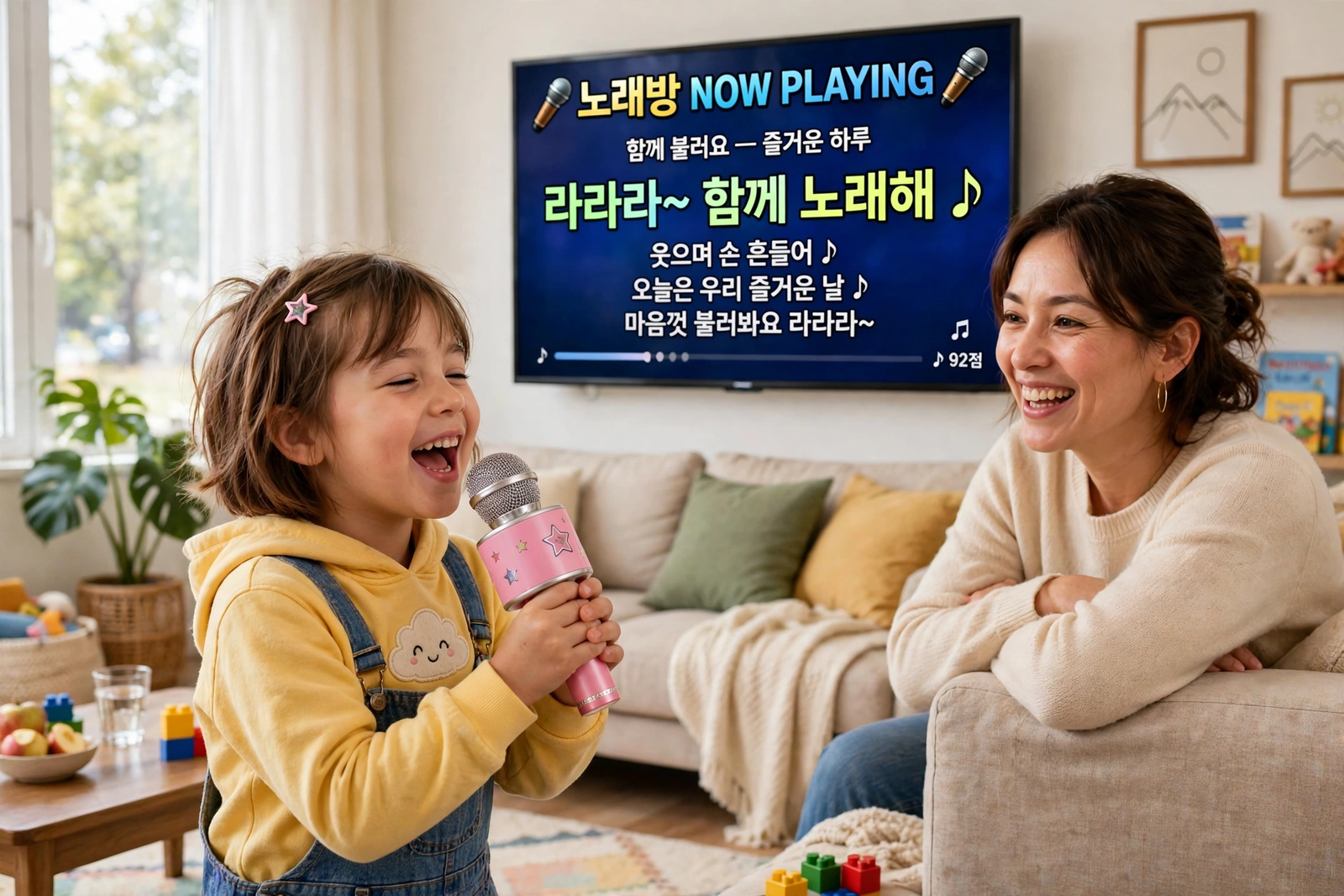
3. Sing the chorus together. Put the lyrics on the screen, point at each line as it comes, and sing loudly. Being off-key is allowed. Being quiet is not.
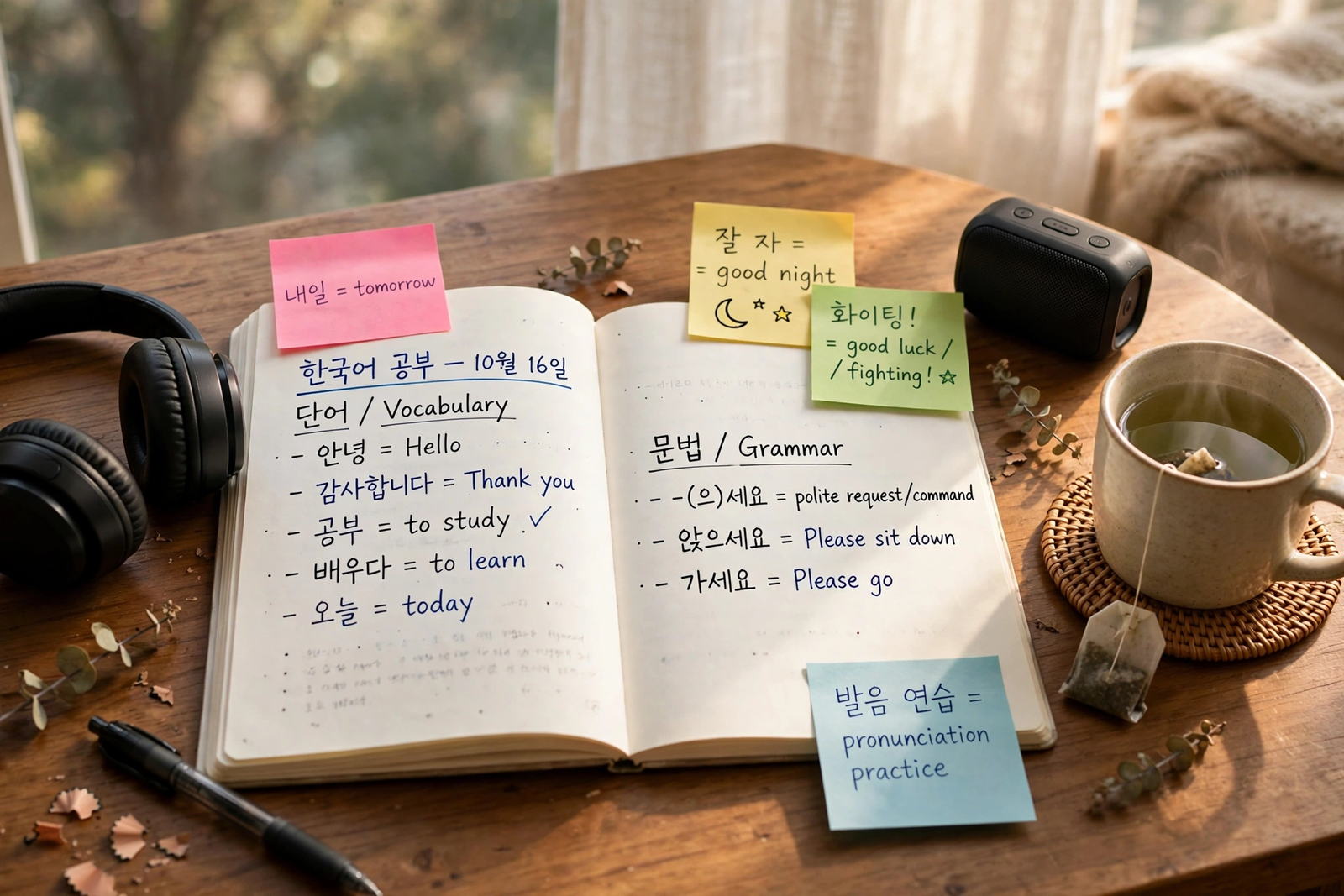
4. Learn one word. Pick the word from the table above that belongs to today’s song. Say it three times, use it in a real sentence, and write it on a sticky note for the fridge.
5. Say good night in Korean. End with the bedtime phrases from the last audio clip, and let Korean be the last language your child hears before sleep.
Listen and repeat together: 내일 봐요 (naeil bwayo), “see you tomorrow.” 잘 자요 (jal jayo), “sleep well.” 좋은 꿈 꿔요 (joeun kkum kkwoyo), “sweet dreams.” Three phrases, and bedtime is now a Korean lesson your child will ask for.
Five mistakes to avoid
Playing all ten songs in one sitting. A playlist is not a lesson. One song a day lets the words settle. Ten songs in an hour lets them all blur together.
Correcting every pronunciation. If you stop the song to fix every sound, your child will stop singing. Let the tune carry the sounds first. Pronunciation sharpens on its own after ten or twenty listens.
Skipping the meaning. A child can sing sounds they do not understand for years. That is karaoke, not learning. One word explained per song is enough, but it has to happen.
Choosing songs you like instead of songs they like. The best OST for learning Korean is the one your child asks to hear again. Let them pick, even if it is the same song five days in a row. Repetition is the teacher here.
Keeping it a secret from the rest of the family. Songs are social. When grandparents, cousins, or friends join the sing-along, the words gain an audience, and an audience makes a child proud of what they know.
If you want a daily structure around this kind of listening, the 20-minute daily Korean routine for kids on LingoBubbo shows how to fit short listening, speaking, and review into one small block of time each day.
5 practice questions: how many lines do you remember?
Answer the 5 questions below quickly — the answer sits right after each question. Try answering on your own first.
Question 1. What does “사랑인가 봐” mean? — Answer: “It seems like love”. 사랑 is love, and 인가 봐 is the pattern “it seems like…”.
Question 2. What does the word 처럼 in the line “첫눈처럼 너에게 가겠다” mean? — Answer: 처럼 means “like”. The whole line means “I will come to you like the first snow”.
Question 3. Which two words make up “이 사랑”, and what do they mean? — Answer: 이 means “this”, and 사랑 means “love”. The whole phrase means “this love”.
Question 4. Which song on the list uses the pattern “인가 봐” to express “it seems like…”? — Answer: “사랑인가 봐” by MeloMance, from the Business Proposal soundtrack. The 인가 봐 pattern works with any word: 배고픈가 봐 (I guess I’m hungry).
Question 5. What does the word 다시 in “Start Over” mean? — Answer: 다시 means “again, once more”. 다시 시작해 means “start over”.
Quick Quiz
Test yourself on the Korean words from these ten drama songs. Click an answer to see if you are right. Your score is at the top.
Score: 0/5
1. What does 사랑해요 mean?
2. Which drama is the song “Stay With Me” from?
3. What does 별 mean?
4. What does 괜찮아요 mean?
5. Who sings “Give You My Heart” for Crash Landing on You?
FAQ
Is it okay for young children to watch K-dramas?
Most K-dramas are family dramas about love, family, and work, but some scenes are made for adults. For young children, stick to the songs, not the shows. Play the OST, enjoy the music, and save the dramas themselves for older kids. The learning in this post comes from the music alone.
My child only likes one song. Should I push the other nine?
No. Let them live inside one song for a week. Deep repetition of one chorus teaches more Korean than a quick tour of ten songs. The rest of the list will still be here when they are ready.
How much Korean will my child really learn from songs?
Songs teach listening, pronunciation, and a small set of everyday words very well. They do not teach grammar or reading on their own. Treat them as the fun half of learning, and pair them with short lessons like the Korean lessons on LingoBubbo for the other half.
What if I cannot read Korean letters yet?
That is fine. Every word in this post comes with romanization, so you can sing along using the English letters. When you are ready to learn the Korean alphabet, the same songs will help, because you will already know how the words sound.
Can adults use this list too?
Yes. These songs are the same ones adults learn from, and singing together is the whole idea. If your child sees you learning the words, they will want to learn them too.
Can learning through soundtracks help me actually speak Korean? Yes, if you choose the right words to learn. Words like 사랑, 마음, 밤, 꿈, 다시 and the patterns 인가 봐 and 처럼 can all be used in everyday conversation. Song lyrics can be poetic, but the vocabulary is real — every usable word you learn is real progress.
How many times should I listen to one song? Three listens are enough for one session: listen 1 for the whole song to get the feel of it, listen 2 to memorize the memorable line, listen 3 to sing along with the whole song. The next day, listen once more before moving on to a new song.
Which drama OST is easiest for beginners? The songs from Goblin and Descendants of the Sun on this list are the easiest, because the melodies are slow, the lyrics are clear, and many English lines are mixed in. Start with “Stay With Me” or “Everytime” before moving on to the all-Korean songs.
Your turn: pick tonight’s song
You now have ten songs, thirteen Korean words, four audio clips to copy, and a fifteen-minute routine that fits into any evening. You do not need a new app or a new plan. You need one song, played tonight, sung badly and loudly, with one word learned before bed. Start with “Everytime” if your child loves romance, “Start Over” if they need courage, or “Sweet Night” if it is already past bedtime. Then come back tomorrow and let them pick the next one.
Keep learning with the Korean lessons on LingoBubbo, where short dialogues and songs like these appear in every lesson. If this list helped your family, send it to another parent whose child is humming a Korean song they do not understand yet. And tell us in the comments: which of these ten songs is your family’s favorite, and which Korean word did your child learn first?