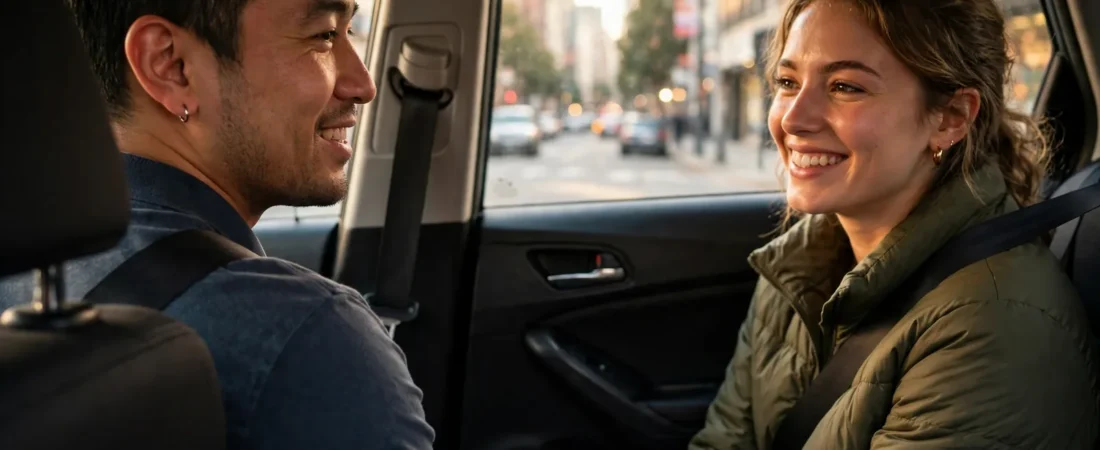
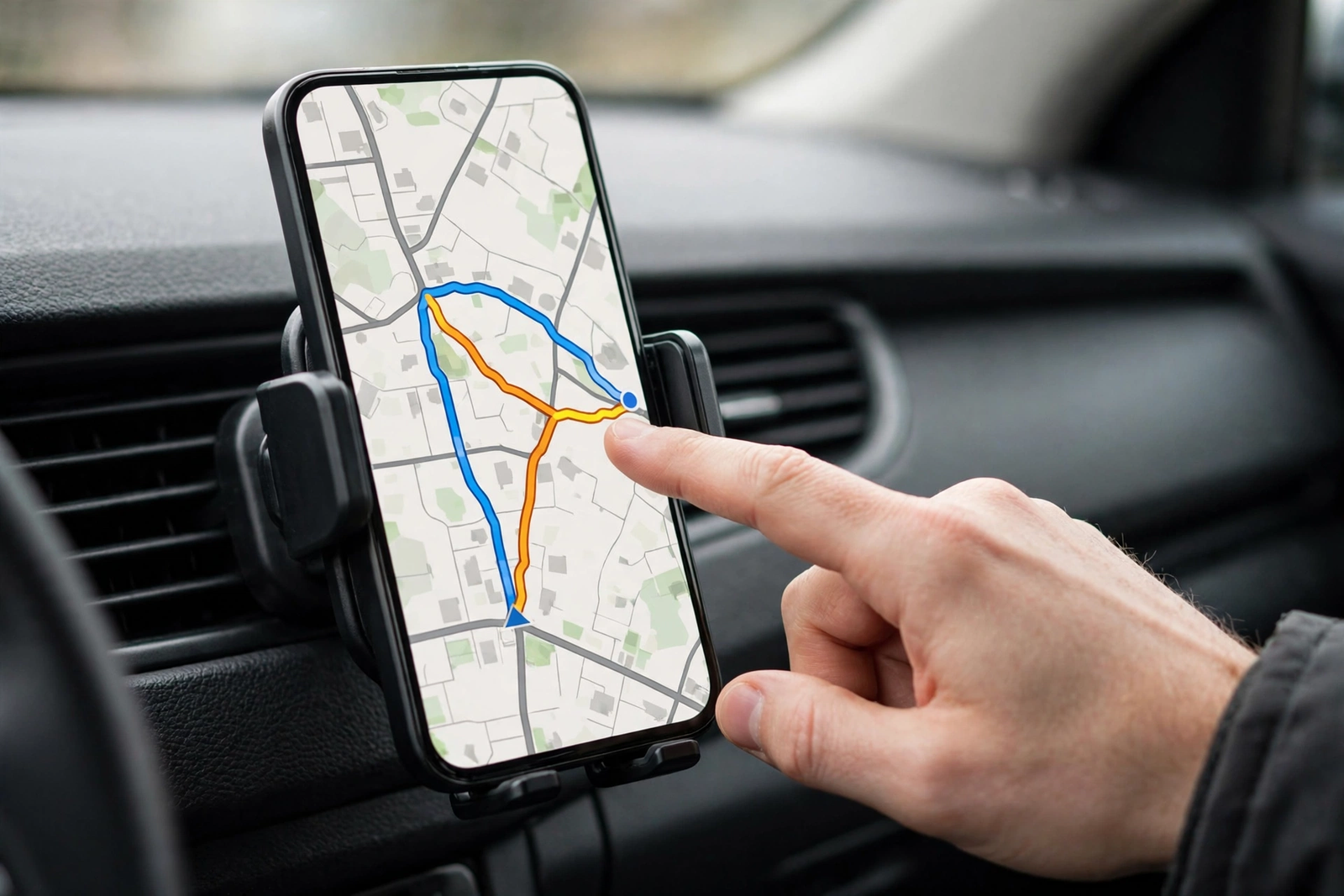
The passenger gets in, buckles up, and looks at you. The app shows two ways to get there: the highway, fast but with a toll, or the local streets, slower but free. Which one does the passenger want? You have about five seconds to ask, and the whole ride feels different depending on the answer. One short question — “Which route would you like to take?” — fixes all of it. This guide gives you that question and everything around it: ten route phrases, three full dialogues with audio, and the mistakes that cost drivers good ratings.
Asking about the route is not small talk. It is the moment the passenger decides you are a professional. A driver who asks gets fewer complaints, fewer wrong turns, and better tips, because the passenger chose the ride they are getting. A driver who guesses gets the blame when the highway costs five dollars in tolls or the local streets take twenty extra minutes. Ask first. Drive second.
This post is written for Uber and Grab drivers who speak English at work every day — in the United States, in Vietnam, and anywhere else riders switch between the two languages. The phrases are short, polite, and natural. You can learn them in one sitting and use them on your very next ride.
## Why this one question matters so much
Think about your last ten rides. How many times did the route cause a problem? The passenger wanted the highway and you took the streets. The passenger wanted to avoid tolls and you sailed through one. The passenger knew a shortcut and you ignored it. Every one of those moments started the same way: nobody asked.
There is a second reason, and it matters even more. Passengers remember how the ride felt, not how fast it was. A driver who asks, listens, and confirms feels safe. A driver who drives in silence and hopes for the best feels like a gamble. One question at the start of the ride sets the tone for the next twenty minutes.
And here is the good news: the question is easy. “Which route would you like to take?” is nine words, and every word in it is simple. You already know all of them. You just need to put them in this order, say them with a smile, and wait for the answer. That is the whole skill.
If you are building your English for the whole ride, start with our guide to [50 English phrases for Uber and Grab drivers, from pickup to drop-off](https://lingobubbo.com/50-cau-tieng-anh-cho-tai-xe-uber-va-grab-tu-luc-don-den-luc-tra-khach/), and our guide on [how Uber drivers greet riders and confirm names in English](https://lingobubbo.com/tai-xe-uber-chao-khach-va-xac-nhan-ten-bang-tieng-anh-the-nao/). This post picks up where the greeting ends: the passenger is in the car, and now you choose the road together.
## 10 route questions every driver should know
Learn these ten first. They cover the whole route conversation: offering a choice, asking about speed, asking about tolls, asking about scenery, and checking again when traffic changes. Say each one out loud as you read it.
| English sentence | When to use it |
|—|—|
| Which route would you like to take? | The basic question — use it on every ride with two options |
| Would you prefer the highway or the local streets? | When the app shows a highway route and a street route |
| Do you want to take the faster route or the scenic route? | When the passenger might enjoy the view |
| Should I avoid the toll road? | Before you enter a road that charges a fee |
| Would you like me to follow the GPS? | When you want to confirm the app’s route |
| Is there a shortcut you prefer? | When the passenger seems to know the area |
| Do you want to go the usual way? | For a regular passenger on a familiar trip |
| Let me know if you want to change the route. | After you start driving, as an open invitation |
| Would you like to take a different route? | When traffic gets heavy ahead |
| Should I take the next exit? | When you need a quick yes or no at a decision point |
Two notes before you practice. First, notice the word “prefer.” “Would you prefer the highway or the local streets?” is softer and more polite than “Do you want the highway or the streets?” Passengers hear the difference, even if they cannot explain it. Second, notice how short these sentences are. None of them is longer than twelve words. Short is good. Short is what a calm, professional driver sounds like.
## Key phrases to practice out loud
Listen to these four key phrases and repeat each one after the speaker. They are the backbone of the whole route conversation, and they work in almost any situation where the road splits in two.
Which way would you like to go? Do you want to take the faster route or the scenic route? Should I avoid the toll road? Let me know if you want to change the route.
Say them three times each. The first time, just listen. The second time, repeat each sentence right after the speaker. The third time, say the whole set together, like you are talking to a real passenger. That third round is where the rhythm sinks in.
Here is the trick to asking well: ask once, then wait. The passenger needs a second to think, to check their phone, to look at the road. Do not fill the silence. Do not answer your own question. Ask, smile, and wait. A passenger who chooses their own route never complains about it.
One more habit to build: learn the difference between “route” and “road.” A route is the whole plan — highway or streets, fast or scenic. A road is one piece of it. When you ask “Which route would you like to take?” you are asking about the plan. When you ask “Should I take the next exit?” you are asking about one road. Keep them straight and your English will sound natural.
## Dialogue 1: The passenger is in a hurry
Here is the whole route conversation in one short dialogue. The driver is A, the passenger is B. Read it out loud, playing both parts.
A: Good morning! Which route would you like to take today?
B: The highway, please. I am in a bit of a hurry.
A: No problem. The highway it is. We should be there in about twenty minutes.
B: Perfect. Thank you so much.
Notice how little the driver says. One question, one confirmation, one time estimate. “The highway it is” is a lovely little phrase — it means “we will take the highway, as you asked.” It tells the passenger you heard them. And “We should be there in about twenty minutes” gives the passenger the one thing every hurried person wants: a time.
Also notice “in a bit of a hurry.” Passengers rarely say “I am very late!” They soften it: “in a bit of a hurry,” “a little pressed for time,” “running a bit behind.” Learn to hear the soft version. It means the same thing, and it means the passenger wants the fastest route without saying so directly.
## Dialogue 2: The passenger wants the view
Not every passenger wants the fastest road. Some want the pretty one. Here the driver offers the choice, and the passenger picks the slow road on purpose.
A: Would you prefer the highway or the local streets?
B: Let us take the local streets today. I enjoy the view.
A: Sure thing. It will take about ten more minutes, is that okay?
B: That is fine. I am not in a rush.
Three things to steal from this dialogue. First, the driver names both options before asking. “The highway or the local streets” is clearer than “Which route?” on its own, because the passenger can picture both. Second, the driver warns about the cost of the choice: “It will take about ten more minutes.” A passenger who knows the price of the slow road will not complain about it later. Third, the passenger’s answer — “I am not in a rush” — is the opposite of Dialogue 1. Same road, different passenger, different ride. Always ask. Never assume.
## What passengers say back — and what they mean
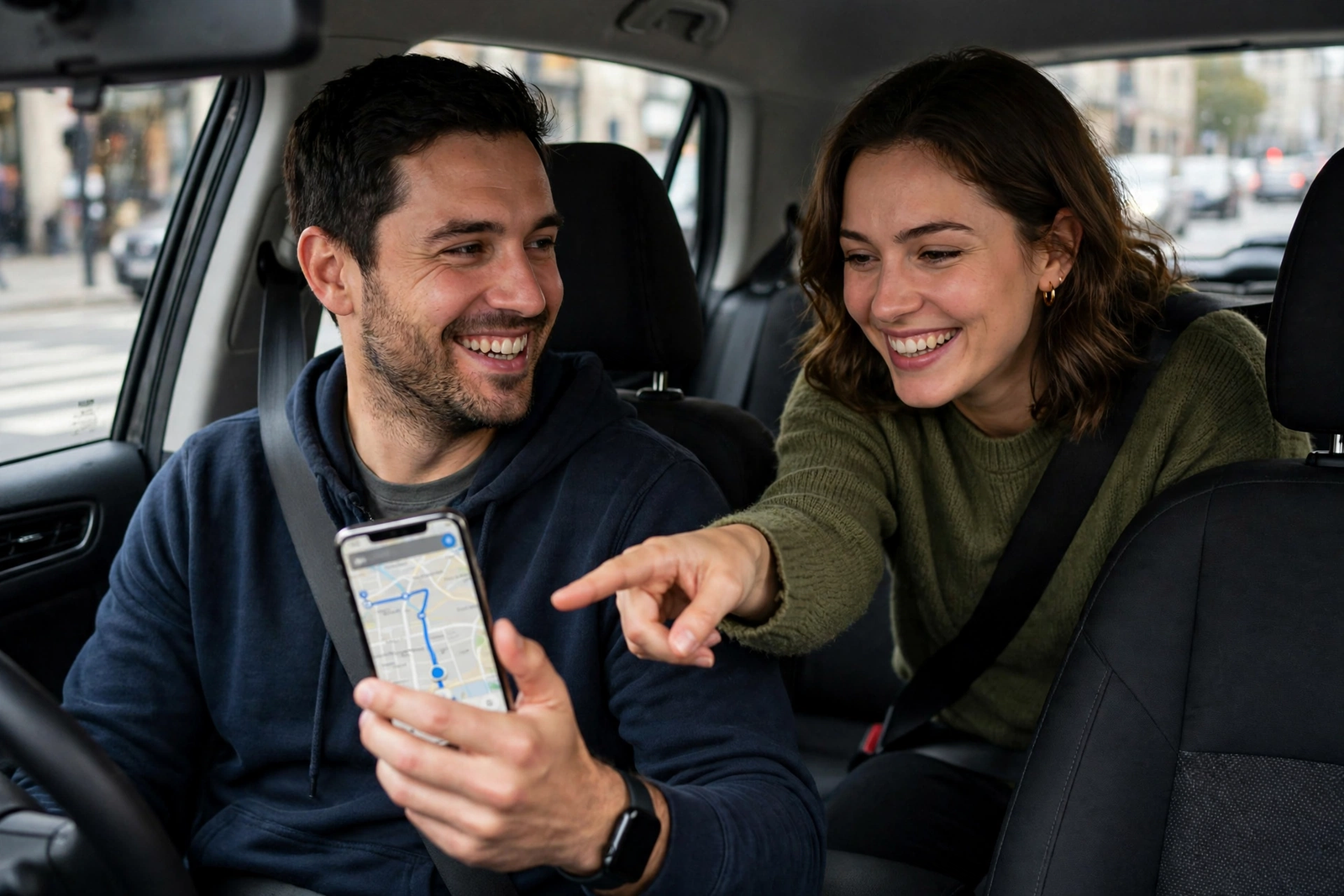
Passengers do not always answer with a clear route name. They answer with feelings, habits, and half-sentences. Here is how to hear what they really mean.
**”The fastest way, please.”** Take the highway. Do not ask again. This passenger is in a hurry, and every extra question costs them time.
**”Avoid the highway.”** The passenger does not like highways, or does not want to pay the toll. Take the local streets, and do not suggest the highway again unless traffic gets very bad.
**”No tolls, please.”** Take the route without toll roads. In the United States, tolls can be a few dollars. In Vietnam, expressway tolls are usually small, but the passenger still wants to avoid them. Say “No problem, I will avoid the toll road” so they know you heard them.
**”The scenic route is fine.”** The passenger wants the pretty road and does not mind the extra time. “Scenic” means beautiful to look at — the coast, the old streets, the view. Take the slow road and enjoy it.
**”I know a shortcut.”** Listen carefully. The passenger is about to give you directions. Say “Sure, please guide me” and follow their lead. A passenger who knows a shortcut and feels ignored will not enjoy the ride.
**”Just follow the GPS.”** The passenger trusts the app. Follow it, and do not improvise. This is the easiest answer you will ever get.
## Dialogue 3: Traffic ahead — offering a new route
Sometimes the plan changes in the middle of the ride. Traffic appears, a road closes, the app turns red. This is when a good driver speaks up instead of silently turning the wheel.
A: There is heavy traffic ahead. Would you like me to take a different route?
B: Yes, please take the side streets.
A: Will do. We should arrive in about fifteen minutes.
B: Great, thank you for letting me know.
“There is heavy traffic ahead” is the sentence that saves the ride. It tells the passenger three things at once: you are watching the road, you see the problem, and you have a plan. Passengers forgive traffic. They do not forgive silence. When the car slows down and the driver says nothing, the passenger starts to worry. When the driver explains and offers a choice, the passenger relaxes.
“Will do” is a short, friendly way to say “I will do that.” It is warmer than “Okay” and faster than “Yes, I will take the side streets.” Drivers say it a hundred times a day, and passengers like hearing it.
## 5 mistakes that cost drivers good ratings
**Never asking at all.** The most common mistake is also the easiest to fix. If the app shows two routes, ask. If it shows one route, you can still say “I will follow the GPS, is that okay?” One sentence, zero complaints.
**Taking the toll road without asking.** Tolls are the number one surprise on a ride. A passenger who did not agree to a toll feels tricked, even if the toll is only a few dollars. Ask first: “Should I avoid the toll road?” It takes three seconds.
**Arguing about the route.** The passenger pays for the ride, so the passenger picks the route. If they choose the slow road, take the slow road. If they choose the highway, take the highway. Your job is to drive well, not to win a debate about traffic.
**Using the word “fastest” when you mean “shortest.”** The fastest route and the shortest route are not the same thing. The highway is often longer in miles but faster in minutes. Say “faster” when you mean time, and “shorter” when you mean distance. Passengers notice.
**Forgetting to check again.** Traffic changes. The route you picked at the start may not be the best route ten minutes later. Check in once: “The traffic is building up. Would you like me to take a different route?” One check-in is enough. More than that feels nervous.
## Your 7-day practice plan
– **Day 1:** Memorize “Which route would you like to take?” Say it 20 times out loud, with a smile in your voice.
– **Day 2:** Add “Would you prefer the highway or the local streets?” Practice the two questions as one flow.
– **Day 3:** Listen to audio clips 1 and 2 and repeat each line right after the speaker, without looking at the text.
– **Day 4:** Read Dialogue 1 out loud, playing both parts, three times. Practice saying “The highway it is.”
– **Day 5:** Read Dialogue 2 out loud three times. Practice the warning: “It will take about ten more minutes.”
– **Day 6:** Read Dialogue 3 out loud three times. Practice the traffic sentence: “There is heavy traffic ahead.”
– **Day 7:** Use the question on a real ride. Ask one passenger which route they want, listen to the answer, and confirm it back: “The highway it is.” If you can do it once, you can do it every day.
## Quick Quiz
Test yourself on asking passengers about the route in English. Click an answer to see if you are right — your score is at the top.
Score: 0/5
1. Which question asks a passenger to choose a route?
2. A passenger is in a hurry. Which route should the driver suggest?
3. What does “the scenic route” mean?
4. The passenger says “Let’s take the local streets.” What does the driver do?
5. Traffic is heavy ahead. What should the driver say?
## FAQ
**What is the difference between a route and a road?**
A route is the whole plan — highway or streets, fast or scenic. A road is one piece of it. Ask “Which route would you like to take?” about the plan, and “Should I take the next exit?” about one road.
**Should I ask about the route on every ride?**
Ask whenever the app shows more than one sensible way to get there. If there is only one road, a quick “I will follow the GPS, is that okay?” is enough. Passengers like being asked, but they do not like being asked the same question three times.
**What if the passenger does not understand my question?**
Say it again, slowly, and point at the phone: “Highway, or local streets?” Most passengers will point at one option on the map. The words and the picture together always work.
**What does “the highway it is” mean?**
It means “we will take the highway, as you asked.” It is a short, warm way to confirm a choice. You can use the same pattern with any choice: “The local streets it is” or “The scenic route it is.”
**Do passengers in Vietnam and the United States answer differently?**
The words are the same, but the roads are different. In the United States, the choice is usually highway versus local streets, and tolls are common. In Vietnam, Grab drivers often choose between main roads and smaller streets, and expressway tolls are usually small. Either way, the question is the same: ask first, then drive.
## Your turn: ask the question on your next ride
You now have ten route questions, three full dialogues, four audio clips to copy, and a seven-day plan. You do not need all of them tomorrow. You need one: “Which route would you like to take?” Say it on your next ride, listen to the answer, and confirm it back: “The highway it is.” In a week, the question will feel natural, and your passengers will feel the difference.
Keep learning with the [English lessons on LingoBubbo](https://lingobubbo.com/tieng-anh/), where work phrases like these appear in short dialogues you can practice every day. If this guide helped you, send it to another driver who works in English — one good question about the route is the easiest skill in the job, and it pays off on the very first ride. And tell us in the comments: what do your passengers choose most often, the highway or the local streets?