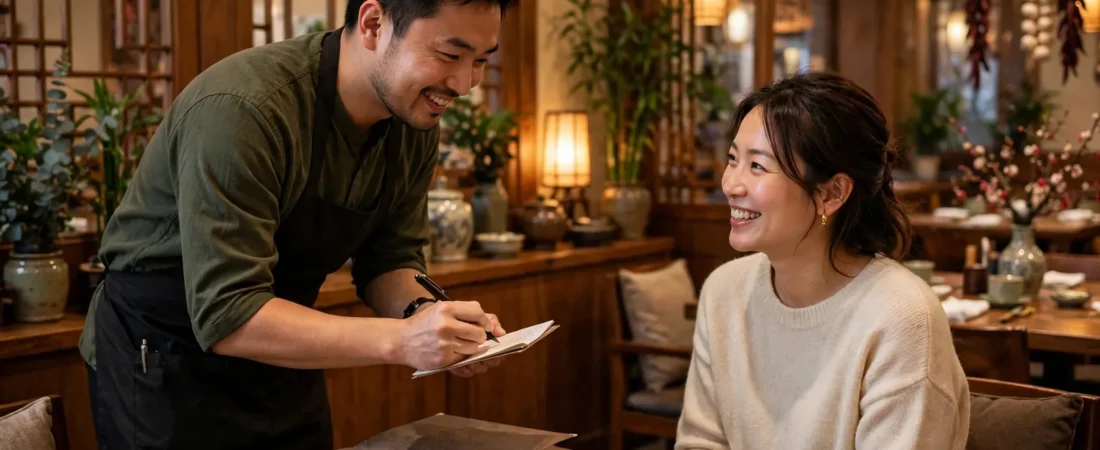
A customer sits down at your table, opens the menu, and looks up at you, waiting. This is your moment. You need one question: what would you like to order? In Chinese, that question is short, polite, and easy to learn — and it is the question that starts every meal, in every restaurant, in every Chinese-speaking city in the world. Learn how to ask customers what they want to order in Chinese, and you can take an order on your first day, even if you only know ten sentences. This guide gives you those sentences, two full dialogues, audio to copy, and a quiz to check yourself.
Restaurants are the friendliest place to learn Chinese for work, because the conversation never changes. The customer sits, you ask what they want, they point at the menu, you bring the food. The words are the same every time, the answers are short, and a smile covers a hundred small mistakes. If you can ask this one question well, the rest of the meal takes care of itself.
## 12 sentences to take any order
Learn these twelve first. They cover the whole meal: the opening question, the menu, the order itself, the drink, the spice level, the bill, and the takeout box. Say each one out loud as you read it.
| Chinese | Pinyin | English meaning |
|—|—|—|
| 您想点什么? | Nín xiǎng diǎn shénme? | What would you like to order? |
| 您想喝点什么? | Nín xiǎng hē diǎn shénme? | What would you like to drink? |
| 请给我菜单。 | Qǐng gěi wǒ càidān. | Please give me the menu. |
| 我想点一份米饭。 | Wǒ xiǎng diǎn yí fèn mǐfàn. | I would like a serving of rice. |
| 我要一碗面条。 | Wǒ yào yì wǎn miàntiáo. | I would like a bowl of noodles. |
| 请给我一杯水。 | Qǐng gěi wǒ yì bēi shuǐ. | A glass of water, please. |
| 这个菜好吃吗? | Zhège cài hǎochī ma? | Is this dish tasty? |
| 我不吃辣。 | Wǒ bù chī là. | I don’t eat spicy food. |
| 请不要放辣。 | Qǐng bú yào fàng là. | Please don’t make it spicy. |
| 请问多少钱? | Qǐngwèn duōshao qián? | How much is it? |
| 请买单。 | Qǐng mǎidān. | The check, please. |
| 我要打包。 | Wǒ yào dǎbāo. | I would like takeout. |
Three words do most of the work here. 点 (diǎn) means to order, and it is the verb in the first question and in every order after it. 菜单 (càidān) is the menu, and it is the first thing a customer asks for when they sit down. And 买单 (mǎidān) is the check, the word that ends the meal. Learn 点, 菜单, and 买单, and you have the beginning, the middle, and the end of every restaurant visit.
Notice how many sentences start with 您 (nín), the polite form of “you.” In a restaurant, always use 您 with customers. It costs nothing and it buys respect. The customer will answer with 我 (wǒ, I) and short sentences, and that is fine. You stay polite, they stay simple, and the order works.

## The question that starts every meal
Timing matters as much as words. Give the customer a minute to sit down and open the menu, bring water or tea, and then ask. Here is the question, with audio to copy.
您想点什么?您想喝点什么?请给我菜单。
(Nín xiǎng diǎn shénme? Nín xiǎng hē diǎn shénme? Qǐng gěi wǒ càidān.)
What would you like to order? What would you like to drink? Please give me the menu.
Listen to it three times. The first time, just listen. The second time, repeat each sentence right after the speaker. The third time, say the whole thing together with the recording. Pay attention to 点 (diǎn): it is a third tone, dipping down and up, and it is the word customers will hear most clearly, because it is the word that tells them you are ready to take their order.
Then wait. After you ask, stop talking. Give the customer time to look at the menu and decide. Many customers need a moment, especially if they are reading a menu in a second language. Silence after a good question is not awkward. It is service. What if the customer answers with something you do not understand? Smile and say 您能再说一遍吗? (Nín néng zài shuō yí biàn ma? Could you say that once more, please?) There is no shame in it. A customer would much rather repeat themselves than get the wrong dish.
## Ordering food and drinks: the phrases that matter
Once the customer is ready, the order writes itself. You need the food, the drink, and one question about spice. Here are the phrases, with audio.
我想点一份米饭。我要一碗面条。请给我一杯水。这个菜好吃吗?
(Wǒ xiǎng diǎn yí fèn mǐfàn. Wǒ yào yì wǎn miàntiáo. Qǐng gěi wǒ yì bēi shuǐ. Zhège cài hǎochī ma?)
I would like a serving of rice. I would like a bowl of noodles. A glass of water, please. Is this dish tasty?
Two measure words to learn here, because they show up in every order. 碗 (wǎn) is a bowl, for noodles and soup. 杯 (bēi) is a cup or glass, for water, tea, and juice. 份 (fèn) is a serving, for rice and dishes. If you mix them up, the customer will still understand you — one bowl of water is a funny picture, not a disaster — but getting them right is what makes you sound like you work in a restaurant instead of a textbook.
The spice question deserves special attention. Many customers cannot eat spicy food, and in Chinese restaurants the food is often spicy by default. Learn both sentences by heart: 我不吃辣 (wǒ bù chī là, I don’t eat spicy food) and 请不要放辣 (qǐng bú yào fàng là, please don’t make it spicy). The second one is the one you say to the kitchen, and it is the sentence that saves a customer from a meal they cannot eat. Note the tone change: 不 (bù) becomes bú before a fourth-tone word like 要 (yào), which is why it is pronounced bú yào, not bù yào. That small change is one of the most natural sounds in spoken Chinese, and hearing it right is a sign your ear is getting good.
## Dialogue 1: Dinner at a small restaurant
Here is the whole meal in one short conversation. Read it out loud, playing both parts. The waiter is A, the customer is B.
A: 您好,请问您想点什么?
(Nín hǎo, qǐngwèn nín xiǎng diǎn shénme?)
Hello, may I ask what you would like to order?
B: 请给我菜单。
(Qǐng gěi wǒ càidān.)
Please give me the menu.
A: 给您菜单。您想喝点什么?
(Gěi nín càidān. Nín xiǎng hē diǎn shénme?)
Here is your menu. What would you like to drink?
B: 请给我一杯水,谢谢。
(Qǐng gěi wǒ yì bēi shuǐ, xièxie.)
A glass of water, please, thank you.
A: 好的。您想吃什么?
(Hǎo de. Nín xiǎng chī shénme?)
Okay. What would you like to eat?
B: 我要一碗面条。不要辣。
(Wǒ yào yì wǎn miàntiáo. Bú yào là.)
I would like a bowl of noodles. Not spicy.
A: 好的,请等一下。
(Hǎo de, qǐng děng yíxià.)
Okay, please wait a moment.
B: 请问多少钱?
(Qǐngwèn duōshao qián?)
How much is it?
A: 三十五块。
(Sānshíwǔ kuài.)
Thirty-five yuan.
B: 请买单。
(Qǐng mǎidān.)
The check, please.
Notice how the waiter asks one question at a time and waits for the answer before asking the next. Drink, then food, then the bill. That order works in every restaurant, for every customer. Also notice 不要辣 (bú yào là, not spicy) — three words, and they change the whole dish. Short answers are real answers. When a customer gives you a short answer, take it and move on. You do not need a full sentence to make a bowl of noodles.
## Dialogue 2: Takeout at a café
The same skill works for takeout, where the conversation is even shorter and the customer is usually in a hurry.
A: 您好,您想点什么?
(Nín hǎo, nín xiǎng diǎn shénme?)
Hello, what would you like to order?
B: 我想点一份米饭和一杯茶。
(Wǒ xiǎng diǎn yí fèn mǐfàn hé yì bēi chá.)
I would like a serving of rice and a cup of tea.
A: 您要在这里吃,还是打包?
(Nín yào zài zhèlǐ chī, háishi dǎbāo?)
Would you like to eat here, or take it to go?
B: 我要打包,谢谢。
(Wǒ yào dǎbāo, xièxie.)
Takeout, please, thank you.
A: 好的,请等五分钟。
(Hǎo de, qǐng děng wǔ fēnzhōng.)
Okay, please wait five minutes.
B: 谢谢。
(Xièxie.)
Thank you.
Three things to steal from this dialogue. First, 打包 (dǎbāo, takeout) is the word that turns a sit-down meal into a takeout order with one word. Learn it the same week you learn the menu. Second, 在这里吃,还是打包? (zài zhèlǐ chī, háishi dǎbāo? Eat here, or take it to go?) is a choice question, and choice questions are the easiest kind for a customer to answer, because the answer is already in the question. Third, the ending: 五分钟 (wǔ fēnzhōng, five minutes) is the most useful time phrase in a café. Learn the numbers one to ten and the word 分钟 (fēnzhōng, minutes), and you can tell any customer how long to wait.
## 4 mistakes that make you sound like a phrasebook
**Asking the whole order at once.** “What do you want to eat and drink and is it spicy?” all in one breath is not a conversation, it is an interrogation. One question, one answer, then the next. The customer sets the pace, not you.
**Asking with 你 instead of 您.** It is a small word, and customers notice it. 您 costs you nothing and buys you respect. Keep it in every question until the customer becomes a regular and invites you to be casual.
**Forgetting the drink.** New waiters ask about food and forget the drink, then have to come back and ask again. Ask about the drink right after the menu, before the food. It is the easiest question in the meal, and it makes the rest of the order flow.
**Forgetting the spice question.** If the food can be spicy, ask. One sentence — 要辣吗? (yào là ma? Do you want it spicy?) — saves a returned dish, an unhappy customer, and a wasted meal. In a restaurant, asking is cheaper than remaking.
## Your 7-day practice plan
– **Day 1:** Memorize 您想点什么? Say it 20 times out loud, with 您 clear every time.
– **Day 2:** Add 您想喝点什么? and 请给我菜单。 Practice the question plus the drink and the menu as one flow.
– **Day 3:** Listen to audio clips 1 and 2 and repeat each sentence right after the speaker, without looking at the text.
– **Day 4:** Read Dialogue 1 out loud, playing both parts, three times.
– **Day 5:** Read Dialogue 2 out loud three times. Practice the takeout ending: 我要打包.
– **Day 6:** Role-play with a friend or family member. One of you is the waiter, one is the customer. Swap roles, and try different answers: noodles, rice, just a drink, takeout.
– **Day 7:** Say the whole flow from memory, out loud, without looking at this post: greeting, the question, the drink, the food, the spice check, and the bill. If you can do it, you are ready for a real customer.

## Quick Quiz
Test yourself on asking customers what they want to order in Chinese. Click an answer to see if you are right — your score is at the top.
Score: 0/5
1. Which sentence asks a customer what they would like to order?
2. What does 菜单 mean?
3. A customer says 我要一碗面条. What do they want?
4. Which sentence asks for the check?
5. What does 打包 mean?
## FAQ
**Should I use 您 with every customer, even young ones?**
Yes. In a restaurant, 您 is the safe default for everyone. It never sounds wrong, and customers hear it as good service. Save 你 for friends and family.
**What should I say if the customer just wants water?**
Say 好的,请等一下 (hǎo de, qǐng děng yíxià, okay, please wait a moment) and bring the water. A customer who orders only water today may order a full meal tomorrow.
**What if the customer answers in English?**
Follow their lead and switch to English. Your Chinese question already did its job: it showed respect and opened the conversation. The language of the answer matters less than the meal.
**How is this different from asking what someone is looking for in a shop?**
The question is the same shape — 您想…什么? (what would you like…) — but the verb changes everything. In a shop it is 找 (zhǎo, to look for); in a restaurant it is 点 (diǎn, to order). Learn the shape once, swap the verb, and you can work in both places.
**Can I use these phrases in a café or a bubble tea shop, not just a restaurant?**
Yes. Swap the food word and keep the question: 您想喝点什么? (what would you like to drink?) is the main question in any drink shop, and the takeout ending works everywhere from cafés to food stalls.
## Your turn: ask your next customer in Chinese
You now have twelve sentences, two full dialogues, four audio clips to copy, and a seven-day plan. You do not need all of them tomorrow. You need one: 您想点什么? Say it to your next customer, with a smile, and listen to what they say back. Then add the drink question the day after, and the spice question the day after that. In a week, the whole flow will feel natural, and your customers will feel the difference.
Keep learning with the [Chinese lessons on LingoBubbo](https://lingobubbo.com/tieng-trung/), where work phrases like these appear in short dialogues you can practice every day. If this guide helped you, send it to a friend who works in a restaurant, a café, or any job where they meet Chinese-speaking customers — one good question is the easiest skill in the language, and it pays off on the very first table. And tell us in the comments: what do customers in your restaurant order most, and which of these sentences still feels tricky to say?