
You work as a server at a restaurant in the US. A guest has just sat down, you walk over with a smile — then freeze, because you don’t know how to open an order in English so it sounds natural. Or worse: the guest orders, then changes their mind, and you fumble, not knowing how to say “change the dish”. Don’t worry — every restaurant worker runs into this in their first week. English dialogues for when guests order and change their order gives you the full set in this post: two complete sample dialogues, 20 sentence patterns organised step by step, American-accent audio to listen to and shadow, a common-mistakes section and a quick quiz at the end. Learn it all, and you can greet tables, take orders and handle dish changes with confidence.
This post is written for Vietnamese people working as restaurant servers in the US, at English level A0–A2. Every sentence comes with its Vietnamese meaning and a Vietnamese-style pronunciation guide so you can read along right away. If you want to practise more workplace communication English, start from LingoBubbo’s English page.
Dialogue 1: a guest orders — listen and read along
The dialogue below is the standard script at most US restaurants: greet the table, ask about drinks, take the main order, confirm it back. Read it turn by turn, noticing how the server asks and how the guest answers briefly. Listen to the audio through once first, then read along sentence by sentence.
Server: Hi, welcome! I’m Anna, I’ll be your server today. Can I get you started with something to drink?
Guest: Hi, I’d like to order the grilled chicken, please.
Server: Of course. Would you like anything to drink with that?
Guest: Just a glass of water, please.
Server: Anything else for you today?
Guest: That’s all for now, thank you.
See? The whole exchange has just 6 turns, and every sentence is short. The server opens with a greeting and introduces their name — that is the standard in the US, and hearing your name makes guests feel much more at ease. The guest orders with the pattern “I’d like to order…” — this pattern works for every dish; just swap in the name of the dish. And the closing line “That’s all for now” is how a guest says “that’s it for the moment” — hear that line and you know the guest has finished ordering and you can take the menu away.
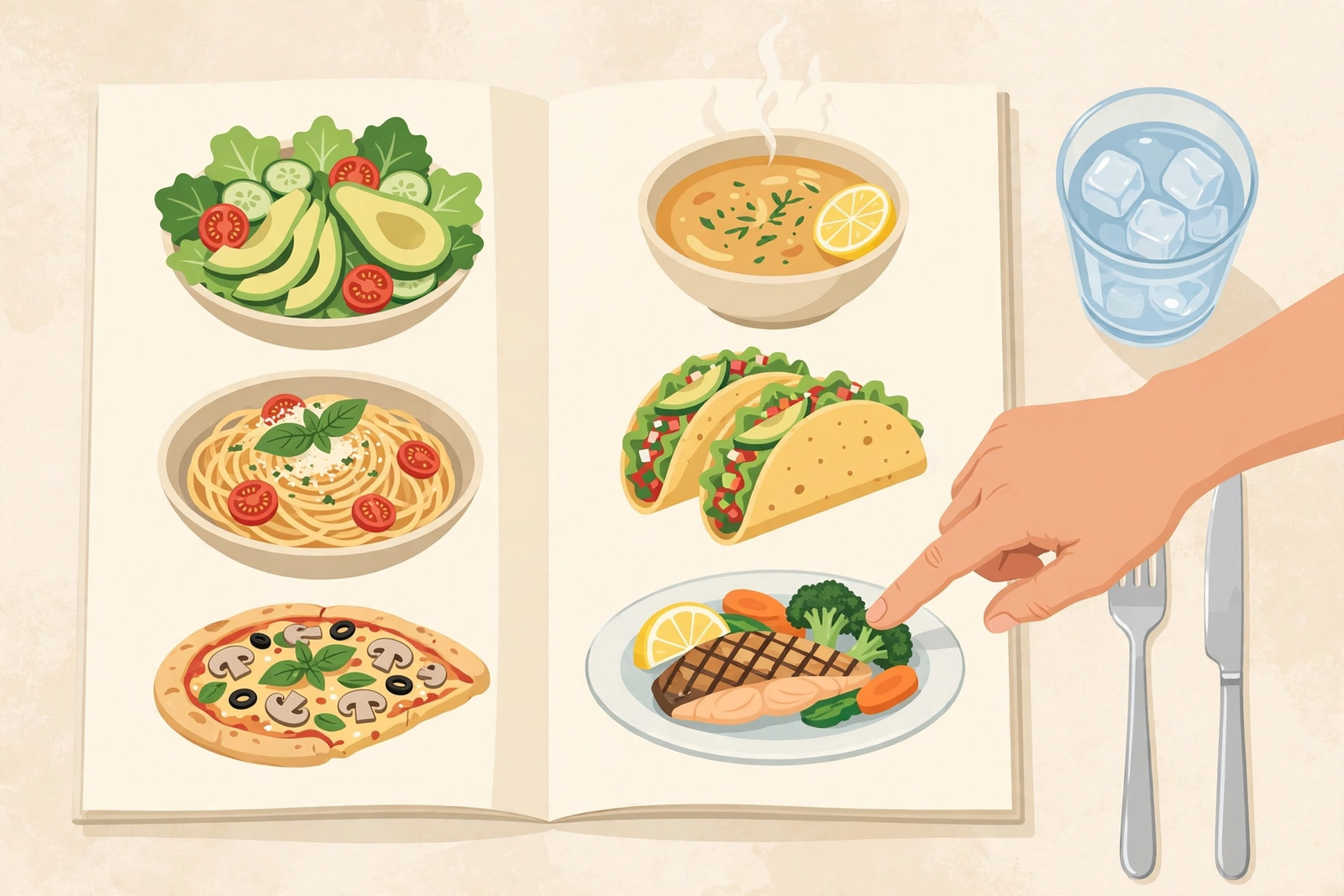
Dialogue 2: a guest changes a dish — handle it smoothly
Changing a dish is the situation new servers worry about most, afraid the guest will be annoyed or that they will mishear. In reality, American guests change dishes very often — swapping the main course, dropping an ingredient, changing the portion size — and they expect the server to answer with “No problem”. The dialogue below gives you exactly that script.
Guest: Actually, could I change the chicken to the beef noodles instead?
Server: No problem at all. I’ll change that for you.
Guest: And could I make the soup without onions?
Server: Sure, I’ll note that down. Anything else?
Guest: That’s it. Thank you so much.
Two of the guest’s opening lines are worth learning by heart: “Actually, could I change…?” and “Could I make the soup without onions?” — these are the two most common dish-changing patterns. “Actually” at the start of a sentence signals that the guest is about to say something different from before; hear that word and you know they are changing their mind. And “without” is the keyword when a guest wants an ingredient removed: “without onions”, “without peanuts”, “without ice”. The server’s golden reply is “No problem at all” — say it with a smile, and the guest feels the change is a small thing; nobody is put out.
20 patterns for ordering and changing dishes, step by step
Here are the 20 patterns this post promised: 10 for ordering, 10 for changing dishes and handling special requests. Each sentence comes with its Vietnamese meaning and a Vietnamese-style reading guide. Learn them in groups — one group of 5 a day is just right.
Listen to the main ordering patterns below, read slowly sentence by sentence, and repeat after each one:
| # | English sentence | How to read it | Meaning |
|---|---|---|---|
| 1 | I’d like to order the grilled chicken, please. | ai-duh laik too or-duh thuh grild chik-uhn, pleez. | I want to order the grilled chicken. |
| 2 | Could I have the menu, please? | kood ai hav thuh men-yoo, pleez? | Can I see the menu? |
| 3 | What do you recommend? | wot doo yoo rek-uh-mend? | What do you recommend? |
| 4 | I’ll have the same as her, please. | ai-l hav thuh saym az her, pleez. | I’ll have the same as her. |
| 5 | Can I get this to go? | kan ai get this tuh go? | Can I get this to go? |
| 6 | Could I have a glass of water, please? | kood ai hav uh glas uhv waw-ter, pleez? | Can I have a glass of water? |
| 7 | Is this dish spicy? | iz this dish spy-see? | Is this dish spicy? |
| 8 | How long will the food take? | how long wil thuh food tayk? | How long will the food take? |
| 9 | Can I see the dessert menu? | kan ai see thuh duh-zert men-yoo? | Can I see the dessert menu? |
| 10 | That’s all for now, thank you. | that-s awl fer now, thank-yoo. | That’s all for now, thank you. |
Listen to the patterns for changing dishes and special requests below, then practise saying them:
| # | English sentence | How to read it | Meaning |
|---|---|---|---|
| 11 | Could I change my order, please? | kood ai chaynj mai or-duh, pleez? | Can I change my order? |
| 12 | Actually, could I change the chicken to the beef noodles? | ak-choo-uh-lee, kood ai chaynj thuh chik-uhn too thuh beef noo-dulz? | Actually, can I change the grilled chicken to the beef noodles? |
| 13 | Sorry, I meant the small size, not the large one. | sor-ee, ai ment thuh smawl size, not thuh larj wun. | Sorry, I meant the small size, not the large one. |
| 14 | Could you please remove the peanuts? | kood yoo pleez ri-moov thuh pee-nuts? | Could you please remove the peanuts for me? |
| 15 | Could I make the soup without onions? | kood ai mayk thuh soup with-owt un-yunz? | Can I make the soup without onions? |
| 16 | Could I add extra cheese, please? | kood ai ad ek-struh cheez, pleez? | Can I add extra cheese? |
| 17 | No problem at all. I’ll change that for you. | no prob-luhm at awl. ai-l chaynj that fer yoo. | No problem at all. I’ll change that for you. |
| 18 | Sure, I’ll note that down. | shoor, ai-l noht that down. | Sure, I’ll note that down. |
| 19 | The food was delicious. Thank you! | thuh food wuz duh-lish-us. thank-yoo! | The food was delicious. Thank you! |
| 20 | Could I get the check, please? | kood ai get thuh chek, pleez? | Can I get the check? |
A note on sentence 13: “I meant…” is how you say “what I meant was…” when you have just misspoken and want to correct yourself. Guests use this a lot when they change their mind mid-order. When you hear “I meant”, you know the guest is revising their earlier request, so listen carefully to the part that follows. Sentences 14 and 15 use “remove” and “without” — two ways to say “leave an ingredient out” that you will meet every day, especially with guests who have allergies.
5 common mistakes when serving guests who order and change dishes
Saying “What do you want?” instead of “Can I get you started with something to drink?” “What do you want?” sounds abrupt and a bit rude. The standard openers are “Can I get you started with…” or “What can I get for you today?” — far more polite and professional.
Answering a guest’s dish change with a curt “OK” “OK” is not wrong, but it sounds cold. Answer “No problem at all” or “Sure, I’ll change that for you” and the guest feels you are happy to take the request — nobody feels like they are being a bother.
Not confirming the dish again after the guest changes it After a change, always read the new order back: “So that’s the beef noodles, soup without onions, and a glass of water. Is that correct?” — confirming back avoids wrong dishes and food being carried to the wrong table.
Using “I want” when ordering “I want the chicken” sounds like giving an order. Use “I’d like…” or “Could I have…” — that is the norm in US restaurants, whether you are the guest or the server repeating a guest’s request.
Forgetting to note down special requests “Without onions”, “extra cheese”, “no peanuts” — these requests must go straight onto the ticket, not be kept in your head. Forgetting one word, “without”, can send an allergic guest to hospital. Making notes is a responsibility, not a bad habit.

Summary table: ordering and changing dishes in one small table
Screenshot this table or copy it into your phone — this is your whole toolkit for every serving shift.
| Step | Ready-to-use sentence |
|---|---|
| Greeting the table | Hi, welcome! I’m [name], I’ll be your server today. |
| Asking about drinks | Can I get you started with something to drink? |
| Guest orders | I’d like to order the [dish], please. |
| Guest changes a dish | Actually, could I change the [old dish] to the [new dish]? |
| Removing an ingredient | Could I make the [dish] without [ingredient]? |
| Server replies | No problem at all. I’ll change that for you. |
| Confirming back | So that’s the [new dish]. Is that correct? |
| Wrapping up | Could I get the check, please? |
Send this table to any friend working as a server in the US — one table that makes greeting guests go smoothly is well worth sharing. You should also read the post 100 English communication sentences for restaurant servers and the post 20 English breakfast words: ordering, American style, because ordering, taking orders and settling the bill are the three stages of the same meal.
Quick quiz: have you mastered the ordering and dish-changing dialogues yet?
Tap the answer you choose — right or wrong shows up on the spot.
Your score: 0/5 — tap an answer to check right away.
Question 1. A guest wants to order the grilled chicken. Which sentence is the most correct?
Question 2. The guest says “Actually, could I change the chicken to the beef noodles?” — what does it mean?
Question 3. A guest wants the soup without onions. Which sentence is correct?
Question 4. Which sentence is the best way for a server to reply to a change request?
Question 5. After a guest changes a dish, what should the server do?
Frequently asked questions about English dialogues for when guests order and change their order
Is it a problem if a guest changes dishes many times? No problem at all — American guests change dishes all the time. Just answer "No problem" each time and note everything down carefully. All you need is to confirm the final order once more before sending it to the kitchen.
What is the difference between "I'd like" and "I want"? "I'd like" is the polite way of speaking, used in restaurants and in every formal situation. "I want" sounds like giving an order, and is only used with close friends. In a restaurant, always use "I'd like" or "Could I have".
If a guest has an allergy, what else should you ask? When a guest says "without peanuts" or "no nuts", you should ask back: "Is that an allergy I should note for the kitchen?" That question tells the kitchen how serious it is — not just a preference.
What should you do if you forget the name of the dish the guest ordered? Don't guess. Say "Could you repeat your order, please?" or point at the menu and ask "Was it this one?" — asking again is always better than bringing the wrong dish.
After finishing this post, what should you learn next? Learn the sentences for taking orders at the counter and settling the bill too, because a complete serving shift includes all three stages: greeting guests, ordering, and the bill. LingoBubbo's post of 20 English sentences for taking counter orders at a restaurant is the most sensible next step.
Once you have learned these two dialogues and 20 patterns by heart, you can handle any table of guests: greet the table with your own name, take orders with "I'd like...", handle changes with "No problem at all", and confirm back before sending the order to the kitchen. On tomorrow's shift, try using both complete dialogues in one session — whichever dialogue flows smoothly and whichever still trips you up, come home that evening and listen to the audio in this post again. Tell me how it went in the comments: which serving moment made you proudest? And send this post on English dialogues for when guests order and change their order to friends working in restaurants, so the whole team can serve with confidence. To keep learning along the path, start from LingoBubbo's English page — every lesson already comes with vocabulary, audio and a quiz.