
You are in a Seoul café. You want two coffees, it is 3 o’clock, and the bill is 15,000 won. Three numbers, three different answers — and if you use the wrong set, the barista will still understand you, but you will feel the wobble. Welcome to Korean numbers, the part of the language that makes every beginner groan and every intermediate learner quietly proud. Korean numbers native vs Sino-Korean is not a trick the language plays on you. It is two systems doing two different jobs, and once you see the split, it stops being confusing.
Here is the short version. Korean has a native set, used for counting things and for age and time, and a Sino-Korean set, borrowed from Chinese centuries ago, used for money, dates, phone numbers and anything that feels official. You do not need to memorise both sets perfectly today. You need to learn which situations call for which set — and that rule fits on one page.
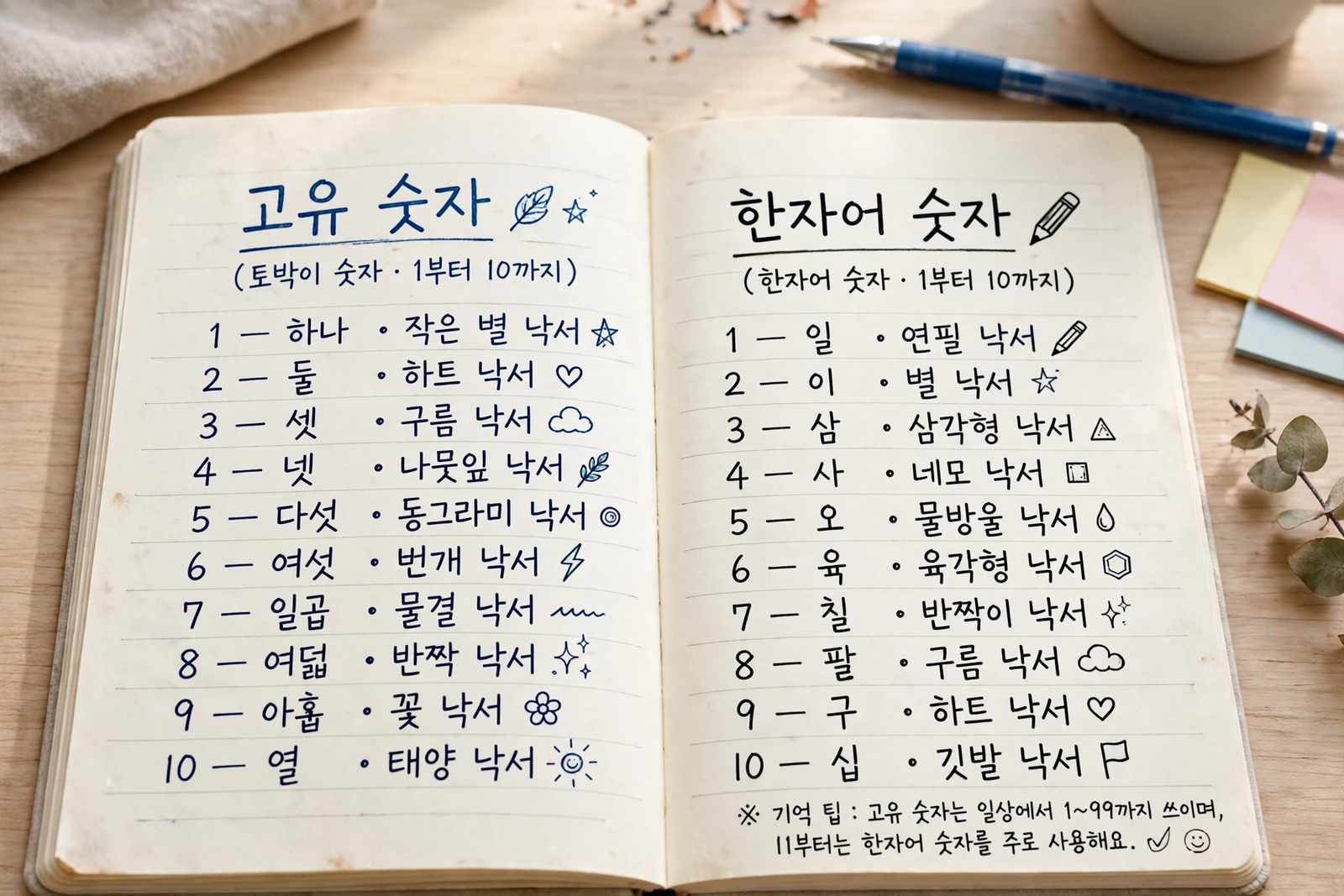
Korean numbers native vs Sino-Korean: the two sets side by side
Learn them as pairs. Say each pair out loud, native first, then Sino-Korean, and notice that the native words are longer and softer, while the Sino-Korean words are short and sharp.
| Number | Native Korean | Sino-Korean |
|---|---|---|
| 1 | 하나 (hana) | 일 (il) |
| 2 | 둘 (dul) | 이 (i) |
| 3 | 셋 (set) | 삼 (sam) |
| 4 | 넷 (net) | 사 (sa) |
| 5 | 다섯 (daseot) | 오 (o) |
| 6 | 여섯 (yeoseot) | 육 (yuk) |
| 7 | 일곱 (ilgop) | 칠 (chil) |
| 8 | 여덟 (yeodeol) | 팔 (pal) |
| 9 | 아홉 (ahop) | 구 (gu) |
| 10 | 열 (yeol) | 십 (sip) |
| 11 | 열하나 (yeolhana) | 십일 (sibil) |
| 20 | 스물 (seumul) | 이십 (isip) |
| 100 | — (no native form) | 백 (baek) |
One thing to notice: the native set builds by addition — eleven is 열하나, literally “ten-one” — and there is no native word for 100, so above 99 Korean switches to Sino-Korean entirely.
When to use native numbers
Native numbers are the warm, everyday set. They count things you can touch, people you know, and hours on a clock.
Counting things: 두 개 (du gae, two things), 세 명 (se myeong, three people), 네 권 (ne gwon, four books). The counter word changes with what you are counting — 개 for general things, 명 for people, 권 for books — but the number stays native.
Age: 스물다섯 살 (seumuldaseot sal, twenty-five years old). Age is always native in Korean. Saying your age with Sino-Korean numbers is the classic beginner mistake, and it is the one Korean friends will correct with a smile.
Hours: 세 시 (se si, three o’clock). The hour uses native numbers — but watch out, because the minutes use Sino-Korean. Three fifteen is 세 시 십오 분 (se si sibo bun): native hour, Sino-Korean minutes. That single sentence is the whole system in miniature.
When to use Sino-Korean numbers
Sino-Korean numbers are the official, precise set. They handle money, dates, phone numbers, and anything you would write down.
Money: 오천 원 (ocheon won, 5,000 won), 만 원 (man won, 10,000 won). Prices are always Sino-Korean, which is why the market signs in Seoul all use this set — and why learning it pays for itself the first time you go shopping.
Dates: 삼월 십오일 (samwol siboil, March 15th). Months and days are Sino-Korean. Your birthday, a flight date, a deadline — all Sino-Korean.
Phone numbers, floors, minutes: 전화번호 (jeonhwabeonho) digits are read one by one in Sino-Korean. Floors are Sino-Korean too — 삼 층 (sam cheung, third floor) — and so are minutes, as you saw above. If it feels like a number on a form, it is Sino-Korean.
The contractions that trip everyone up
Here is the part textbooks bury in a footnote and learners discover the hard way. When native numbers 1 to 4 meet a counter word, they change shape:
| Number | Alone | Before a counter | Example |
|---|---|---|---|
| 1 | 하나 (hana) | 한 (han) | 한 개 (han gae, one thing) |
| 2 | 둘 (dul) | 두 (du) | 두 명 (du myeong, two people) |
| 3 | 셋 (set) | 세 (se) | 세 시 (se si, three o’clock) |
| 4 | 넷 (net) | 네 (ne) | 네 권 (ne gwon, four books) |
So “two coffees” is not 둘 커피 — it is 두 잔 (du jan, two cups). The counter for cups of coffee is 잔 (jan).
The mistakes every beginner makes (and how to dodge them)
Using Sino-Korean for age. Seven years old is 일곱 살 (ilgop sal), with the native seven. Saying 칠 살 (chil sal), the Sino-Korean seven, for an age is the mistake every beginner makes once. Age is native, always.
Using native numbers for money. “다섯 원” for five won sounds wrong to a Korean ear; money is 오 원 (o won). If the number has 원 (won) after it, reach for the Sino-Korean set.
Mixing the two sets in one number. Eleven is either 열하나 (native) or 십일 (Sino-Korean). Never mix them into something like “십하나”. Pick a set and stay in it for the whole number.
Forgetting the hour-minute split. Three fifteen is 세 시 십오 분 — native for the hour, Sino-Korean for the minutes. It feels strange for a week, then it feels obvious, because it matches how Koreans think about time: the hour is a thing you count, the minutes are a measurement.
Your one-week practice plan
Numbers only stick if you say them out loud, in real situations. Try this:
☐ Count everything you touch today in native numbers: 한 개, 두 개, 세 개…
☐ Say your age and three friends’ ages in Korean, out loud.
☐ Read every price you see as a Sino-Korean number: 오천 원, 만 원, 삼만 원.
☐ Say the time every time you check your phone — hour native, minutes Sino-Korean.
☐ Order something for two people and say 두 명 (du myeong) when they ask how many.
By the end of the week you will not be translating numbers in your head any more. You will be reaching for the right set the way you reach for the right word — because you have used it, not because you studied it.

Quick Quiz
Test yourself on Korean numbers, native vs Sino-Korean. Click an answer to see if you are right — your score is at the top.
Score: 0/5
1. Which number set is used for counting things and for age?
2. What is the native Korean word for one?
3. How do you say 3:15 in Korean?
4. Before a counter word, 둘 (two) changes to which form?
5. What is the native Korean word for 100?
Quick answers
Do I really need both sets?
Yes — and you already use two sets in English without noticing. We say “first, second, third” for order and “one, two, three” for counting. Korean’s two sets are the same idea, split by situation instead of by order. Learn the situations and the sets follow.
Which set should I learn first?
Learn 1 to 10 in both sets, then practise native numbers for counting things and age, and Sino-Korean numbers for money. Those two situations cover most of daily life, and everything else builds on them.
What about numbers above 99?
Above 99, Korean uses Sino-Korean only — 백 (baek, 100), 천 (cheon, 1,000), 만 (man, 10,000). There is no native word for 100, which makes the rule easy: big numbers are always Sino-Korean.
Two sets, one rule: count things in native, measure things in Sino-Korean. Our Korean programme teaches numbers the same way — through ordering food, telling the time, and counting real things, so the right set comes out without thinking.