Four tiny syllables decide whether your Korean sounds natural or just slightly off. The korean particles eun neun i ga are the glue of every Korean sentence, and once you see what each one does, the fog lifts fast. This guide explains them in plain English, with everyday examples you can say out loud today.
Korean does not use word order the way English does. Instead, small endings called particles stick to nouns and tell the listener each word’s job: this is the topic, that is the subject, this is the object. Miss a particle and the sentence still limps along, but Koreans will hear the wobble. Get it right and even simple sentences sound confident.
Korean particles eun neun i ga: two pairs, two different jobs
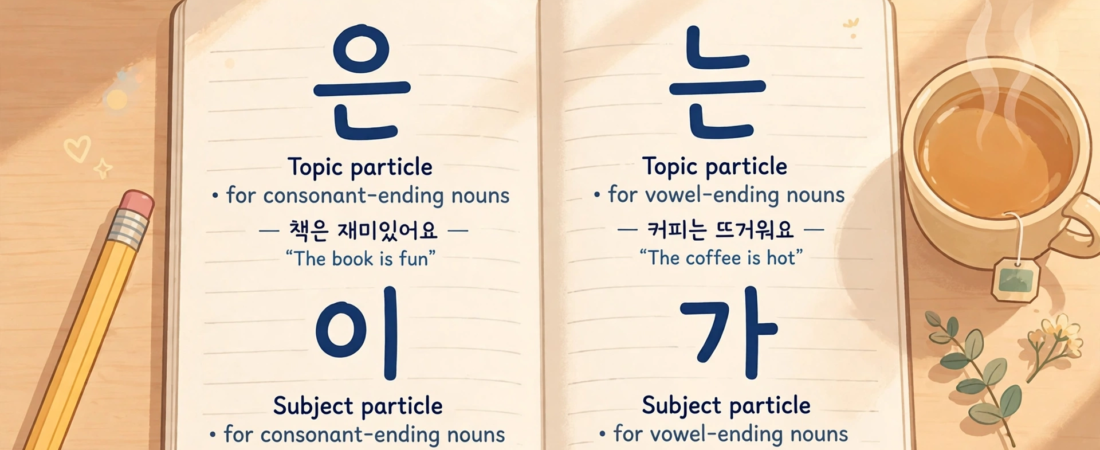
Start with the big picture. 은/는 and 이/가 look like twins, and learners mix them up for months, but they do two different jobs. 은/는 points at the topic, the thing the sentence is about. 이/가 points at the subject, the thing doing the action or being described. Two jobs, four forms, and the choice between the two forms in each pair is pure sound: 은 and 이 follow a consonant, 는 and 가 follow a vowel.
은/는 are the topic markers
Think of 은/는 as a spotlight. It says: as for this one, here is what I want to say about it. The rest of the sentence comments on the topic.
저는 학생이에요. Jeoneun haksaeng-ieyo. “I am a student.”
저는 한국어를 공부해요. Jeoneun hangugeoreul gongbuhaeyo. “I study Korean.”
이것은 책이에요. Igeoseun chaek-ieyo. “This is a book.”
Notice the pattern. 저 ends in a vowel sound, so it takes 는. 책 ends in a consonant, so it takes 은. And 저는 shows up in the first sentence of almost every self-introduction you will ever hear in Korean, which makes it the most useful word in this whole article.
Listen: three sentences with the topic marker 은/는
이/가 are the subject markers
이/가 is the workhorse for new information. When you introduce something the listener does not know yet, or answer a who question, 이/가 steps in. Rain, cats and kimchi are the classic textbook examples, and they are classics because they work.
비가 와요. Biga wayo. “It’s raining.”
고양이가 자요. Goyangiga jayo. “The cat is sleeping.”
김치가 매워요. Gimchiga maewoyo. “Kimchi is spicy.”
Same sound rule. 비 ends in a vowel, so it takes 가. 학생 ends in a consonant, so it takes 이: 학생이 공부해요, the student studies. 이/가 also shows up with 있다 and 없다, to be and not to be, and in every 누가 question. 누가 왔어요? Who came? The answer keeps the same marker: 민준 씨가 왔어요. Minjun came.
Listen: three sentences with the subject marker 이/가
The one-sentence test that tells them apart
Here is the test I give every student. Say the sentence out loud, then ask: am I introducing a topic to talk about, or am I pointing at who did it? 오늘은 비가 와요. Today, it is raining. 오늘 takes 는 because today is the topic, the frame for the sentence. 비 takes 가 because the rain is the thing doing the raining. One sentence, both markers, each doing its own job.
오늘은 비가 와요. Oneureun biga wayo. “Today, it’s raining.”
이거는 뭐예요? Igeoneun mwoyeyo? “What is this?”
Try it with something from your own day. 저는 사과를 좋아해요. I like apples. 저는 sets the topic, me. 사과를 takes the object marker 를, the next pair to learn, but notice the rhythm: topic first, then the rest of the sentence. Korean sentences almost always open with the topic, and that habit alone will make your Korean sound far more natural.
Listen: one sentence with both markers, and two more to say out loud
Now listen to a tiny dialogue and spot both markers in it.
A: 누가 왔어요? (Nuga wasseoyo?) “Who came?”
B: 민준 씨가 왔어요. (Minjun ssiga wasseoyo.) “Minjun came.”
A: 이거는 뭐예요? (Igeoneun mwoyeyo?) “What is this?”
B: 이것은 책이에요. (Igeoseun chaek-ieyo.) “This is a book.”
Listen: a short dialogue using the question word 누가 and the subject marker 가

Three mistakes every beginner makes
| Mistake | Why it is wrong | Say this instead |
|---|---|---|
| 책는 재미있어요 | 는 cannot follow a consonant | 책은 재미있어요 |
| 학생가 공부해요 | 가 cannot follow a consonant | 학생이 공부해요 |
| 저는 한국어가 공부해요 | 공부하다 needs the object marker 를 | 저는 한국어를 공부해요 |
The third one is the sneakiest. 공부하다, to study, takes an object, so Korean needs 를, not 가. If a verb acts on something, reach for 을/를. If a word is the topic or the doer, reach for 은/는 or 이/가.
Your five-minute daily practice
Five minutes, every day, for two weeks. That is all it takes for 은/는 and 이/가 to stop being a rule you recite and start being a habit your mouth remembers.
☐ Say 저는 학생이에요 and 저는 한국어를 공부해요 out loud three times
☐ Look out the window and describe the weather with 가: 비가 와요, or 눈이 와요 if it is snowing
☐ Pick five things in your room and give each the right particle: 책은, 커피는, 고양이는
☐ Ask and answer 누가 왔어요? with a friend’s name
☐ Write one sentence about your day using both markers, like 오늘은 비가 와요

Quick answers about Korean particles
Can I just leave the particles out?
In casual speech, Koreans drop them all the time. 저는 학생이에요 becomes 저 학생이에요 between friends. But in class, in writing and on the TOPIK test, the particles stay. Learn them properly first, then drop them like a native, on purpose.
Do I really need both pairs?
Yes. 은/는 frames what you are talking about, 이/가 names who does it. Korean speakers hear the difference instantly, even when the English translation looks the same.
What comes after 이/가?
The object markers 을/를, the place markers 에 and 에서, and the friendly 도, also. Learn them in that order and your sentences will grow one clean step at a time.
Particles are the kind of thing that clicks once and stays clicked. Say today’s examples out loud, try the five-minute practice tonight, and when you are ready for the next step, explore our Korean programme for guided lessons with audio and real dialogues, or keep the same everyday, speak-first method going in our English programme.
Quick quiz: can you pick the right particle?
Tap an answer and see right away if you have got it.
Question 1. Which particle marks the topic in “___ 학생이에요” (I am a student)?
Question 2. In “비가 와요” (It’s raining), why is the particle 가?
Question 3. Which sentence is correct?
Question 4. Fill the blank: “오늘___ 비가 와요” (Today, it’s raining).
Question 5. In “누가 왔어요?” (Who came?), what does 누가 show?