
Picture your first morning in a Korean classroom. The teacher walks in, everyone stands up, and a classmate leans over and whispers something you almost understand. Korean school life words are the vocabulary that turns that moment from confusing into exciting. These are the words students really say, not the ones that only live in textbooks.
The classroom words you will hear on day one
Start with the room itself. 교실 (gyosil) is the classroom, 학교 (hakgyo) is the school, and 선생님 (seonsaengnim) is the teacher. That last word matters more than any other in this post, because in Korea you address a teacher as 선생님, never by name. Add it to every question you ask a teacher and you will already sound respectful.
Your desk is 책상 (chaeksang), your bag is 가방 (gabang), and your book is 책 (chaek). The blackboard is 칠판 (chilpan) and the thing you write with is 펜 (pen) or 연필 (yeonpil, pencil). Learn these five nouns first and you can follow a surprising amount of classroom talk, because teachers point at things as often as they name them.
Listen: teacher, I have a question
What students actually say in class
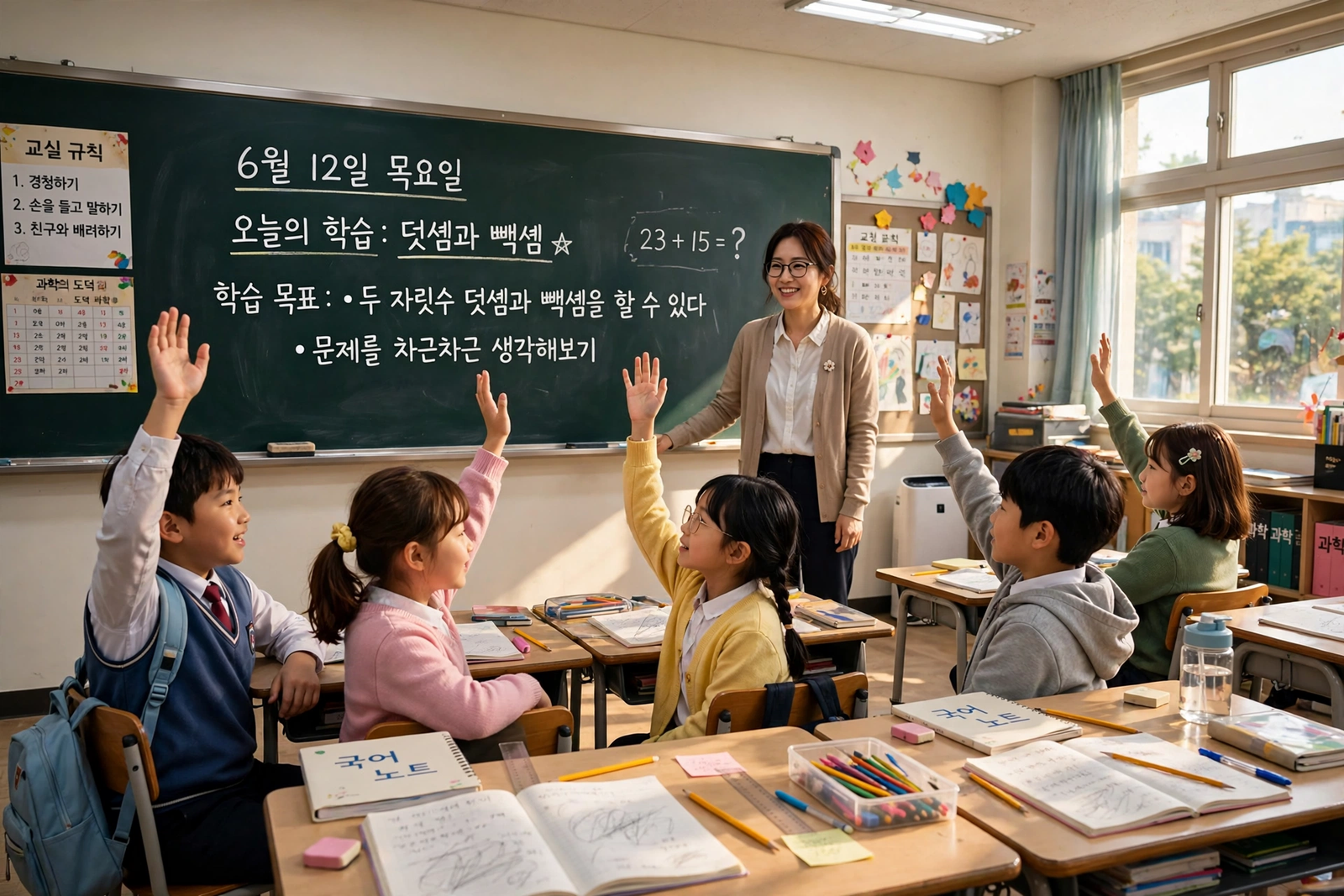
Textbooks teach you how to introduce yourself. Real students need phrases for the middle of a lesson. 선생님, 질문이 있어요 (seonsaengnim, jilmuni isseoyo, “Teacher, I have a question”) is the sentence that opens every door. If you did not catch something, say 다시 한 번 말씀해 주세요 (dasi han beon malsseumhae juseyo, “Please say it one more time”). It is polite, it is clear, and teachers love hearing it.
When the teacher asks if everyone understands, the answer is usually 네, 알겠어요 (ne, algesseoyo, “Yes, I understand”) or 아니요, 잘 모르겠어요 (aniyo, jal moreugesseoyo, “No, I do not really understand”). Saying the second one takes courage, but it is the sentence that actually gets you help. A good teacher would rather hear it than watch you nod along in silence.
Homework, tests and grades
| Korean | Romanization | Meaning |
|---|---|---|
| 숙제 | sukje | Homework |
| 시험 | siheom | Test, exam |
| 공부 | gongbu | Studying |
| 점수 | jeomsu | Score, grade |
| 수업 | sueop | Lesson, class |
| 쉬는 시간 | swineun sigan | Break time |
| 점심시간 | jeomsim sigan | Lunch time |
Homework talk follows a simple pattern. 숙제를 다 했어요 (sukjereul da haesseoyo) means “I finished my homework”, and 숙제를 안 했어요 (sukjereul an haesseoyo) means “I did not do my homework”. Before a test, you will hear 시험이 어려워요 (siheomi eoryeowoyo, “the test is hard”) in the hallway at least ten times. After it, the question is always 시험 잘 봤어요? (siheom jal bwasseoyo?, “Did you do well on the test?”). The honest answer is usually 좀 어려웠어요 (jom eoryeowosseoyo, “It was a bit hard”).
The school day in order
A Korean school day has a rhythm, and knowing the words for each part helps you follow it. 아침 (achim) is morning, and 수업 starts after the first bell. Between lessons comes 쉬는 시간, the short break when students stretch, chat and swap snacks. 점심시간 is lunch, eaten in the 급식실 (geupsiksil, school cafeteria) or in the classroom. 방과 후 (bang-gwa hu) means after school, when clubs and academies begin. Many students go on to 학원 (hagwon, a private academy) in the evening, which is why 공부하다 (gongbuhada, to study) is one of the most common verbs you will hear.
Do not be surprised if a Korean student asks you about your own school day. A friendly reply is 우리 학교는 달라요 (uri hakgyoneun dallayo, “Our school is different”) followed by one detail. Comparing school life is one of the easiest conversations a learner can have, because everyone has a school story.
Listen: I finished my homework, and the test was hard
Words students say to each other
Classmates talk differently from teachers, and that is part of the fun. 친구 (chingu) is friend, 반 친구 (ban chingu) is a classmate in your class. 같이 가자 (gachi gaja, “Let’s go together”) is the invitation you will hear at lunch and after school. 뭐 해? (mwo hae?, “What are you doing?”) is casual, so save it for friends, not teachers. And when someone shares a snack, the right answer is 고마워 (gomawo, “Thanks”), the casual form of 감사합니다 (gamsahamnida). Food is friendship in a Korean school, and a shared snack is a shared afternoon.

Listen: what are you doing at lunch time?
Your school vocabulary checklist
Tick each one off as you learn it:
☐ Say 선생님, 질문이 있어요 out loud five times
☐ Learn 교실, 학교, 책상, 가방 and 책 by heart
☐ Practise 숙제를 다 했어요 and 시험이 어려워요
☐ Learn 쉬는 시간, 점심시간 and 방과 후
☐ Ask a friend 뭐 해? and answer with what you are doing
☐ Say 감사합니다 to a teacher and 고마워 to a friend, and notice the difference
☐ Watch one Korean school scene and write down three words you recognise
Tick them all and a Korean classroom will start to feel familiar.
Quick answers about Korean school words
How do you address a teacher in Korean?
Call them 선생님. Never use a teacher’s personal name. Add 선생님 to the start of questions, for example 선생님, 질문이 있어요.
What is the Korean word for homework?
숙제 (sukje). 숙제를 다 했어요 means “I finished my homework”, and 숙제를 안 했어요 means “I did not do my homework”.
What does 방과 후 mean?
It means after school. It is the time for clubs, sports and 학원, the private academies many Korean students attend in the evening.
School vocabulary is the fastest way to feel at home in a new language, because school is where real conversations happen every day. Learn the classroom words first, then the homework and test words, and practise them out loud until they feel natural. When you are ready for the next step, our Korean programme takes you from classroom words to real conversations, one lesson at a time.
Listen: let us go together, and thank you
Quick quiz: do you know Korean school words?
Tap an answer and see right away if you have got it.
Question 1. What does 선생님 mean?
Question 2. What is the Korean word for homework?
Question 3. How do you say “I have a question” to a teacher?
Question 4. What does 점심시간 mean?
Question 5. Which phrase means “Let us go together”?