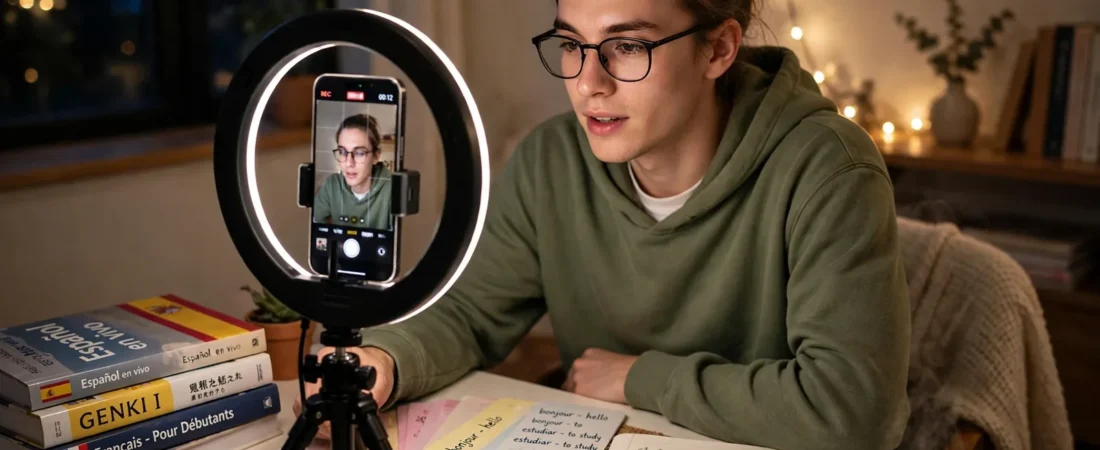
Somewhere between your morning coffee and the school run, you have probably scrolled past it: a creator filming their 5 a.m. study desk, four languages on the whiteboard behind them, a caption promising fluency in ninety days. That is language-maxxing — and if it left you feeling both inspired and slightly exhausted, you are not alone.
The language maxxing trend borrows its name from looksmaxxing, the online habit of squeezing every possible improvement out of your appearance, and applies the same all-or-nothing energy to learning a language. The formula is usually familiar by now: hours of study a day, several languages at once, streaks, immersion challenges, and a camera recording all of it. Some of it is genuinely good advice dressed up in dramatic packaging. Some of it is a recipe for quitting by week three. Here is how to tell the difference — and how to steal the good parts without rearranging your whole life.
What “language-maxxing” actually means
The “-maxxing” suffix is internet shorthand for maximising something: take one goal and push it as hard as you possibly can. Applied to languages, it usually means a public, extreme routine. Think waking up at dawn to drill flashcards, banning your own language for a whole day, shadowing audio on every walk, and posting a progress video each night so the streak stays alive in front of an audience.
Why did it catch on? Because language learning is slow and mostly invisible for months. You study for weeks and still stumble through a simple conversation, which feels like nothing is happening. Maxxing makes progress visible: a streak counter climbing, hours logged, words learned, a video that proves you showed up today. That visibility is motivating — and it is also where the trouble starts, because the video shows the best ten minutes of someone’s day, edited and lit like a film set, not the messy Tuesday underneath it.
The parts worth keeping
Strip away the camera and the captions, and three habits inside the trend are solid teaching, not hype. First, daily contact beats weekend marathons. Fifteen minutes every day keeps a language warm in your head in a way that a heroic three-hour Sunday never will. Second, input volume matters. The learners who improve fastest are the ones who hear and read the most of their language — podcasts on the commute, a show in the evening, a few pages before bed. Third, speak early and out loud. Shadowing audio, narrating your cooking in the target language, or chatting with a tutor all do something flashcards alone cannot: they train your mouth, not just your memory.
There is a fourth habit worth stealing too: keeping score, lightly. A simple log — minutes studied, pages read, days in a row — tells you the truth about your own effort without anyone else’s highlight reel involved. The streak itself is not the point. The habit it protects is.

Where the hype falls apart
The first crack is burnout. A routine built on four or five hours of daily study works for a creator whose job is making videos about studying. For the rest of us — jobs, kids, a kitchen to clean — it lasts about two weeks, and then the crash comes with a side of guilt. A plan you abandon is worse than a modest plan you keep.
The second crack is comparison. When every video in your feed shows someone else’s perfect desk and perfect accent, your own ordinary progress starts to feel like failure. It is not. You are comparing your unedited life to someone’s edited highlight reel, and that is a comparison nobody wins.
The third crack is starting five languages at once. It looks impressive on a whiteboard, but attention is a limited resource. Five languages at twenty minutes each means none of them gets enough input to stick, and you end up relearning the same beginner words in five languages instead of building real skill in one. One language, done properly, teaches you how to learn the next one faster anyway.
And then there are the promises. “Fluent in ninety days” sounds like a plan, but fluency means different things to different people — ordering dinner, or debating politics? A deadline that was never realistic does not motivate you. It just sets the date of your disappointment.
Maxxing-lite: a weekly plan for real life
So keep the spirit and drop the extremes. Maxxing-lite means one language, thirty to forty-five minutes a day, built around things you already do. Here is a week that actually survives contact with a real schedule:
| Day | Focus | What it looks like |
|---|---|---|
| Monday | Words + speaking | Learn 10 new words, then say each one in a sentence out loud |
| Tuesday | Listening | One podcast episode or 20 minutes of a show in the language |
| Wednesday | Reading | A few pages of a graded reader or one short article |
| Thursday | Speaking | Chat with a tutor or language partner, or narrate your evening routine aloud |
| Friday | Review | Flashcards for the week’s words; re-listen to Tuesday’s episode |
| Saturday | Fun immersion | A film, music, or a cooking video — enjoyment counts as study |
| Sunday | Rest + plan | 15 minutes maximum: light review, then pick next week’s show or book |
Notice what is missing: no 5 a.m. alarm, no banned languages, no camera. The routine is boring on purpose. Boring is what survives February, when the excitement of January has worn off and only the habit is left.

Quick Quiz
Test yourself on language-maxxing. Click an answer to see if you are right — your score is at the top.
Score: 0/5
1. What does the «-maxxing» suffix mean?
2. Which habits from the trend does the post say are worth keeping?
3. Why does starting five languages at once fall apart?
4. What is «maxxing-lite»?
5. What happens if you miss a day?
Quick answers
Is language-maxxing a real method?
Not really — it is a label for very intense routines, and the methods inside it are ordinary good habits turned up loud. Daily practice, lots of listening and reading, speaking out loud: all proven. The extreme packaging is new; the habits are not.
Can I learn two languages at once?
You can, once one of them is already solid. If both are brand new, pick a primary language and give the second one a small, fun slot — a song a week, one show — so it stays a treat instead of a second job.
How many hours a day do I actually need?
Thirty to forty-five focused minutes a day moves a beginner forward steadily. An hour is lovely if you have it. What matters most is showing up most days, not the length of any single session.
What if I miss a day?
Nothing breaks. A missed day is a normal Tuesday, not a failed identity. Streaks are tools for keeping a habit warm; the moment a broken streak makes you quit entirely, the tool has stopped helping. Just pick it up tomorrow.
If the trend got you curious, that curiosity is worth something — channel it into one language and a plan you can actually keep. Start with a programme that gives you structure instead of spectacle: our Chinese programme, Korean programme and Spanish programme each build daily habits around real lessons, real speaking, and steady progress — the maxxing-lite way, minus the burnout.