
You open the HSK 1 listening test, the audio starts, and the speaker says a word you are sure you know — except you are not sure. Was it mǎi or mài? Was that rice or noodles? The sentence is gone before you can decide, and the next one has already started. If that has happened to you, this HSK 1 listening practice on food is the fix. Food words are the easiest place to train your ear, because you already know what they look like, and in this post you will hear them, say them, and test yourself — with audio, a dictation exercise, and a quiz at the end.
One thing to know before we start: this post follows the **HSK 2.0 syllabus, Level 1** — the official 150-word vocabulary list published by Chinese Testing International (Hanban) and used by the HSK 1 test since 2010. In 2021, China published a new standard, **HSK 3.0**, which expands Level 1 to about 500 words. Most courses and most test preparation still teach to HSK 2.0 Level 1, and every food word in this post appears on the HSK 2.0 Level 1 list, so nothing here will surprise you on test day. Where HSK 3.0 adds a word that HSK 2.0 does not have, we will say so clearly. The two versions are different lists, and knowing which one you are studying matters more than knowing one extra word.
## The 12 food words to train your ear on
All twelve of these words are on the HSK 2.0 Level 1 list. They are also the words you will hear most often in a real restaurant, which is why they are the perfect listening set: short, common, and easy to confuse if your ear is not trained yet.
| Chinese | Pinyin | English | Listen for |
|—|—|—|—|
| 米饭 | mǐfàn | cooked rice | the falling-rising 米 (mǐ) |
| 面条 | miàntiáo | noodles | the falling 面 (miàn) |
| 水 | shuǐ | water | the dipping third tone |
| 茶 | chá | tea | the rising second tone |
| 苹果 | píngguǒ | apple | the rising 苹 (píng) |
| 香蕉 | xiāngjiāo | banana | the flat 香 (xiāng) |
| 鸡蛋 | jīdàn | egg | the high 鸡 (jī) |
| 面包 | miànbāo | bread | 面 again, then 包 (bāo) |
| 牛奶 | niúnǎi | milk | the rising 牛 (niú) |
| 肉 | ròu | meat | the falling fourth tone |
| 菜 | cài | dish / vegetables | the falling fourth tone |
| 鱼 | yú | fish | the rising second tone |
Read the table once with your eyes. Then close your eyes and listen to the audio. Your ear needs to do this job, not your eyes.
米饭,面条,水,茶,苹果,香蕉,鸡蛋,面包,牛奶,肉,菜,鱼。
(Mǐfàn, miàntiáo, shuǐ, chá, píngguǒ, xiāngjiāo, jīdàn, miànbāo, niúnǎi, ròu, cài, yú.)
Rice, noodles, water, tea, apple, banana, egg, bread, milk, meat, vegetables, fish.
Listen to the whole list three times. The first time, just listen and notice which words sound alike. The second time, repeat each word right after the speaker. The third time, say the word together with the recording before the speaker finishes it. If you can keep up on the third round, your ear is already faster than it was five minutes ago.
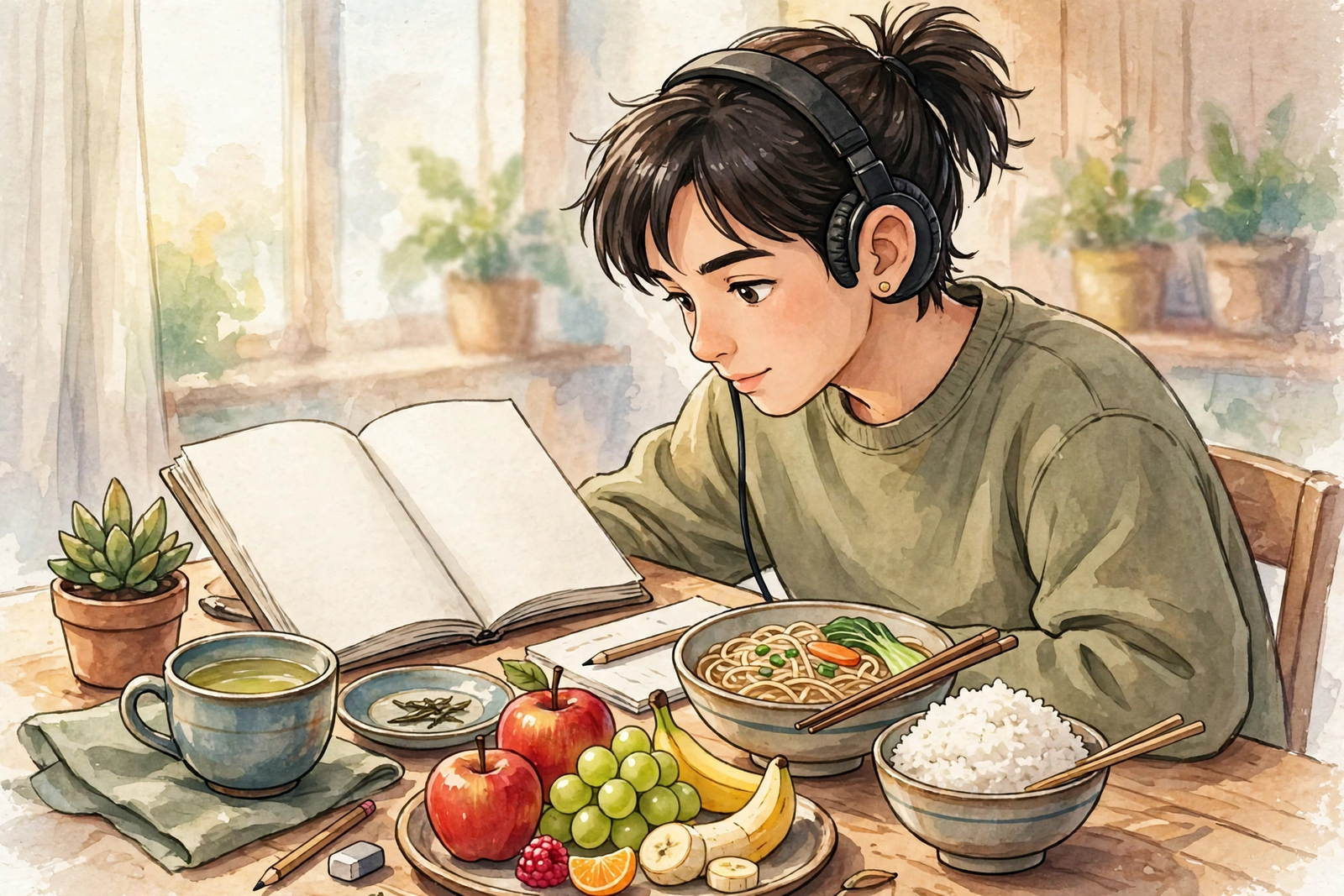
Two pairs in this list cause most of the mistakes. 米饭 (mǐfàn, rice) and 面条 (miàntiáo, noodles) both start with an “m” sound and both are foods you eat with chopsticks, so beginners mix them up constantly. The difference is the tone on the first syllable: 米 is third tone, dipping down and up, while 面 is fourth tone, falling sharply. And 菜 (cài, dish or vegetables) and 茶 (chá, tea) look nothing alike on paper but sound close enough in fast speech to confuse a tired listener. 菜 falls, 茶 rises. Tone is the whole difference, which is why this post trains tones before it trains sentences.
## Minimal pairs: the two sounds that decide your score
HSK listening tests love minimal pairs — two words that differ by one sound. The most famous pair in all of beginner Chinese is 买 (mǎi, to buy) and 卖 (mài, to sell). Same consonant, same vowel, different tone, opposite meaning. In a restaurant, 我买米饭 (wǒ mǎi mǐfàn, I buy rice) and 我卖米饭 (wǒ mài mǐfàn, I sell rice) are two different jobs. The test knows this, and it will play one of them and ask you which one you heard.
买,卖。买米饭,卖米饭。米饭,面条。茶,菜。水,睡。
(Mǎi, mài. Mǎi mǐfàn, mài mǐfàn. Mǐfàn, miàntiáo. Chá, cài. Shuǐ, shuì.)
Buy, sell. Buy rice, sell rice. Rice, noodles. Tea, vegetables. Water, sleep.
Here is how to practice this clip. Play it once and write down which word you heard each time: 买 or 卖? Do not look at the transcript yet. Then play it again and check. The words you get wrong are your real study list, and it is usually only one or two sounds. Most students find that 水 (shuǐ, water) and 睡 (shuì, sleep) are the hardest pair here, because the only difference is the tone: third tone for water, fourth tone for sleep. Say them out loud yourself, slowly, and feel the difference in your own voice. Third tone dips. Fourth tone drops like a stone.
One more classic pair to know for HSK 1: 妈 (mā, mom), 麻 (má, hemp), 马 (mǎ, horse), 骂 (mà, to scold). Four tones, four words, one syllable. You will not meet all four on the Level 1 test, but practicing them for two minutes teaches your ear the four tones faster than any chart. Say them in order, high, rising, dipping, falling, like walking down four steps.
## Listen and understand: ordering food
Now the words become sentences. In this dialogue, a customer orders lunch. Listen first without reading the transcript, and see how much you catch. Then read along, then listen again. Each round you will hear more, and that is the whole method.
A: 您好,您想吃什么?
(Nín hǎo, nín xiǎng chī shénme?)
Hello, what would you like to eat?
B: 我想吃米饭和鱼。
(Wǒ xiǎng chī mǐfàn hé yú.)
I would like to eat rice and fish.
A: 您想喝什么?
(Nín xiǎng hē shénme?)
What would you like to drink?
B: 我想喝茶,谢谢。
(Wǒ xiǎng hē chá, xièxie.)
I would like tea, thank you.
A: 好的,请等一下。
(Hǎo de, qǐng děng yíxià.)
Okay, please wait a moment.
B: 多少钱?
(Duōshao qián?)
How much is it?
A: 二十块。
(Èrshí kuài.)
Twenty yuan.
Notice the two verbs that carry this whole conversation: 吃 (chī, to eat) and 喝 (hē, to drink). In Chinese you eat rice and drink tea, and the verb tells you which one is happening. A listening test will often hide the answer in the verb: if you hear 喝, the next word is a drink, not a food. Train yourself to catch 吃 and 喝 first, and the rest of the sentence gets much easier, because you already know what kind of word is coming.
Also notice 多少钱 (duōshao qián, how much is it) and 二十块 (èrshí kuài, twenty yuan). Numbers and money appear in almost every HSK 1 listening section, and food is the most common place they show up. If you can hear 二十 (èrshí, twenty) clearly, you can answer a whole question. Practice numbers separately if they are still shaky: 一 (yī), 二 (èr), 三 (sān), 十 (shí), 二十 (èrshí).
## Dictation practice: write what you hear
Dictation is the exercise that turns listening into real skill, because you cannot fake it. Play the clip, write down what you hear in pinyin or characters, then check against the transcript below. Do not look at the transcript first. That ruins the exercise, and you know it.
我喜欢吃苹果。我想喝牛奶。请给我一碗面条。鱼很好吃。
(Wǒ xǐhuan chī píngguǒ. Wǒ xiǎng hē niúnǎi. Qǐng gěi wǒ yì wǎn miàntiáo. Yú hěn hǎochī.)
I like to eat apples. I would like to drink milk. Please give me a bowl of noodles. The fish is very delicious.
How did you do? Here is what each sentence was testing:
1. **我喜欢吃苹果。** (Wǒ xǐhuan chī píngguǒ.) The verb 喜欢 (xǐhuan, to like) plus 吃 (chī, to eat). If you heard 喝 (hē, to drink) instead of 吃, the sentence would make no sense with an apple, and that is your clue. Meaning helps your ear.
2. **我想喝牛奶。** (Wǒ xiǎng hē niúnǎi.) The verb 喝 (hē) tells you a drink is coming, so 牛奶 (niúnǎi, milk) fits and 米饭 (mǐfàn, rice) does not. Listen for the verb first.
3. **请给我一碗面条。** (Qǐng gěi wǒ yì wǎn miàntiáo.) 碗 (wǎn, bowl) is the measure word for noodles. If you heard 杯 (bēi, cup), that would be for water or tea, not noodles. Measure words are clues too.
4. **鱼很好吃。** (Yú hěn hǎochī.) 好吃 (hǎochī, delicious) is the word HSK 1 uses for tasty food. It only goes with food, never with drinks. If you hear 好吃, the word before it is something you eat.
If you got all four, your ear is ready for the test. If you got two, practice audio clip 1 for another day and try again. Dictation is not a talent. It is a muscle, and it grows every time you use it.
## 5 mistakes that cost points on HSK 1 listening
**Listening for words instead of tones.** Two words can share every sound except the tone and mean different things. Train tones first, vocabulary second. A student who knows 200 words with wrong tones hears less than a student who knows 100 words with right ones.
**Reading the question while the audio plays.** Your eyes steal attention from your ears. In the real test, read the question before the audio starts, then close your eyes or look away while it plays. Listen first, answer second.
**Panicking after one missed word.** One word is never the whole question. If you miss a word, let it go and catch the next sentence. Students who freeze on one word miss the next three as well.
**Practicing only with slow audio.** Slow audio is for learning; normal-speed audio is for testing. This post’s clips are slow and clear on purpose, but your last week of practice before the test should use normal-speed recordings, so the test does not feel fast.
**Studying the wrong syllabus.** HSK 2.0 Level 1 has about 150 words. HSK 3.0 Level 1 has about 500 words. If your course teaches HSK 3.0 and you study only the HSK 2.0 list, you will meet words you have never seen. If your course teaches HSK 2.0 and you study the HSK 3.0 list, you will waste time on words the test will not ask. Ask your teacher which version you are preparing for, and study that list. This post is built for HSK 2.0 Level 1, and it says so on purpose, because guessing is not a study plan.
## Your 7-day listening plan
– **Day 1:** Listen to audio clip 1 three times. Repeat each word after the speaker. Learn the twelve words.
– **Day 2:** Audio clip 2, the minimal pairs. Write down 买 or 卖 each time before checking. Do it until you get ten in a row right.
– **Day 3:** Audio clip 3, the restaurant dialogue. Listen without the transcript first, then read along, then listen again.
– **Day 4:** Audio clip 4, dictation. Write all four sentences from hearing alone. Check, then repeat the ones you missed.
– **Day 5:** Say the dialogue out loud, playing both parts, three times. Your mouth needs to know the words too.
– **Day 6:** Take the quiz below. Then listen to all four clips once more, back to back, without stopping.
– **Day 7:** A full practice run: play all four clips in order, answer the quiz from memory, and write the four dictation sentences without looking. If you can do that, your ear is ready.

## Quick Quiz
Test your HSK 1 food listening. Click an answer to see if you are right — your score is at the top.
Score: 0/5
1. What does 米饭 mean?
2. You hear 买 (mǎi) with a dipping third tone. What does it mean?
3. In the dialogue, the customer says 我想喝… What kind of word comes next?
4. What does 请给我一碗面条 mean?
5. Which syllabus version does this post follow?
## FAQ
**Is this post for HSK 2.0 or HSK 3.0?**
HSK 2.0 Level 1, the 150-word list. HSK 3.0 Level 1 covers about 500 words, and every word in this post is also in the HSK 3.0 list, so it helps either way — but the practice is built around the HSK 2.0 test format.
**How many times should I listen to each clip?**
At least three times each: once to listen, once to repeat, once to say it together with the speaker. Then come back the next day and do it once more. Listening once is hearing. Listening three times is learning.
**What if I still mix up 买 and 卖?**
You are not alone — it is the most mixed-up pair in beginner Chinese. Say them out loud ten times a day for a week: mǎi, mài, mǎi, mài. Your mouth will teach your ear.
**Where can I find the official HSK vocabulary list?**
The official HSK 2.0 syllabus and vocabulary lists are published by Chinese Testing International (CTI), the organization that runs the HSK test. Your course or textbook should state which version it follows; if it does not say, ask your teacher before you study.
**Can I use food words to practice with a real person?**
Yes, and you should. Order food in Chinese at a restaurant, or practice the dialogue in this post with a classmate. Real ordering is the best listening test there is, and the waiter will not mind if you point at the menu.
## Keep listening: your ear is the test
Listening is the part of HSK 1 that students worry about most, and it is the part that improves fastest, because every minute of listening is practice. You now have twelve food words, the trickiest minimal pairs, a restaurant dialogue, and four dictation sentences, all with audio you can replay as many times as you like. Use them every day this week, and the next time the audio starts on a test, you will not be guessing. You will be hearing.
Keep learning with the [Chinese lessons on LingoBubbo](https://lingobubbo.com/tieng-trung/), where HSK vocabulary appears in short dialogues and listening practice like this one. If this post helped, send it to a classmate who is preparing for HSK 1 too — the listening section is easier when you practice together. And tell us in the comments: which pair still tricks your ear, 买 and 卖, or 水 and 睡?