
A guest has just walked in. You smile, hand over the menu — then freeze. The only English in your head is “This is menu”, and even that doesn’t sound right out loud. The Chinese guest looks at you, you look at the guest, and you both force an awkward smile. If you work in a restaurant or a café, or you simply often eat out with Chinese friends, this scene feels very familiar, doesn’t it?
The good news is you don’t need a whole year of Chinese to handle this situation. With just the 15 Chinese phrases for inviting guests to look at the menu below — learn them by heart and say them in the order given in this article — you can greet guests, hand over the menu, suggest dishes and see guests off politely, like a seasoned restaurant worker. This article is written for people who need Chinese right away at work, so every phrase comes with Chinese characters, pinyin and an English translation, plus standard-pronunciation audio so you can listen and imitate.
## 5 words to learn by heart before the phrases
Learning phrases without knowing the key words is like cooking without knowing the names of the ingredients — you can hear the words but don’t understand what you’re saying. There are only 5 words; learn these 5 and the 15 phrases below will feel much lighter.
| Word | Pinyin | Meaning |
|—|—|—|
| 菜单 | càidān | menu |
| 点菜 | diǎn cài | to order food |
| 推荐 | tuījiàn | to recommend, to suggest |
| 招牌菜 | zhāopái cài | signature dish, the restaurant’s “star” dish |
| 服务员 | fúwùyuán | waiter/waitress, server |
The two words you’ll meet most often in this article are 菜单 (càidān, menu) and 点菜 (diǎn cài, to order). Keep them clearly apart: 菜单 is the booklet the guest holds in their hand, while 点菜 is the action of choosing dishes. Don’t say “请点菜单” — people will know at once that you’re a beginner. The correct phrases are “请看一下菜单” (please have a look at the menu) or “请点菜” (please go ahead and order), depending on the moment.
One small note many people overlook: in a restaurant, with guests you don’t know, you address them as 您 (nín — the polite “you”) rather than 你 (nǐ — the informal “you”). One character changes, and the whole attitude changes with it. Every phrase in this article uses 您, so just learn them as they are and you’re safe.
## 15 Chinese phrases for inviting guests to look at the menu
The fifteen phrases fall into 4 groups, following the exact order of a real meal: greeting guests and handing over the menu, introducing dishes, asking what the guest would like to eat, and wrapping up politely. Learn them by group, not one scattered phrase at a time.
### Group 1: Greeting guests and inviting them to look at the menu
These are the 3 opening phrases, and also the 3 most important ones. Say these 3 well and guests warm to you from the very first moment.
**1. 您好!请看一下菜单。**
Nín hǎo! Qǐng kàn yí xià càidān.
Hello! Please have a look at the menu.
**2. 这是菜单,请慢慢看。**
Zhè shì càidān, qǐng mànmàn kàn.
Here is the menu — please take your time looking through it.
**3. 这是我们的菜单。**
Zhè shì wǒmen de càidān.
This is our menu.
Notice the character 请 (qǐng, please) at the start of phrases 1 and 2. In Chinese, 请 is politeness packed into a single character. “看菜单” (look at the menu) sounds like an order, while “请看一下菜单” sounds like an invitation. Adding 一下 (yí xià, a little, briefly) in the middle softens the sentence even more — like saying “just have a quick look”, with no pressure on the guest. This is a small trick native speakers use every day.
Listen to these 3 phrases read at normal speed, then imitate each one:
Listen to 3 phrases for inviting guests to look at the menu, read at normal speed
If you didn’t catch it, listen to the slow version again. The slow reading isn’t for rote memorisation — it’s so you can hear every tone clearly, especially 请 (qǐng, third tone) and 看 (kàn, fourth tone):
Listen slowly — the 2 most important phrases for inviting guests to view the menu
### Group 2: Introducing dishes and making suggestions
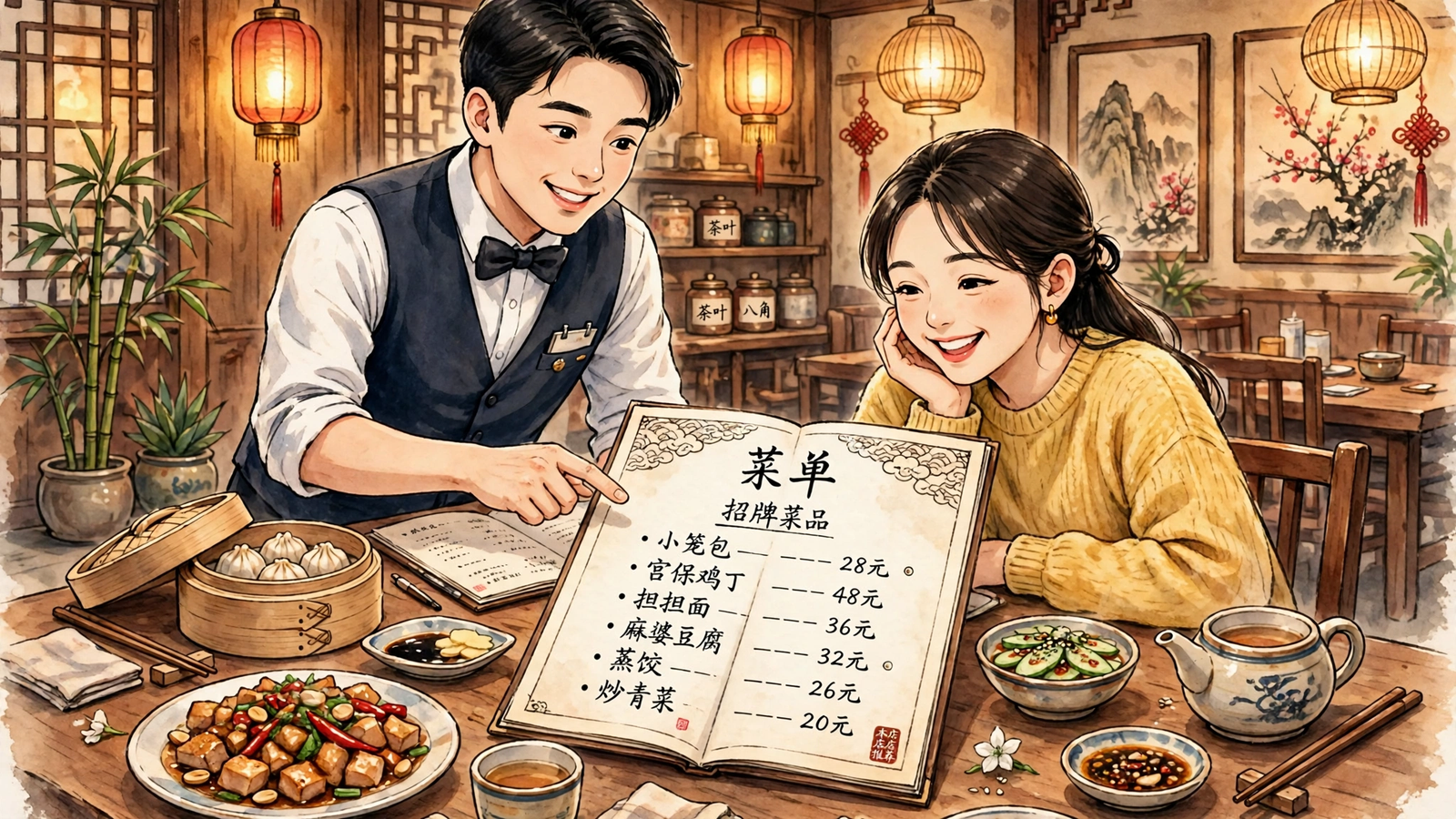
When a guest holds the menu and hesitates, that’s your moment to speak up. Vietnamese guests and Chinese guests are alike in this: everyone likes being recommended a good dish, as long as the suggestion sounds genuine and not like reading an advertisement.
**4. 我们今天有特价菜。**
Wǒmen jīntiān yǒu tèjià cài.
Today we have some special-price dishes.
**5. 我们的招牌菜是宫保鸡丁。**
Wǒmen de zhāopái cài shì Gōngbǎo jīdīng.
Our signature dish is Kung Pao chicken.
**6. 这道菜很受欢迎。**
Zhè dào cài hěn shòu huānyíng.
This dish is very popular with our guests.
**7. 您要辣的还是不辣的?**
Nín yào là de háishi bù là de?
Would you like it spicy or not spicy?
Phrase 7 is worth learning by heart. Chinese people’s tolerance for spice is very different from Vietnamese people’s: some can handle tongue-searing heat, others can’t manage a single bit of chilli. Ask one question first and you avoid the scene where a guest orders, takes one bite, and pulls a face. Asking this question also shows guests you’re attentive — not the “whatever you order is what you get” type.
### Group 3: Asking what the guest would like to eat and drink
Once the guest has finished looking at the menu, you need to ask so they can order. These three phrases get used over and over every day; learn them until they come out as a reflex.
**8. 您想吃点儿什么?**
Nín xiǎng chī diǎnr shénme?
What would you like to eat?
**9. 您想喝点儿什么?**
Nín xiǎng hē diǎnr shénme?
What would you like to drink?
**10. 请问,您几位?**
Qǐngwèn, nín jǐ wèi?
Excuse me, how many people are in your party?
Phrase 10 sounds strange to Vietnamese ears, but in a Chinese restaurant this is often the first thing a server asks — even before handing over the menu. 几位 (jǐ wèi) means “how many (honoured) guests” — a very polite way to ask about party size. You ask this to know how many seats to set and how many place settings to bring. If you work in a Chinese restaurant, you could even learn this phrase before the menu invitation itself.
Oh, and one phrase many people ask about: when do you use “点菜”? When the guest has finished choosing and you want to say “please go ahead and order”, you say “请点菜” (Qǐng diǎn cài). And when a guest calls you over to order more, you’ll hear them say “服务员,点菜!” (Server, we’d like to order!) — then you only need to answer “好的,马上来” (Hǎo de, mǎshàng lái — Certainly, I’ll be right there) and walk over.
### Group 4: After the guest orders — ending politely
**11. 请稍等一下。**
Qǐng shāo děng yí xià.
Please wait a moment.
**12. 请慢用。**
Qǐng màn yòng.
Please enjoy your meal.
**13. 有需要,请叫我。**
Yǒu xūyào, qǐng jiào wǒ.
If you need anything, please just call me.
**14. 祝您用餐愉快。**
Zhù nín yòngcān yúkuài.
We wish you a very pleasant meal.
**15. 谢谢,请慢走。**
Xièxie, qǐng màn zǒu.
Thank you — please take care on your way.
Phrase 12, 请慢用, is the one you’ll say most during a shift. You bring the dish out, set it on the table, say 请慢用 and smile — done. Don’t say “请吃” (please eat) — it sounds abrupt and a bit rough. Phrase 15 is for when guests leave: 请慢走 literally means “walk slowly”, but what it conveys is “take your time, and take care on your way” — the most familiar farewell in every Chinese restaurant.
Listen to these 3 polite closing phrases, then practise saying them:
Listen to 3 polite phrases for the end of a meal
## 2 sample dialogues: listen, then role-play them
Once you’ve learned the individual phrases, putting them together into dialogues is when you find out whether you can actually use them. The first dialogue is the menu-invitation and ordering situation — exactly this article’s topic. Play the server, read your lines out loud, let the audio read the guest’s lines, then swap roles.
**Dialogue 1: Inviting a guest to view the menu and order**
– 服务员 (Fúwùyuán, Server): 您好!请看一下菜单。
Nín hǎo! Qǐng kàn yí xià càidān.
Hello! Please have a look at the menu.
– 客人 (Kèrén, Guest): 谢谢。你们有什么推荐的菜吗?
Xièxie. Nǐmen yǒu shénme tuījiàn de cài ma?
Thank you. Do you have any dishes you would recommend?
– 服务员:我们的招牌菜是宫保鸡丁和麻婆豆腐,都很受欢迎。
Wǒmen de zhāopái cài shì Gōngbǎo jīdīng hé Mápó dòufu, dōu hěn shòu huānyíng.
Our signature dishes are Kung Pao chicken and Mapo tofu — both are very popular.
– 客人:好的,我要一份宫保鸡丁,再来一碗米饭。
Hǎo de, wǒ yào yí fèn Gōngbǎo jīdīng, zài lái yì wǎn mǐfàn.
Alright, I’ll have one portion of Kung Pao chicken, and another bowl of rice, please.
– 服务员:好的,请稍等。
Hǎo de, qǐng shāo děng.
Certainly — please wait a moment.
– 客人:谢谢!
Xièxie!
Thank you!
Listen to the whole dialogue in two voices — server and guest — then role-play it:
Listen to the dialogue inviting a guest to view the menu and order, in 2 voices
**Dialogue 2: A guest asks whether a dish is spicy**
– 客人:这个菜辣吗?
Zhège cài là ma?
Is this dish spicy?
– 服务员:有一点儿辣。您要不辣的吗?
Yǒu yìdiǎnr là. Nín yào bú là de ma?
It’s a little spicy. Would you like it non-spicy?
– 客人:我不要太辣的。
Wǒ bú yào tài là de.
I don’t want it too spicy.
– 服务员:好的,我跟厨房说一下。
Hǎo de, wǒ gēn chúfáng shuō yí xià.
Certainly, I’ll let the kitchen know.
This dialogue is short but contains a very handy pattern: “我跟厨房说一下” (I’ll let the kitchen know). In a restaurant, this sentence works for all sorts of things: telling the kitchen to make it less spicy, make it quickly, leave out the onions, add more ice… Just change what comes after “说一下” and you gain a dozen new sentences without learning a single new word.
## 5 mistakes Vietnamese speakers often make when inviting guests to view the menu
**Saying “看菜单” and forgetting 请。** “看菜单!” sounds like you’re giving the guest an order. Always put 请 at the start: 请看一下菜单. One character, a completely different attitude.
**Using 你 with guests you don’t know.** You and the guest haven’t met before, so 您 is the right choice. Save 你 for friends, people younger than you, or regulars you’ve become close to. Get this wrong and older guests may feel you’re being disrespectful.
**Asking “你要吃什么?” too directly.** This sentence isn’t grammatically wrong, but it sounds blunt — like asking a close friend. With guests, say “您想吃点儿什么?” — with 您, 想 and 点儿, the sentence becomes much softer.
**Reading pinyin but dropping the tones.** 菜单 is read càidān, not a flat “cai dan” with no tones. Chinese listeners can still guess wrong tones from context, but too many mistakes tire them out. Practise with the audio in this article — especially the slow version — so your ears gradually get used to the tones.
**Forgetting the farewell.** Many servers think the job is done once the dishes are served, and just nod when guests leave. Add one “谢谢,请慢走” as you see guests off, and next time they’ll remember your restaurant. In the service industry, the last sentence a guest hears is sometimes more important than the first.

## Summary table: all 15 phrases on one screen
Save this table, or screenshot it and send it to friends who are learning Chinese for work too. Fifteen phrases — enough for a whole shift.
| # | Chinese phrase | Pinyin | English meaning |
|—|—|—|—|
| 1 | 您好!请看一下菜单。 | Nín hǎo! Qǐng kàn yí xià càidān. | Hello! Please have a look at the menu. |
| 2 | 这是菜单,请慢慢看。 | Zhè shì càidān, qǐng mànmàn kàn. | Here is the menu — please take your time. |
| 3 | 这是我们的菜单。 | Zhè shì wǒmen de càidān. | This is our menu. |
| 4 | 我们今天有特价菜。 | Wǒmen jīntiān yǒu tèjià cài. | Today we have special-price dishes. |
| 5 | 我们的招牌菜是宫保鸡丁。 | Wǒmen de zhāopái cài shì Gōngbǎo jīdīng. | Our signature dish is Kung Pao chicken. |
| 6 | 这道菜很受欢迎。 | Zhè dào cài hěn shòu huānyíng. | This dish is very popular. |
| 7 | 您要辣的还是不辣的? | Nín yào là de háishi bù là de? | Spicy or not spicy? |
| 8 | 您想吃点儿什么? | Nín xiǎng chī diǎnr shénme? | What would you like to eat? |
| 9 | 您想喝点儿什么? | Nín xiǎng hē diǎnr shénme? | What would you like to drink? |
| 10 | 请问,您几位? | Qǐngwèn, nín jǐ wèi? | Excuse me, how many in your party? |
| 11 | 请稍等一下。 | Qǐng shāo děng yí xià. | Please wait a moment. |
| 12 | 请慢用。 | Qǐng màn yòng. | Please enjoy your meal. |
| 13 | 有需要,请叫我。 | Yǒu xūyào, qǐng jiào wǒ. | If you need anything, just call me. |
| 14 | 祝您用餐愉快。 | Zhù nín yòngcān yúkuài. | Have a pleasant meal. |
| 15 | 谢谢,请慢走。 | Xièxie, qǐng màn zǒu. | Thank you — take care on your way. |
**7-day plan to memorise these 15 phrases:**
– **Day 1:** Listen to the audio of the 3 Group 1 phrases ten times and read along. Learn the 3 opening phrases by heart.
– **Day 2:** Learn Group 2, and practise introducing dishes with a friend playing the guest.
– **Day 3:** Learn Group 3, and practise asking “您想吃点儿什么?” until you can say it without thinking.
– **Day 4:** Learn Group 4, especially 请慢用 and 请慢走 — the two most-used phrases.
– **Day 5:** Role-play both dialogues, swapping roles after each round.
– **Day 6:** Try out 5 phrases in a real shift, and note which ones guests understood right away and which ones you had to repeat.
– **Day 7:** Take the quiz at the end of the article. Score 5/5 and move on to the next lesson: how to ask how many people are in a party and seat them, in Chinese.
## Quick quiz
Let’s see how much you remember. Choose an answer — your score appears at the top.
Score: 0/5
1. How do you politely invite a guest to look at the menu?
2. What does 菜单 (càidān) mean?
3. A guest asks “你们有什么推荐的菜吗?” — what does the guest want?
4. Which is the most polite way to ask a guest what they would like to eat?
5. When do you use 请慢用 (Qǐng màn yòng)?
## FAQ
**How long does it take to be able to use these 15 phrases?**
If you practise 15–20 minutes a day following the 7-day plan in this article, by the end of the week you’ll be speaking fluently during your shifts. The 3 Group 1 phrases are the most important — learn those 3 first and you can already use them at work tomorrow.
**I don’t know any Chinese characters yet — can I still learn from this article?**
Yes. You only need to listen to the audio and read the pinyin to be able to speak. The Chinese characters in this article are there so you can match them against real menus in Chinese restaurants — because menus in Chinese restaurants usually show only characters, with no pinyin.
**What’s the difference between 您 and 你?**
您 (nín) is the polite form of address for people older than you, customers, and people you don’t know yet. 你 (nǐ) is used with friends, family, and people younger than you. In a restaurant, with guests you don’t know, always use 您.
**If I get the tones wrong, will guests still understand me?**
Usually yes, because guests guess from context — you’re in a restaurant and handing over a menu, so even a wrong-toned “cai dan” will still be understood as 菜单. But many tone mistakes force guests to keep guessing, and the conversation stops feeling natural. Listening to the slow audio in this article and imitating it is the fastest way to fix your tones.
**After this article, what should I learn next on LingoBubbo?**
Next, learn how to ask how many people are in a party and seat them with 几位, in the article [Asking How Many People Are in Your Party in Chinese: 几位 (Jǐ Wèi) for Restaurant Staff](https://lingobubbo.com/hoi-khach-di-may-nguoi-bang-tieng-trung-ji-wei/), then review how to greet customers naturally like a native speaker in the article [How to Greet Customers in a Shop in Chinese, the Natural Way](https://lingobubbo.com/cach-chao-khach-trong-cua-hang-bang-tieng-trung-tu-nhien/). Both articles have audio and sample dialogues just like this one.
## Try speaking today
Fifteen phrases, four audio files, two dialogues — all packed into a single situation: inviting a guest to look at the menu. You don’t need to learn anything else before using them. Tomorrow at work, a guest walks in and you simply say: “您好!请看一下菜单。” Finish the first sentence and the second one will follow naturally.
Keep learning Chinese phrases for restaurant work in the [Chinese section on LingoBubbo](https://lingobubbo.com/tieng-trung/). If this article made you more confident on shift, send it to a colleague who is learning Chinese for work too — you might both have it memorised before the weekend. And tell us in the comments: what was the first Chinese sentence you ever said to a guest, and how did they reply?