Have you ever noticed this? A word you meet in a textbook disappears from your memory in three days, but a meme that made you laugh stays with you for a year. That is not a coincidence. Strong emotion works like glue for memory, and nothing sticks emotion to vocabulary quite like a meme.
Below are 20 English memes you have almost certainly seen on your own feed. Each one teaches a word or phrase, with a real example sentence you can steal for yourself. Read through, laugh a little, and walk away with 20 pieces of English you will actually remember. The keyword to keep in mind is simple: learn English vocabulary with memes — because the funnier the picture, the longer the word stays.
Why Your Brain Remembers a Meme Better Than a Word List
A word list gives your brain one thing to hold on to: letters on a page. A meme gives it four: a picture, a joke, a feeling, and a situation. When you see a dog sitting calmly in a burning room saying “This is fine,” you are not memorizing the word fine — you are remembering a whole scene, and the word comes along for the ride.
That is why the method in this post works. You are not drilling flashcards. You are meeting each word inside a moment you already know, and then you are using it in a sentence about your own life. Try saying each example out loud as you go. Your mouth needs the practice as much as your memory does.
Listen: two friends react to memes using the phrases from this post — “This is fine,” “nailed it,” “what a dilemma,” and more
20 Memes, 20 Words and Phrases
Here they are, in no particular order — just like your feed. For each meme, note the word, read the example, and try making your own sentence before you move on.
1. One does not simply… — “it is not as easy as it looks”
From The Lord of the Rings: Boromir says, very seriously, “One does not simply walk into Mordor.” The structure is now used to stress that something is much harder than it looks.
“One does not simply finish this project in one night.”
2. This is fine — “everything is fine” (said ironically)
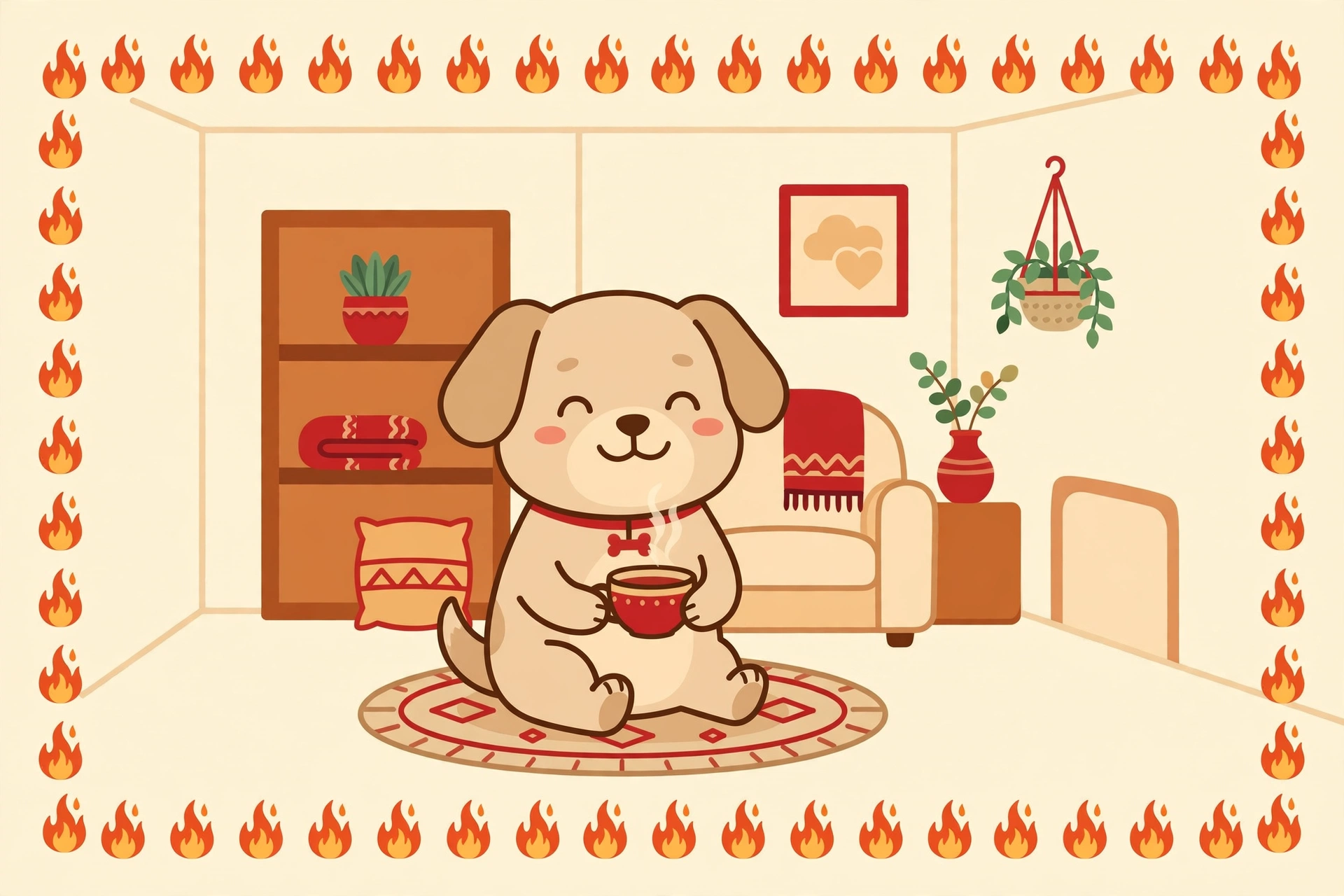
A dog sits in a room on fire and says “This is fine.” It teaches you how native speakers use fine with heavy irony — when everything is going wrong but you pretend it is all okay.
“My deadline is tomorrow and I haven’t started. This is fine.”
3. Distracted boyfriend — “losing focus” and “temptation”
A man walks with his girlfriend and turns his head to look at another woman. The meme is a perfect picture of distracted (unable to focus) and temptation (something that pulls you away from what you should be doing).
“I get distracted by my phone every 10 minutes.”
4. Drake Hotline Bling — “reject” vs “approve”
Drake pushes one thing away with his hand, then points and smiles at another. The meme teaches the pair reject (to say no to something) and approve (to say yes to something) more clearly than any textbook table.
“I reject junk food, I approve home cooking.”
5. Woman yelling at a cat — “argument” and “counterpoint”
A woman shouts; a cat sits calmly at the table. The meme shows an argument (a heated disagreement) and a counterpoint (a calm reply that pushes back). One side is loud, the other side answers without raising its voice.
“Every family dinner turns into an argument about politics.”
6. Success Kid — “nailed it!”
A little boy pumps his fist in celebration. The meme goes with the phrase nailed it — you did something perfectly, exactly as planned.
“I nailed the presentation this morning!”
7. Grumpy Cat — “grumpy”
A cat whose face always looks angry at the whole world. The word to learn is grumpy — bad-tempered and easily annoyed, usually for a small reason.
“Don’t talk to me before coffee — I’m grumpy.”
8. Two buttons — “dilemma”
A sweating man hesitates in front of two red buttons. The meme is the perfect image of a dilemma — a situation where you have to choose, and every option has a downside.
“Save money or travel? What a dilemma.”
9. Is this a pigeon? — “mistake A for B”
An anime character points at a butterfly and asks, “Is this a pigeon?” The meme teaches the verb pattern mistake A for B — to wrongly think one thing is another.
“I mistook salt for sugar in the recipe.”
10. Surprised Pikachu — “face the consequences”
Pikachu stares in shock when the obvious thing happens. The meme goes with the phrase face the consequences — to deal with the results of your own actions.
“He partied all night and failed the exam. Now he has to face the consequences.”
Listen: ten key phrases from the first half of the list — say each one out loud after you hear it
11. Change my mind — “prove me wrong”
A man sits at a table with a sign that says “Change my mind.” The meme teaches a fun way to invite debate — and the word opinion, a belief about something.
“Pineapple on pizza is great. Change my mind.”
12. Expanding brain — “levels of understanding”
A brain “grows” brighter across four panels, from dim to glowing. The meme shows levels of understanding — how your knowledge deepens from shallow to deep.
“Level 1: learn words. Level 4: think in English.”
13. Left exit 12 off ramp — “last-minute decision”
A car suddenly swerves toward an exit. The meme is the image of a last-minute decision — a choice to change direction at the very last moment.
“I made a last-minute decision to join the trip.”
14. Anakin and Padmé — “awkward”
Anakin smiles nervously and asks, “Right?” Padmé answers with the same nervous smile. The meme teaches awkward — that uncomfortable, embarrassing feeling every English learner knows well.
“My first English call was so awkward.”
15. Spider-Man pointing at Spider-Man — “hypocrite” and “accuse”
Two Spider-Men point at each other. The meme shows a hypocrite — someone who criticizes others for something they do themselves — and the verb accuse, to say someone did something wrong.
“He accused me of being late, but he’s the real hypocrite.”
16. “I am once again asking…” — “once again”
Politician Bernie Sanders, very serious, asks for support. The phrase once again in this meme is handy whenever you want to stress that something is happening one more time.
“I am once again asking you to review your vocabulary daily.”
17. Hide the pain Harold — “hide the pain”
An older man smiles brightly, but his eyes tell a different story. The meme teaches the phrase hide the pain — to cover up suffering behind a smile — and the adjective painful.
“Smiling in the meeting while hiding the pain of 50 unread emails.”
18. Roll Safe — “clever workaround”
A young man taps his head with a knowing look. The meme shows a clever workaround — a smart trick to get around a problem, sometimes a little bit cheeky.
“Can’t fail the test if you never take it — clever workaround, right?”
19. Mocking SpongeBob — “mock” and “sarcasm”
SpongeBob repeats words in alternating capital and lowercase letters to imitate someone mockingly. The meme teaches the verb mock (to imitate someone to make fun of them) and the noun sarcasm (saying the opposite of what you mean, to be funny or cutting).
“Stop mocking my accent!”
20. Crying vs. Chad — “cope”
On one side, a character cries and complains; on the other, “Chad” walks on calmly. The meme teaches the verb cope — to deal with a difficult situation and keep going, instead of only complaining about it.
“Instead of complaining, learn to cope with stress.”
Listen: the last ten phrases from the list, including “change my mind” and “cope with stress”
How to Turn Any Meme Into Your Vocabulary Tutor
Twenty memes are a good start, but the real trick is the habit. Your feed gives you new memes every day, and every one of them can teach you something. Here is how to make that happen without turning your free time into homework.
Save the meme with the word attached. When a meme makes you laugh, screenshot it and write the new word or phrase right under the picture. Your brain will link the word to that funny image, and the link is what makes it stick.
Make a sentence about your own life. For every new word, write one sentence that is true for you, following the meme’s “script.” “This is fine” works best when it is about your deadline. “What a dilemma” works best when it is about your choice between saving money and travelling.
Sharing is studying. Send the meme to a friend with the English sentence you wrote yourself. You get a laugh, and you get a free correction if your sentence is off. Friends are the most honest teachers you will ever have.
Do not just laugh and scroll past. Stop for ten seconds, read the new word out loud, and say its meaning. Those ten seconds decide whether you remember the word tomorrow or forget it by dinner.

What to Learn Next
Memes help you remember words fast, but to use words naturally, you still need a base: topic vocabulary, listening and speaking reflexes, and a steady review habit. That is exactly what the LingoBubbo English hub is for — it builds your vocabulary and reflexes step by step, so that the next time a meme shows up on your feed, you understand every word of it.
Want more natural phrases like the ones in this post? Our guide to 15 English phrases that make you sound like an American gives you everyday expressions with meanings and examples — perfect for your next round of meme sentences. Start tonight: pick one meme from this list, write your own sentence with its word, and send it to a friend. Share this post with someone who is learning English too, and leave a comment: which meme taught you your favourite new word?
Quick Quiz
Five questions on the memes and words in this post. Pick one answer per question — you get instant feedback either way. Score: 0/5
1. What does “This is fine” usually mean when someone says it?
2. What does “nailed it” mean?
3. Which sentence uses “mistake A for B” correctly?
4. What is a “dilemma”?
5. What does “cope with stress” mean?
How did you score? If you missed a question, scroll back to that meme and re-read the word — then write one sentence of your own with it tomorrow. Words stick when you use them, so keep practicing in the LingoBubbo English hub, and share this post with a friend who loves memes as much as you do.