
Picture this: a table of four sits down, you walk over with menus, and for two seconds your mind goes blank. You know the words. You practiced them at home. But right now, in front of real guests, “Please look at the menu” comes out stiff, and “today special is salmon” sounds wrong even to you. If that has ever happened to you, this post is your fix. Here are the exact sentences American servers use to hand over the menu and introduce the specials, how to say them so guests understand you the first time, and what to say when guests answer back. Fifteen sentences, two short dialogues, and one practice routine. Learn them tonight, use them tomorrow.
The job in one scene
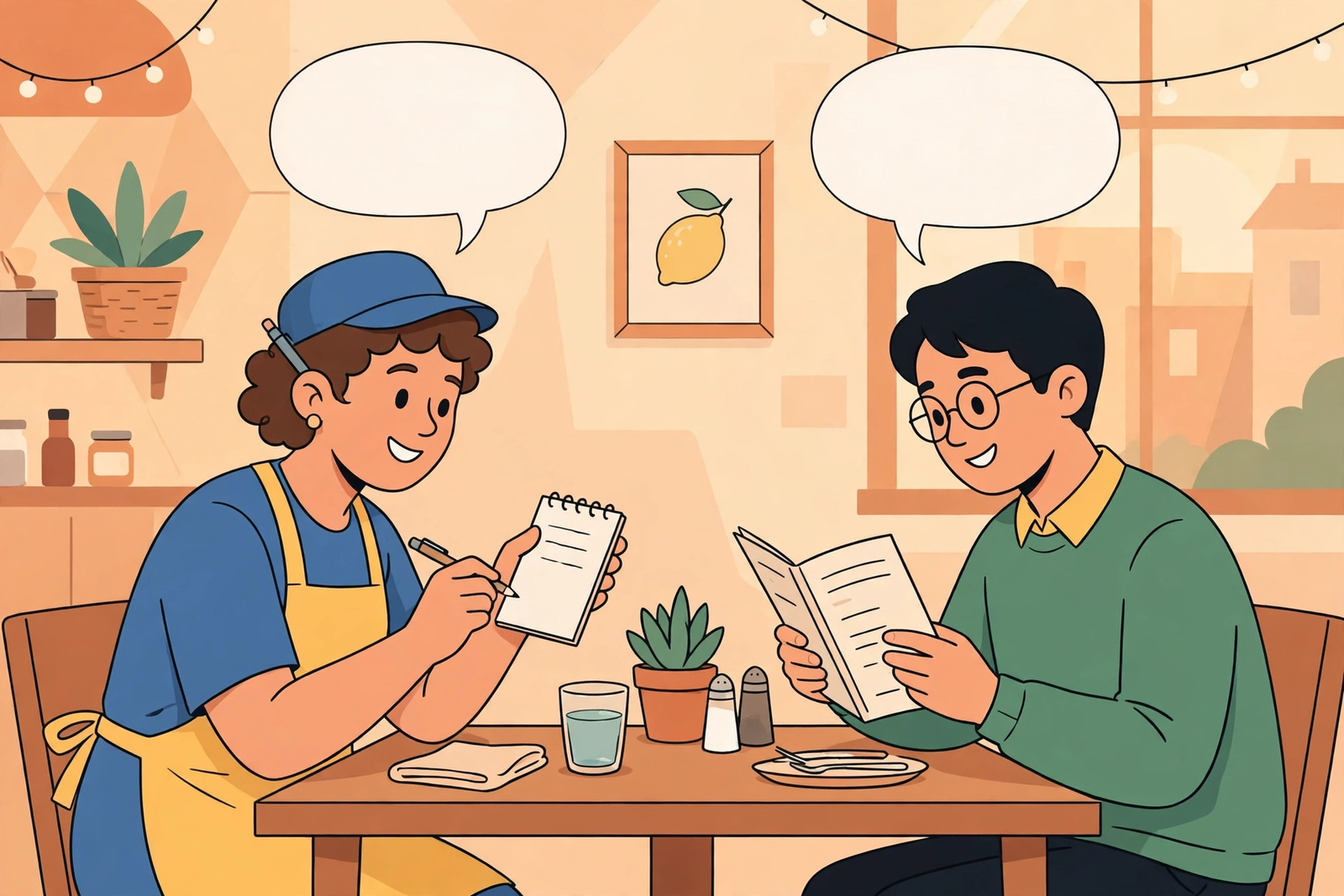
You work in a restaurant in the US. A party of two or four walks in, the host seats them, and you arrive at the table with menus and water. Your job in the first minute is simple: greet them warmly, give them the menu, tell them about the special, and give them time to decide. Guests expect this little ritual, and when it goes smoothly, the whole meal goes smoothly.
Here is the flow, step by step. You greet the table. You hand over the menus. You mention the special, in one or two sentences, not a speech. You offer a drink. Then you step back and let them read. That is it. Nobody expects perfect English. They expect a friendly face, clear words, and a little patience. The sentences below do all three.
The 15 sentences that do the whole job
Start with the menu. These are the sentences American servers actually say, in the order they say them. The pronunciation notes tell you the one word in each sentence that most learners rush or mumble, so you can slow down exactly where it counts.
| # | Say this | Pronunciation note |
|---|---|---|
| 1 | Good evening, welcome. Here are your menus. | Menus: MEN-yooz, two syllables, stress on the first. |
| 2 | Take your time looking at the menu. | “Take your time” runs together: take-yer-time. |
| 3 | Can I get you started with a drink? | “Started” sounds like STAR-ted, not “start-ed.” |
| 4 | Our special today is the grilled salmon. | Grilled: GRILD, one quick syllable. |
| 5 | Tonight we have grilled salmon with lemon butter. | Lemon: LEM-un, the o is a soft “un.” |
| 6 | We also have a mushroom pasta for vegetarians. | Vegetarian: vej-uh-TAIR-ee-un, stress on “tair.” |
| 7 | Our most popular dish is the grilled salmon. | Popular: POP-yuh-ler, three quick syllables. |
| 8 | The soup of the day is tomato basil. | Basil: BAY-zul in the US, not “bah-sil.” |
| 9 | Would you like to hear today’s specials? | “Would you” sounds like “wood-jew.” |
| 10 | Please let me know if you have any questions about the menu. | “Questions”: KWES-chuns, stress on the first part. |
| 11 | I’ll be right back with water. | “I’ll be right back” is the friendliest sentence in a restaurant. |
| 12 | Of course, no rush at all. | “Of course” is one smooth sound: uh-KORS. |
| 13 | I’ll check back in a few minutes. | “Few” sounds like “fyoo,” one syllable. |
| 14 | Just a little. I can ask the kitchen to make it mild if you like. | Mild: MY-uld, rhymes with “wild.” |
| 15 | Enjoy your meal. | Say it warmly as you step away, never flat. |
Listen to the first three sentences now, slowly, and say each one right after the speaker.
Take your time with the menu. Our special today is the grilled salmon with lemon butter. Can I get you started with a drink?
Notice the rhythm. American servers do not speak fast here. They slow down on the important words: the name of the dish, the price words, the question at the end. If you say the dish name slowly and clearly, guests forgive everything else. “Grilled salmon” said clearly beats a perfect sentence said too fast.
What the guest says, and what you answer
The menu moment is a two-way conversation, and guests say the same five things over and over. Learn the answers and you will never freeze again.
Guest: “Could we have a few more minutes?”
Server: “Of course, no rush at all. I’ll check back in a few minutes.”
Why it works: “No rush at all” is the magic phrase. It tells the guest they are not a problem. Say it with a smile and the whole table relaxes.
Guest: “What is the special today?”
Server: “Tonight we have grilled salmon with lemon butter, and a mushroom pasta for vegetarians.”
Why it works: one sentence, two dishes, and you name the one for vegetarians without being asked. Guests love that.
Guest: “Is the soup spicy?”
Server: “Just a little. I can ask the kitchen to make it mild if you like.”
Why it works: you answer honestly, and you offer a fix in the same breath. That is the difference between a server who knows the food and one who is just reading a card.
Guest: “We’re ready to order.”
Server: “Wonderful. What can I get for you?”
Why it works: “Wonderful” is warm and professional at the same time, and “What can I get for you?” is the standard American way to take an order.
Guest: “Can we have the check, please?”
Server: “Of course, I’ll bring it right over.”
Why it works: short, warm, and no extra words. When guests ask for the check, they want it fast.
Listen to the first three exchanges as a real conversation. One voice is the server, the other is the guest.
Server: Good evening, welcome. Here are your menus. Take your time, and I will be right back with water.
Guest: Thank you. What is the special today?
Server: Tonight we have grilled salmon with lemon butter, and a mushroom pasta for vegetarians.
Guest: That sounds good. We will look at the menu and let you know.
Role-play: the full two minutes
Here is the whole scene from start to finish. Read it out loud with a friend, one of you as the server and one as the guest. Then switch roles. The first time will feel slow. The third time will feel like a real shift.
Server: Good evening, welcome to our restaurant. Here are your menus. Our special today is the grilled salmon with lemon butter, and we also have a mushroom pasta for vegetarians. Can I get you started with a drink?
Guest: Thank you. Could we have a few more minutes to look at the menu?
Server: Of course, no rush at all. I’ll be right back with water, and I’ll check back in a few minutes.
Guest: Actually, one question. Is the soup spicy?
Server: Just a little. I can ask the kitchen to make it mild if you like.
Guest: That would be great, thank you. And we will have two waters, please.
Server: You got it. Take your time, and please let me know if you have any questions about the menu.
That is the whole job. No big vocabulary, no complicated grammar. Just the same sentences, in the same order, every single time. Guests do not judge your English. They judge whether they felt welcome, and these sentences make them feel welcome.
Listen to the second dialogue, the one about needing more time and asking about the soup. This is the exchange most new servers stumble on, because the guest’s question comes when you least expect it.
Guest: Could we have a few more minutes?
Server: Of course, no rush at all. I will check back in a few minutes.
Guest: Is the soup spicy?
Server: Just a little. I can ask the kitchen to make it mild if you like.
Common mistakes, and the easy fix for each one
“Please see menu.”
Guests understand it, but it sounds like a command. Say “Take your time looking at the menu” or “Here are your menus” instead. Americans soften requests with “take your time” and “please let me know,” and guests hear the difference immediately.
“Today special is salmon.”
The word order is off, and “today special” is not how Americans say it. The fixed sentence is “Our special today is the grilled salmon.” Put “our special” first, “today” after it, and the dish name at the end, where guests are listening hardest.
“Do you want drink?”
It is understandable, but it sounds blunt. “Can I get you started with a drink?” is the sentence every American server uses, and it is softer because it offers help instead of asking a yes-or-no question. Learn that one sentence and you will use it a hundred times a week.
Rushing the dish name.
New servers often say the special fast, because they are nervous. Do the opposite. Say the dish name slowly: “grilled… salmon… with lemon butter.” Guests remember the dish, not the speed. If you are not sure how to pronounce a dish, ask a coworker before your shift, not in front of the table.
Freezing when the guest asks a question you did not expect.
You do not need a perfect answer. You need one safe sentence: “Great question, let me check with the kitchen.” That sentence buys you thirty seconds, it sounds professional, and guests respect it far more than a guessed answer. Never invent an ingredient or a price. Check, then come back.
Forgetting to step back.
The menu moment has two parts: talk, then stop talking. After you mention the special and offer a drink, step back and let the guests read. Standing at the table while they read feels like pressure. A good server disappears for two minutes and comes back smiling.
Your practice routine: ten minutes a night
You do not need an hour. You need ten minutes, every night, for one week.
Night 1 and 2: Read the fifteen sentences out loud, slowly, three times. Mark the three that feel hardest, and say those five extra times.
Night 3 and 4: Play the audio clips and repeat each line right after the speaker. Copy the rhythm, not just the words. Slow on the dish name, warm on the greeting.
Night 5: Do the role-play with a friend or family member. One of you is the server, one is the guest. Switch roles and do it again. The guest should ask at least one question you did not expect, so you practice saying “Great question, let me check.”
Night 6 and 7: Say the whole scene from memory, no paper, in front of a mirror. Time yourself. The full two minutes should feel easy by now, and the sentences should come out without thinking.
Listen to the closing phrases one more time before your next shift. These are the lines guests hear last, and they are the ones guests remember.
Would you like to hear today’s specials? Our most popular dish is the grilled salmon. Please let me know if you have any questions about the menu.
The shareable cheat sheet
Print this, or save it on your phone, and read it once before every shift until the sentences are automatic.
| Moment | Say this |
|---|---|
| Hand over the menu | Good evening, welcome. Here are your menus. |
| Give them time | Take your time looking at the menu. |
| Introduce the special | Our special today is the grilled salmon. |
| Offer a drink | Can I get you started with a drink? |
| Guest needs more time | Of course, no rush at all. |
| Guest asks about spice | Just a little. I can ask the kitchen to make it mild. |
| Guest is ready | Wonderful. What can I get for you? |
| Guest asks for the check | Of course, I’ll bring it right over. |
| Stepping away | Enjoy your meal. |
Send this table to a coworker who just started. It is the whole first minute of the job, on one card.
If you want more restaurant sentences for the rest of the shift, our guide to 100 English sentences for restaurant staff, from greeting the table to the bill covers everything after the menu moment. And if you work the breakfast shift too, the 20 English words for breakfast foods, for ordering the American way will help you talk about the morning menu with the same confidence.
Quick Quiz
Test yourself on inviting guests to look at the menu and introducing the specials in English. Click an answer to see if you are right — your score is at the top.
Score: 0/5
1. What is the most natural way to invite guests to look at the menu?
2. Which sentence introduces the special correctly?
3. What should you say to offer a guest a drink?
4. A guest says, “Could we have a few more minutes?” What is the best reply?
5. A guest asks a question you cannot answer. What should you do?
FAQ
Do I need perfect English to work as a server in the US?
No. Guests expect a friendly face, clear words, and patience, not perfect grammar. The fifteen sentences in this post cover the whole menu moment, and saying the dish name slowly and clearly matters more than anything else.
What if a guest asks about an ingredient I do not know?
Say “Great question, let me check with the kitchen,” then go and check. Never invent an ingredient or a price. Guests respect an honest check far more than a guessed answer.
Should I describe every special, or just name it?
Name it in one sentence, with one detail: “grilled salmon with lemon butter.” If the guest wants more, they will ask. A long speech about the special keeps guests from reading the menu, which is the opposite of what you want.
How do I handle a guest who is ready to order but I am not ready?
Say “Wonderful, one moment please” and finish what you are doing. Guests wait happily for a server who sounds calm and in control. Never rush to the table while you are carrying something else.
What is the best way to practice these sentences?
Out loud, every night, for ten minutes. Read the fifteen sentences, copy the audio clips, and role-play the full two-minute scene with a friend. After one week, the sentences will come out without thinking.
Your turn: use the sentences on your next shift
You now have the whole first minute of the job: fifteen sentences, the five answers guests expect, a full role-play, and a cheat sheet you can read before every shift. You do not need one more phrasebook. You need one real table, one real greeting, and the sentence “Take your time looking at the menu” said with a smile. Do that tomorrow, and the second table will be easier. By the end of the week, the sentences will belong to you.
Keep learning with the English lessons on LingoBubbo, where short workplace dialogues like the ones in this post appear in every lesson. If this guide helped you, send it to a coworker who just started serving in the US. And tell us in the comments: which sentence from this post will you use first on your next shift?