Ask ten Vietnamese learners what scares them most about Chinese and nine will say the same two words: tones and characters. Fair enough — both are real. But here is the part nobody tells you on day one: as a Vietnamese speaker, you walk into Chinese class already holding half the deck. Your language shares sounds, words, and grammar habits with Mandarin that English speakers spend years building from scratch. This guide to learning Chinese as a Vietnamese speaker lays out exactly where you have a head start, where the road genuinely gets steep, and how to turn each advantage into faster progress — with example sentences, audio to shadow, and five short exercises you can do tonight.
Everything here uses simplified Chinese characters, the standard in mainland China, with pinyin and English meaning. When this post mentions HSK levels, it follows the current HSK 3.0 syllabus (the nine-level standard in use since 2021). Want the full learning path after this post? Start from the LingoBubbo Chinese page — every lesson there comes with vocabulary, audio, and a quiz.
Your first advantage: you already hear tones
English speakers hear Mandarin’s four tones as one blurry musical note. You do not. Vietnamese has six tones of its own, so your ear already knows that changing the pitch of a word changes its meaning. That is not a small thing. It is the single hardest listening skill in Chinese, and you arrive with it half-trained.
Take the classic example. The syllable “ma” means four different things depending on the tone:
| Character | Pinyin | Tone | Meaning |
|---|---|---|---|
| 妈 | mā | 1st — high and flat | mother |
| 麻 | má | 2nd — rising | hemp / numb |
| 马 | mǎ | 3rd — dipping | horse |
| 骂 | mà | 4th — falling | to scold |
Now compare that with Vietnamese. Your tone “ngang” (flat) feels a lot like Mandarin’s 1st tone. Your “sắc” (rising) sits close to the 2nd tone. Your “huyền” (falling) resembles the 4th tone. The match is not perfect — the 3rd tone, that dip down and up, has no exact Vietnamese twin, and the two tones “hỏi” and “ngã” can blur together when you first meet it. Still, you are mapping new sounds onto an ear that already works this way. An English learner is building the ear itself.
Listen to the four sentences below, then say each one out loud right after the audio. Your goal is not perfection. It is to hear the tone move and copy the movement.
Your second advantage: thousands of words you almost already know
Here is the secret that makes Vietnamese learners smile in week two. A huge share of Vietnamese vocabulary comes from Chinese — the Sino-Vietnamese layer of the language. When you meet the Chinese word, the Vietnamese word you already know is sitting right next to it, same meaning, similar sound.
| Chinese | Pinyin | Vietnamese (Sino-Vietnamese) | English |
|---|---|---|---|
| 学生 | xuésheng | học sinh | student |
| 老师 | lǎoshī | lão sư (thầy) | teacher |
| 中国 | Zhōngguó | Trung Quốc | China |
| 越南 | Yuènán | Việt Nam | Vietnam |
| 时间 | shíjiān | thời gian | time |
| 电话 | diànhuà | điện thoại | telephone |
| 学习 | xuéxí | học tập | to study |
| 国家 | guójiā | quốc gia | country |
| 朋友 | péngyou | bằng hữu | friend |
| 文化 | wénhuà | văn hóa | culture |
Notice the pattern. The first syllable of the Chinese word usually echoes the first part of the Vietnamese word: xué sounds like “học”, shí like “thời”, diàn like “điện”, guó like “quốc”. It is not a perfect rhyme every time — sounds shifted over centuries — but it is close enough that the word sticks after two or three meetings instead of ten. Learners who know this trick routinely pick up HSK 1 and HSK 2 vocabulary (under the HSK 3.0 syllabus, Levels 1–2) far faster than the textbook schedule expects.
Try it yourself with this sentence. Say it slowly, and notice how many words already feel familiar:
我每天学习中文三十分钟。(Wǒ měitiān xuéxí Zhōngwén sānshí fēnzhōng. — I study Chinese for thirty minutes every day.)
学习 (xuéxí — to study) is “học tập”. 中文 (Zhōngwén — Chinese language) is “Trung văn”. Even 三十 (sānshí — thirty) echoes “tam thập”. Three words in one sentence, and you barely had to memorize anything new.
Your third advantage: the grammar feels like home
Chinese grammar is famously light: no verb conjugations, no plural endings, no past-tense forms to memorize. Vietnamese works the same way. You already think in this pattern — time words do the job that verb endings do in European languages.
Compare. In English you say “I studied yesterday” and “I will study tomorrow” — the verb changes. In Vietnamese you say “Hôm qua tôi học” and “Ngày mai tôi sẽ học” — the verb “học” never changes; the time word does the work. Chinese is identical: 昨天我学习 (Zuótiān wǒ xuéxí — Yesterday I studied) and 明天我学习 (Míngtiān wǒ xuéxí — Tomorrow I will study). Same verb, same shape, different time word.
Word order helps too. Both Vietnamese and Chinese are subject–verb–object languages: 我爱你 (Wǒ ài nǐ — I love you) lines up word for word with “Tôi yêu bạn”. You are not rewiring your sentence brain. You are mostly swapping in new words and learning a few new particles.
The particles are the one grammar habit to watch. Chinese uses small words like 了 (le — completed action), 过 (guo — past experience), and 的 (de — possession or description) where Vietnamese uses nothing or a different word. They are tiny, they carry real meaning, and dropping them is the most common grammar mistake Vietnamese learners make. Example: 我吃饭了 (Wǒ chī fàn le — I have eaten) needs that 了 at the end; without it, the sentence feels unfinished, like saying “Tôi ăn cơm” when you mean “Tôi đã ăn cơm rồi”.

Now the hard parts — four walls every Vietnamese learner hits
Advantages get you moving fast. These four difficulties decide whether you keep going. None of them is a reason to stop. Each one just needs a different tool.
1. Characters: thousands of pictures to memorize
Vietnamese uses the Latin alphabet. Chinese does not. Every word is a character — or several — built from strokes in a fixed order, and there is no alphabet to sound them out with. A beginner needs roughly 600 characters for HSK 3.0 Level 2, and everyday reading takes a few thousand. That number frightens people. It should not. You do not learn characters one by one like lottery numbers. You learn them by parts: radicals that repeat, sounds that repeat, meanings that repeat.
Take 好 (hǎo — good). It is 女 (nǚ — woman) plus 子 (zǐ — child): woman + child = good. Once you see the logic, the character stops being a random drawing. Learn the 100 most common radicals first, and every new character becomes a combination of pieces you already know. If you want to drill tones and pinyin before characters, the post Pinyin for beginners: the 4 tones of Chinese in 10 minutes is the right warm-up.
2. Tones that sound the same to you — until they do not
Your Vietnamese ear is an advantage and a trap at the same time. Some Mandarin tones sit close to Vietnamese tones, so your brain files them under the Vietnamese sound and stops listening carefully. The 2nd tone (rising) and the 3rd tone (dipping) blur together for many Vietnamese learners. So do the pairs zh/ch/sh — those curled-tongue sounds have no Vietnamese equivalent — and q/x/j, which all sound like “s” or “ch” until you train your ear.
The fix is boring and it works: minimal pairs, five minutes a day. Say 妈 (mā) and 马 (mǎ) back to back. Say 知道 (zhīdào — to know) and 吃 (chī — to eat) until the tongue position feels different. Record yourself on your phone once a week and compare with the audio in this post. You will hear the gap close.
3. Measure words — the little word between the number and the noun
Vietnamese has classifiers too (“một cái bàn”, “một con mèo”), so the idea is not new. But Chinese measure words are pickier, and the default 个 (gè) only takes you so far. Books take 本 (běn): 一本书 (yì běn shū — one book). Flat things take 张 (zhāng): 一张纸 (yì zhāng zhǐ — one sheet of paper). People, politely, take 位 (wèi): 一位老师 (yí wèi lǎoshī — one teacher). Using 个 for everything is understandable, and it is also the fastest way to sound like a beginner forever. Learn one new measure word per week, attached to a real object in your house.
4. Listening speed: real Chinese talks fast
Textbook audio is slow and clear. A shopkeeper in Guangzhou is not. Connected speech swallows sounds, tones soften, and sentences run together. This is the wall that makes learners say “I can read HSK 2 but I understand nothing on the street.” The cure is graded listening: start with slow audio like the clips in this post, move to short dialogues, then to real-life videos with subtitles. Never jump straight to fast native speech and decide you are bad at listening. You are not bad — you skipped steps.
How to use both sides: a 30-minute daily plan
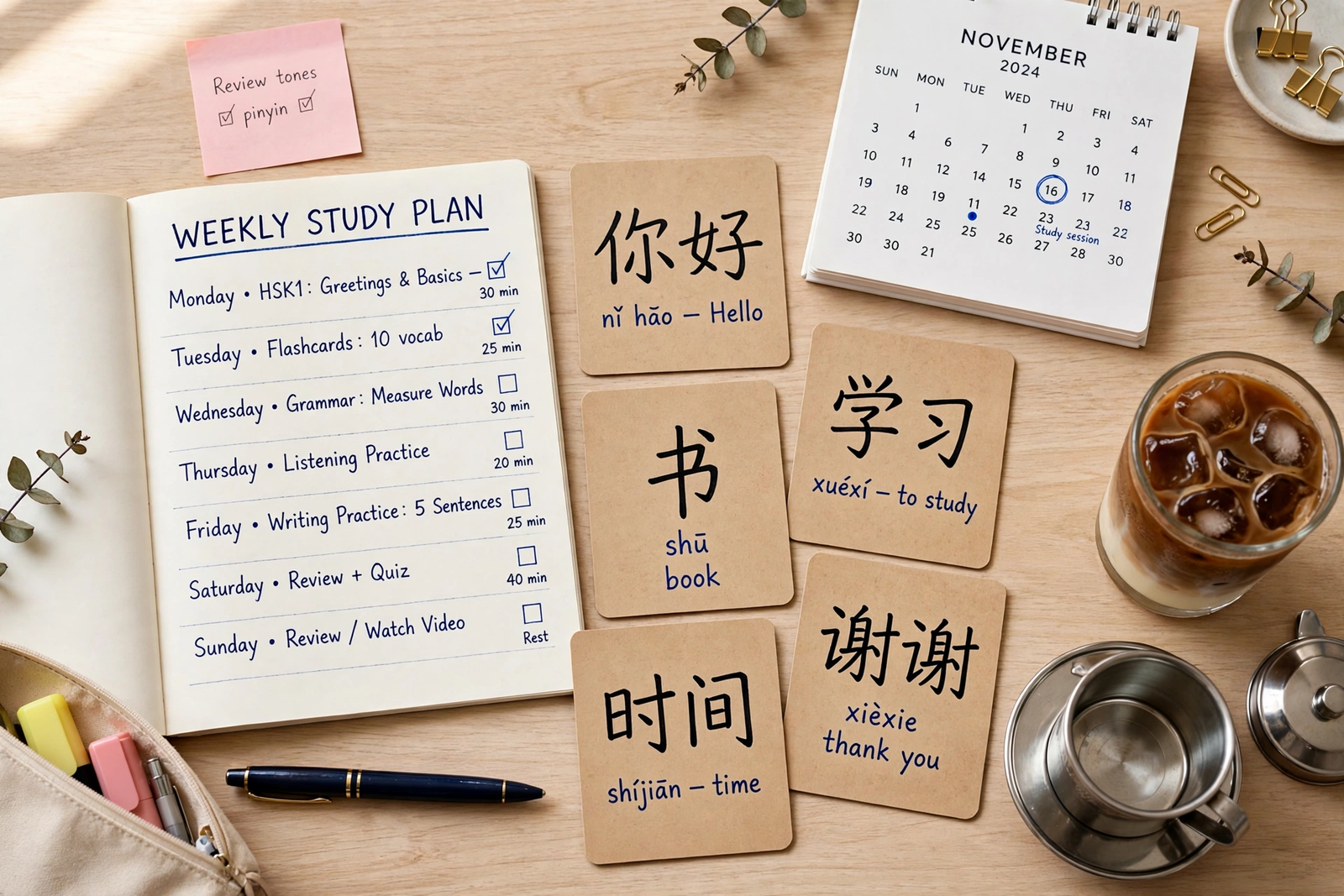
Here is a plan that leans on your advantages and attacks your weak spots at the same time. Thirty minutes a day, five days a week, is enough to finish HSK 3.0 Level 2 in about four to six months.
| Minutes | What to do | Which advantage it uses |
|---|---|---|
| 0–5 | Shadow the audio in this post — listen, repeat, record yourself once | Tone ear + pronunciation |
| 5–15 | Learn 5 new words; for each one, ask: does it sound like a Vietnamese word I know? | Sino-Vietnamese vocabulary |
| 15–22 | Write 5 new characters by hand, naming each radical as you write it | Character logic, not rote copying |
| 22–28 | Make 3 sentences with today’s words using the SVO order you already know | Grammar similarity |
| 28–30 | One minimal pair: say the two tones or two sounds until they feel different | Tone traps + zh/ch/sh |
That last clip is your safety sentence. 请你说慢一点 (Qǐng nǐ shuō màn yìdiǎn — Please speak a little more slowly) is the most useful phrase a beginner owns. Use it with real people. Nobody minds slowing down for a learner who is clearly trying — and every slow conversation is listening practice at exactly your speed. If you want a structured week of pronunciation drills, try the plan in 7-day experiment: let AI teach me Chinese pronunciation.
5 short exercises — do them now, answers included
Do not just read this post. Stop at each exercise, answer out loud, then check. Five minutes here is worth more than an hour of rereading.
Exercise 1 — Tone check. Say 妈 (mā — mother) and 马 (mǎ — horse). Which one dips down and comes back up? Answer: 马 (mǎ), the 3rd tone. If they sounded the same, replay the audio and exaggerate the dip.
Exercise 2 — Find the familiar word. The Chinese word 时间 (shíjiān) means “time”. Which Vietnamese word does it echo? Answer: “thời gian”. The first syllable shí matches “thời”, and jiān matches “gian”.
Exercise 3 — Fix the sentence. A learner writes: 我三本书有. (Wǒ sān běn shū yǒu.) What is wrong? Answer: word order — the measure word phrase comes before the noun, and 有 (yǒu — to have) comes before the object: 我有三本书。(Wǒ yǒu sān běn shū. — I have three books.)
Exercise 4 — Choose the measure word. One teacher: 一___老师. Is it 个, 本, or 位? Answer: 位 (wèi) — the polite measure word for people. 个 is understandable, 位 is correct and respectful.
Exercise 5 — Say it in Chinese. “I study Chinese for thirty minutes every day.” Answer: 我每天学习中文三十分钟。(Wǒ měitiān xuéxí Zhōngwén sānshí fēnzhōng.) Replay AUD4 and shadow it three times.
Quick summary: your advantages and hard parts at a glance
Save this table or copy it into your notebook. It is the whole post in one place.
| Advantage | Why it helps | Hard part | What to do |
|---|---|---|---|
| You hear tones | Vietnamese has 6 tones; your ear already works this way | 2nd vs 3rd tone blur | Minimal pairs, 5 min/day |
| Shared vocabulary | Sino-Vietnamese words echo Chinese sounds and meanings | False friends and shifted sounds | Check meaning every time, never guess |
| Same grammar shape | SVO order, no conjugations, time words carry tense | Particles 了 / 过 / 的 | Learn one particle per week in real sentences |
| High motivation | Jobs, study, family, travel — real reasons to keep going | Characters feel endless | Learn radicals first, then characters by parts |
| Listening ear | You already parse fast tonal speech in Vietnamese | Real Chinese talks fast | Graded listening: slow audio → dialogues → real videos |
Send this table to a friend who is learning Chinese too. Two learners who compare notes keep each other going far longer than one learner alone.
Quick Quiz: learning Chinese as a Vietnamese speaker
Click the answer you choose — right or wrong, you will know immediately.
Score: 0/5 — click an answer to check it right away.
Question 1. Which Vietnamese tone feels closest to Mandarin’s 1st tone (high and flat)?
Question 2. The Chinese word 电话 (diànhuà) means “telephone”. Which Vietnamese word does it echo?
Question 3. What is the correct measure word in 一___书 (one book)?
Question 4. What does 请你说慢一点 mean?
Question 5. In the sentence 明天我学习, what tells you the action is in the future?
Frequently asked questions about learning Chinese as a Vietnamese speaker
How long does it take a Vietnamese speaker to reach conversational Chinese? With 30 minutes a day, most learners hold simple everyday conversations after 4–6 months (around HSK 3.0 Level 2), because the shared vocabulary and grammar carry them fast. Reading and writing take longer — characters need their own daily practice.
Do I need to learn characters, or is pinyin enough? Pinyin is enough for speaking and listening at the start. But you cannot read menus, messages, or street signs without characters, and every learner who skips them hits a wall later. Start characters in week two, five a day, and the wall never appears.
Which is harder for Vietnamese learners: tones or characters? Tones feel hard in week one and fade fast because your ear already works with tones. Characters stay hard longer because the writing system is completely new. Budget more time for characters than for tones.
Should I learn simplified or traditional characters? Learn simplified first — it is the standard in mainland China, where most Vietnamese learners work, study, or do business, and it matches the HSK 3.0 syllabus. Traditional characters are used in Taiwan and Hong Kong; you can add them later if you need them.
Can I learn Chinese on my own, without a teacher? Yes, up to a point. Audio, quizzes, and a daily plan like the one in this post carry you through the beginner levels. A teacher or speaking partner becomes valuable once you start real conversations — that is when someone needs to hear your tones and correct them in the moment.
You did not start from zero. You started with an ear for tones, a few thousand half-familiar words, and grammar that already points the same way. The hard parts are real — characters, measure words, fast speech — but every one of them has a concrete fix, and the plan in this post fits in half an hour a day. Pick one exercise from this post and do it tonight: shadow the four audio clips, or learn five words through their Vietnamese echoes. Then tell us in the comments: which advantage surprised you most, and which hard part are you working on right now? Share this post with a friend who is learning Chinese — the two of you will get further together. And when you are ready for the next step, continue on the LingoBubbo Chinese page, where every lesson comes with vocabulary, audio, and a quiz.