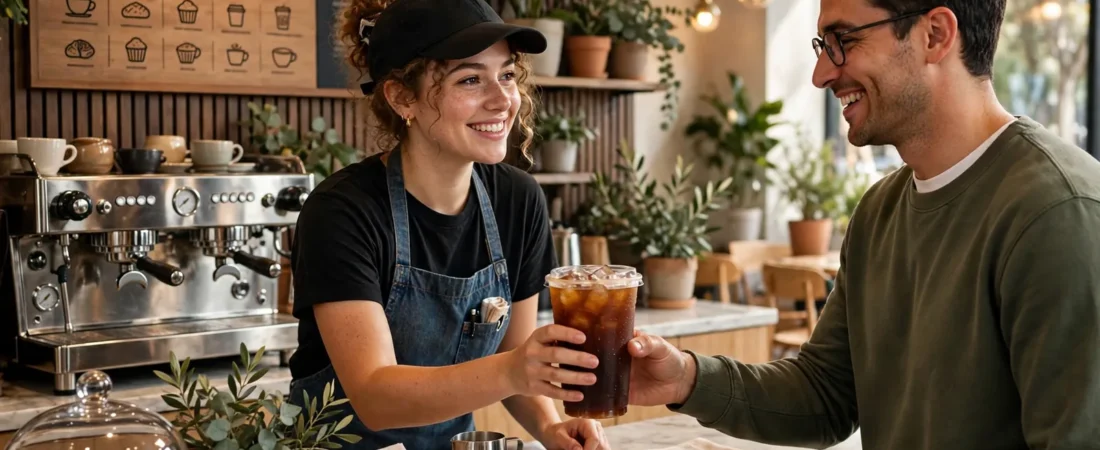
A customer walks up to your counter and says, “Can I get a venti iced caramel macchiato, decaf, with oat milk, extra shot?” You freeze. You understood about half of that. Was it hot or iced? What does decaf mean again? And what on earth is a macchiato? If you work in a coffee shop and English is not your first language, this exact moment happens every single day. This guide fixes it. You will learn the four words that decide every coffee order — hot, iced, blended, and decaf — plus the phrases customers actually say, the questions staff actually ask, and one full role-play you can practice tonight.
Here is the good news: coffee orders are not real conversations. They are a short script, and the script barely changes. The customer says a size, a temperature, a drink, and maybe one extra. You repeat it back, you ask one question, and you are done. Learn the script and you can take any order, even from the fastest-talking customer in the morning rush.
## The four words that decide every order
Every coffee order starts with one of these four words, and each one changes what you make. Get these right and the rest is easy.
| Word | What it means | Say it like this |
|—|—|—|
| Hot | Served warm, in a cup, no ice | “hot” — short o, like “not” |
| Iced | Served cold, poured over ice | “iced” — sounds like “eyes” + d |
| Blended | Mixed with ice in a blender, thick and cold | “blen-ded” — two clear beats |
| Decaf | Made with decaffeinated coffee, very little caffeine | “dee-kaf” — stress the first part |
Hot and iced are opposites, and they are the two words customers say first and fastest. If you hear only one word of an order, it is usually this one. Blended is the one beginners mix up most, because it sounds like a smoothie and looks like a milkshake. It is neither, quite: a blended coffee is coffee mixed with ice and milk in a blender until it is thick and cold, and it comes with whipped cream on top more often than not. Decaf is the one that causes real trouble, because a customer who orders decaf usually has a reason — they cannot have caffeine, or it is late at night. Decaf coffee still contains a very small amount of caffeine, so never tell a customer it has none. Just make it decaf and move on.
One more word you will hear every day: **shot**. A shot is one serving of espresso. “Extra shot” means one more. “Two shots” means two. When a customer says “double shot,” they want two shots in one drink. The word sounds small and it is small, but it changes the price and the strength, so repeat it back every time.
Customer: Hi, can I get a large iced latte, please?
Staff: Sure. Would you like that with whole milk or oat milk?
Customer: Oat milk, please. And can I add an extra shot?
Staff: Of course. Anything else?
Customer: That’s all. How much is it?
Staff: Six fifty. Your name for the order?
Customer: Anna.
Staff: Thanks, Anna. It’ll be ready in a few minutes.
Read that dialogue twice. It is seven lines long, and it is ninety percent of all coffee orders. Size, temperature, drink, one extra, the price, the name. That is the whole job. The audio is two voices, customer and staff, so you can hear how the conversation actually sounds at a real counter, fast and friendly and full of short sentences.
## 16 phrases customers say — and what to say back
Here are the phrases you will hear most, with the reply that goes with each one. Learn them in pairs, because a phrase without its reply is only half a skill.
**Ordering the drink**
| Customer says | It means | You can say |
|—|—|—|
| “Can I get a medium hot coffee, please?” | A medium coffee, hot | “Sure, coming right up.” |
| “I’d like a large iced latte.” | A big cold latte | “Large iced latte, got it.” |
| “I’ll have a small cappuccino.” | A small cappuccino | “Small cappuccino, anything else?” |
| “Can I get a blended mocha?” | A cold blended mocha | “Would you like whipped cream on top?” |
| “One decaf americano, please.” | Decaf, no caffeine | “Decaf americano, one moment.” |
| “I’ll take a cold brew.” | Cold brew coffee, steeped cold | “Cold brew, great choice.” |
**Asking about the order**
| Customer says | It means | You can say |
|—|—|—|
| “Do you have oat milk?” | They want oat milk | “Yes, we do. Would you like oat milk?” |
| “Can I get that to go?” | Take it away, not stay here | “Of course, to go it is.” |
| “How much is a large?” | They want the price | “A large is six fifty.” |
| “Can I add an extra shot?” | One more shot of espresso | “Sure, that’s seventy-five cents extra.” |
| “Is this decaf?” | They need to be sure | “Yes, this one is decaf.” |
**The questions YOU ask**
| You ask | It means | Listen for |
|—|—|—|
| “Hot or iced?” | Which temperature? | “Hot” or “Iced” |
| “What size would you like?” | Small, medium, or large? | The size word |
| “Would you like whipped cream?” | Cream on top? | “Yes, please” or “No, thanks” |
| “For here or to go?” | Stay or take away? | “For here” or “To go” |
| “Can I get a name for the order?” | Whose drink is this? | Their first name |
Pronunciation matters more than grammar here. Customers forgive a missing “the” or a wrong verb. They do not forgive a misunderstood order. Three words to practice out loud tonight: **latte** (lah-tay), **cappuccino** (cap-oo-chee-no), and **espresso** (ess-press-oh, never “expresso” — there is no x in it, and baristas notice). Say each one five times before your next shift.
Hot or iced? What size would you like? Would you like whipped cream? For here or to go? Can I get a name for the order?
Listen to these five questions until you can say them without thinking. They are the questions that save you when you only caught half of an order. A customer who mumbles their drink will always answer “hot or iced” clearly, because it is a choice between two words, not an open question. Use these questions like tools. They are there to help you, not to test you.

## Role-play: the morning rush, start to finish
Now put it all together. This is one customer, one order, from hello to goodbye, exactly as it happens at 8 in the morning when the line is out the door. Read it out loud, playing both parts. The customer is A, the staff is B.
A: Good morning! Can I get a medium blended mocha, please?
B: Good morning! Medium blended mocha. Would you like whipped cream on top?
A: Yes, please. And can I make it decaf?
B: Of course, decaf blended mocha. For here or to go?
A: To go, please.
B: Got it. That’ll be seven twenty-five. Can I get a name for the order?
A: It’s Sam.
B: Thanks, Sam. Your drink will be ready in about three minutes.
Two things to steal from this role-play. First, notice how the staff repeats the order back after every change: “Medium blended mocha,” then “Decaf blended mocha.” Repeating is not slow. Repeating is how you catch mistakes before the drink is made, and customers love hearing their order said back to them. It tells them you listened. Second, notice what the staff does when the customer changes the order mid-sentence — “can I make it decaf?” The staff does not sigh or start over. They just say “Of course” and repeat the new version. Changes are normal. Treat them as normal, and the customer stays calm.
Now try it yourself. Cover the staff lines and say them from memory. Then cover the customer lines and answer them. Then do the whole thing with a friend, swapping roles. Three rounds of this and the script will be in your head for your next shift.
## 5 mistakes that make an order go wrong
**Saying “I want a coffee” instead of “I’d like a coffee.”** “I want” is not rude exactly, but it sounds demanding, and in a coffee shop it marks you as a beginner. “I’d like” and “Can I get” are the polite forms everyone uses. Teach customers nothing; just use the polite forms yourself, and they will copy you.
**Mixing up iced and blended.** Iced means coffee poured over ice. Blended means coffee mixed with ice in a blender. They look different, they cost different amounts, and a customer who wanted one and got the other will send it back. If you are not sure which one they said, ask: “Iced or blended?” One question saves a remake.
**Forgetting to repeat the order back.** The customer said “large.” You heard “large.” Probably. Repeat it anyway: “Large iced latte, oat milk, extra shot.” It takes three seconds and it catches the one order in twenty that you heard wrong.
**Saying “expresso.”** The drink is espresso, with an s. “Expresso” is the most common mistake in coffee English, and every barista hears it a hundred times a week. Say it right and you sound like you belong behind the counter.
**Promising things you cannot promise.** Never tell a customer a drink is caffeine-free, sugar-free, or safe for an allergy unless you are completely sure. Decaf still has a small amount of caffeine. A syrup can contain milk. If you do not know, say so: “Let me check that for you.” That sentence is always safe, and it is always professional.
## Your 7-day practice plan
– **Day 1:** Learn the four key words: hot, iced, blended, decaf. Say each one ten times, with the pronunciation notes above.
– **Day 2:** Listen to audio clip 1 and repeat the dialogue out loud, playing both parts.
– **Day 3:** Learn the sixteen phrases in the tables. Cover one column and say the other from memory.
– **Day 4:** Listen to audio clip 2 and practice the five staff questions until they come out without thinking.
– **Day 5:** Read the morning-rush role-play out loud three times. Then do it with a friend.
– **Day 6:** Go to a coffee shop and order in English, using one new phrase. Listen to how the staff answers you.
– **Day 7:** Say the whole order flow from memory: greeting, size, temperature, drink, extra, price, name. If you can do it without looking at this post, you are ready for the rush.
I’d like a large iced latte. Decaf, please. For here or to go? Can I add an extra shot? Would you like whipped cream?

## Quick Quiz
Test yourself on coffee orders in English. Click an answer to see if you are right — your score is at the top.
Score: 0/5
1. What does “blended” mean in a coffee order?
2. What does “decaf” mean?
3. Which is the most polite and natural way to order?
4. A customer asks for “an extra shot.” What do they want?
5. What does “For here or to go?” mean?
## FAQ
**What is the difference between iced coffee and cold brew?**
Iced coffee is hot coffee that is cooled and poured over ice. Cold brew is coffee steeped in cold water for many hours, so it tastes smoother and less bitter. Both are served cold, but they are made differently and they taste different.
**Is decaf really caffeine-free?**
No. Decaf coffee still contains a very small amount of caffeine. Never tell a customer it has none. Just make it decaf and let the customer decide.
**What size should I order if I am not sure?**
Medium. It is the safe default in most American coffee shops, and the staff will not think twice about it. Small and large are for when you know what you want.
**Do I have to tip at a coffee shop?**
Tipping is common but not required in most American coffee shops. A dollar or two for good, fast service is normal. The card reader will usually ask you.
**What does “venti” mean?**
Venti is a size word used by one large coffee chain: it means twenty ounces, a large. Most other shops use small, medium, and large. Learn small, medium, and large first — they work everywhere.
## Your next shift starts with one sentence
You do not need all sixteen phrases tomorrow. You need one: “Hot or iced?” Ask it the next time an order sounds unclear, and watch how fast the customer answers. Then add “What size would you like?” the day after, and the order repeat the day after that. In a week, the whole script will be in your head, and the morning rush will feel like a conversation instead of a test.
Keep learning with the [English lessons on LingoBubbo](https://lingobubbo.com/tieng-anh/), where work English appears in short dialogues you can practice every day. If this guide helped you, send it to a friend who works in a coffee shop or a restaurant — one good phrase at the counter makes the whole shift easier. And tell us in the comments: which coffee word still trips you up, blended or decaf?