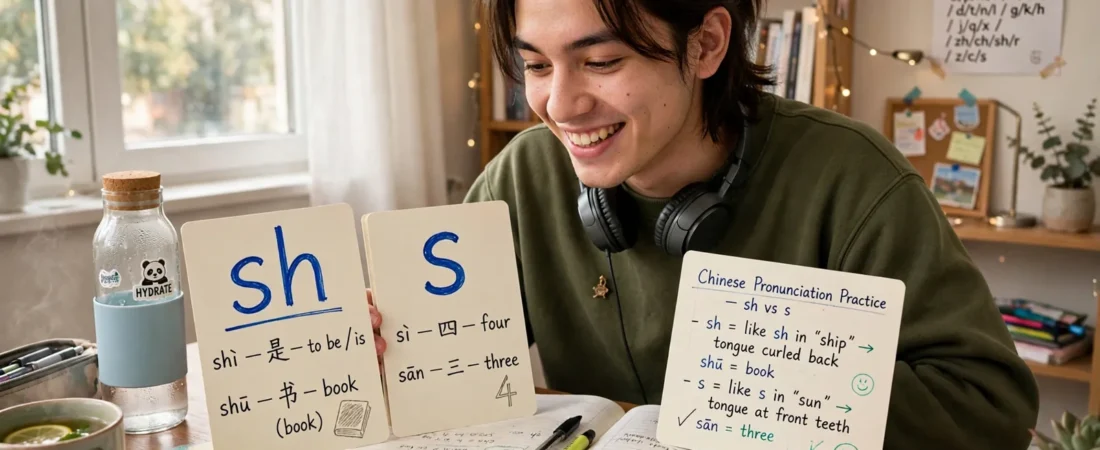
Say 十 (shí) when you mean ten, and your teacher smiles. Say it as sì, and you just said “four.” Say 山 (shān, mountain) as sān, and you said “three.” One small sound, one completely different word — and this is the sound pair that trips up almost every beginner in Chinese. The difference between sh and s in Chinese is small, but it changes meaning, and once you can hear it, you can say it. This quick guide shows you exactly where your tongue goes, gives you word pairs to practice with audio, and ends with five short exercises you can do in ten minutes.
Here is the good news first: you already know both sounds. English has “sh” in “ship” and “s” in “sip.” Chinese sh is a little further back in the mouth, and Chinese s is a little sharper, but the feeling is close. You are not learning a new sound from zero. You are learning to aim two sounds you already have at two different targets — and to hear which one someone else just used.
## What your mouth actually does: sh vs s
Put your hand in front of your mouth and say the English word “ship.” Feel the soft, wide air? Now say “sip.” The air is thinner, sharper, and your tongue is closer to your teeth. Chinese works the same way, with one difference: for Chinese sh, pull the tip of your tongue a little further back, away from your teeth, and round your lips just slightly. For Chinese s, keep the tip of your tongue right behind your upper front teeth, almost touching them.
Try it now, out loud. Say shān (mountain), then sān (three), back and forth: shān, sān, shān, sān. For shān, your tongue pulls back and the sound feels warm and wide. For sān, your tongue stays forward and the sound feels thin and sharp, like a hiss. That contrast is the whole skill. If you can feel it in your own mouth, you can hear it in someone else’s voice.
One common mistake: making Chinese sh sound like the English “sh” in “shoe” with the tongue too far forward. It still works — people will understand you — but it can blur into s. The trick is to think “tongue back” every time you see sh in pinyin. The other common mistake is the opposite: pushing s too far back until it sounds like sh. If your s starts sounding like sh, bring your tongue forward until you can almost feel your front teeth. Slow is fine. Clear beats fast every time.

## 8 word pairs that teach your ear the difference
This table is the heart of the post. Each row puts a sh word next to an s word, and the first four rows are true minimal pairs — the same sounds except for sh vs s — where the meanings are completely different. Read the Chinese, say the pinyin slowly, and notice how the meaning jumps. Then listen to the audio and repeat each pair right after the speaker.
| sh word | Pinyin | Meaning | s word | Pinyin | Meaning |
|—|—|—|—|—|—|
| 书 | shū | book | 苏 | sū | revive / surname Su |
| 山 | shān | mountain | 三 | sān | three |
| 十 | shí | ten | 四 | sì | four |
| 深 | shēn | deep | 森 | sēn | forest |
| 时间 | shíjiān | time | 四个 | sì gè | four (things) |
| 上海 | Shànghǎi | Shanghai | 三个 | sān gè | three (things) |
| 生日 | shēngrì | birthday | 速度 | sùdù | speed |
| 水饺 | shuǐjiǎo | dumplings | 三明治 | sānmíngzhì | sandwich |
Listen to the pairs first, slowly, before you try them yourself.
请听,请跟我读。书,苏,山,三,十,四,深,森,时间,四个。
(Qǐng tīng, qǐng gēn wǒ dú. Shū, sū, shān, sān, shí, sì, shēn, sēn, shíjiān, sì gè.)
Listen, and repeat after me. Book, Su, mountain, three, ten, four, deep, forest, time, four things.
The pair that matters most is 十 (shí, ten) vs 四 (sì, four). You will say both words constantly — telling the time, counting, giving your phone number — and mixing them up confuses everyone. Practice just this one pair ten times a day for a week: shí, sì, shí, sì. The second pair worth extra practice is 山 (shān, mountain) vs 三 (sān, three), because both appear in place names and numbers all the time. The rest will follow once your ear locks onto these two.
A tip from teachers: practice pairs, never single words alone. Your brain learns contrast, not isolated sounds. Saying shū ten times in a row teaches you little. Saying shū, sū, shū, sū teaches your tongue the two positions and your ear the two sounds in the same minute.
## Hear it in real sentences: the sh set
Single words are the warm-up. Real Chinese comes in sentences, and that is where your ear has to work at full speed. Listen to these five sentences. Every one of them is built around sh words — Shanghai, book, ten o’clock, mountain, birthday, dumplings — and your job is to catch the sh sounds as they fly past.
上海很大。书在桌子上。我十点上山。今天是我的生日。我喜欢吃水饺。
(Shànghǎi hěn dà. Shū zài zhuōzi shàng. Wǒ shí diǎn shàng shān. Jīntiān shì wǒ de shēngrì. Wǒ xǐhuan chī shuǐjiǎo.)
Shanghai is very big. The book is on the table. I go up the mountain at ten o’clock. Today is my birthday. I like eating dumplings.
Did you catch all of them? Shànghǎi, shū, shàng, shí, shān, shì, shēngrì, shuǐjiǎo — eight sh sounds in five short sentences. That is how often this sound appears. Say the sentences yourself now, slowly, and exaggerate the sh a little. Exaggerating is not a bad habit at this stage; it trains your tongue to find the back position, and you can relax it later once the habit is set.
If a sentence feels hard, break it into pieces. “我十点上山” (wǒ shí diǎn shàng shān, I go up the mountain at ten o’clock) is three pieces: 我 (wǒ, I), 十点 (shí diǎn, ten o’clock), 上山 (shàng shān, go up the mountain). Say each piece three times, then join them. Nobody learns a sentence by swallowing it whole.
## Hear it in real sentences: the s set
Now the other side. These five sentences are built only around s sounds — three, Su, speed, four, sandwich — with no sh syllable hiding anywhere. Listen first, then repeat.
三个人在公园里。我的同学姓苏。速度很快。四个朋友去买东西。我想吃三明治。
(Sān gè rén zài gōngyuán lǐ. Wǒ de tóngxué xìng Sū. Sùdù hěn kuài. Sì gè péngyou qù mǎi dōngxi. Wǒ xiǎng chī sānmíngzhì.)
Three people are in the park. My classmate’s surname is Su. The speed is very fast. Four friends go shopping. I want to eat a sandwich.
Notice how different these sentences feel in your mouth from the sh set. Your tongue stays forward, close to your teeth, the whole time. If you catch yourself pulling your tongue back on 三 (sān) or 四 (sì), slow down and say the word alone first, then put it back in the sentence. Speed comes later. Right now, the goal is one thing: every s stays an s.
A fun check: say “三个人” (sān gè rén, three people) and then “山” (shān, mountain) right after it. Can you feel your tongue jump from the front of your mouth to the back? That jump is the skill. Once you can feel it, you can control it.
## Mixed practice: can you tell them apart now?
Time to put the two sets together. These four sentences mix sh and s sounds the way real conversation does. Listen once without looking at the text and see how many words you can catch. Then listen again while reading.
他是我的老师。他三点去商店。书和水都在桌子上。十个学生,四个老师。
(Tā shì wǒ de lǎoshī. Tā sān diǎn qù shāngdiàn. Shū hé shuǐ dōu zài zhuōzi shàng. Shí gè xuésheng, sì gè lǎoshī.)
He is my teacher. He goes to the shop at three o’clock. The book and the water are both on the table. Ten students, four teachers.
How did you do? If you caught 老师 (lǎoshī, teacher) and 学生 (xuésheng, student) — both sh words — and 三 (sān) and 四 (sì) — both s words — in the same sentence, your ear is already working. If you missed a few, that is normal. Go back to the pairs table, say shí, sì five times, and listen again. Improvement on this sound is fast; most learners hear the difference clearly within a week of short daily practice.
## 5 short exercises to lock it in
– **Exercise 1 — Pair drill (2 minutes):** Say each pair from the table out loud, five times each: shū, sū — shān, sān — shí, sì — shēn, sēn. Slow, with the tongue positions clear.
– **Exercise 2 — Listen and point (3 minutes):** Play audio clip 1 again. Every time you hear sh, point up. Every time you hear s, point down. Your hand will teach your ear.
– **Exercise 3 — Shadow the sh sentences (3 minutes):** Play audio clip 2 and repeat each sentence immediately after the speaker, like an echo. Do not read the text — just copy the sound.
– **Exercise 4 — Shadow the s sentences (3 minutes):** Same game with audio clip 3. If a sentence trips you, say it alone three times, then rejoin the echo.
– **Exercise 5 — The mixed test (2 minutes):** Play audio clip 4 with your eyes closed. Write down every number word you hear: is it shí (ten) or sì (four), sān (three) or shān (mountain)? Check your answers against the text. Getting all four right means you are ready to move on.
Do these five exercises once a day for a week and the difference will start to feel automatic. Ten minutes a day beats one long weekend session, because your tongue learns by repetition, not by cramming.

## Quick Quiz
Test yourself on sh vs s in Chinese. Click an answer to see if you are right — your score is at the top.
Score: 0/5
1. What does 十 (shí) mean?
2. Which word means “mountain”?
3. Where does your tongue go for the Chinese sh sound?
4. What does 书 (shū) mean?
5. In the mixed practice clip, 他三点去商店 means:
## Your turn: say it out loud today
You now have eight word pairs, four audio clips, and five short exercises. You do not need to master this sound today. You need one thing: to say shí, sì, shí, sì out loud, five times, and feel your tongue move. Do that, and the rest follows. The difference between sh and s is small, but once your ear catches it, it never lets go — and every Chinese word with sh or s gets easier from here.
Want to check your pinyin as you practice? Open the [Pinyin chart on LingoBubbo](https://lingobubbo.com/bang-pinyin/) and listen to each sound on its own — this post teaches you to hear sh vs s, and the chart lets you compare them with every other sound in the language. Keep learning with the [Chinese lessons on LingoBubbo](https://lingobubbo.com/tieng-trung/), where pronunciation like this appears in short dialogues you can practice every day. If this guide helped you, send it to a friend who is learning Chinese — one small sound is the easiest win in the language, and it pays off in every conversation. And tell us in the comments: which pair still tricks your ear, shí vs sì or shān vs sān?