
Say 早 (zǎo, morning) with the wrong tongue and it turns into 找 (zhǎo, to look for). One letter changes the meaning, and your listener hears a different word entirely. That is the whole problem with zh vs z in Chinese: the two sounds look almost the same on paper, feel almost the same in your mouth, and mean completely different things. This guide shows you exactly where your tongue goes for each sound, gives you six minimal pairs to hear the difference, and ends with five short exercises you can finish in ten minutes.
## Why zh vs z in Chinese trips up so many beginners
Most learners meet z and zh in their first week of pinyin and think the job is done. They are not. English has no sound quite like either of them. The closest English sound to z is the “ts” at the end of “cats”, and the closest to zh is the “j” in “jam”, said with the tongue pulled back. Close is not the same, and your ear needs training before the difference becomes obvious.
The second problem is that the two sounds share the same vowels. Almost every syllable you can say with z has a twin with zh: za and zha, ze and zhe, zi and zhi, zu and zhu, zai and zhai, zao and zhao. So the choice is never about the vowel. It is always about the first consonant, and that consonant is decided by one thing only: where your tongue tip sits.
Here is the good news. Once you can feel the two tongue positions, you can hear the difference, and once you can hear it, you can say it. This is a muscle skill, not a memory skill. Ten minutes of the right drill beats a week of staring at a chart. And if you are a Vietnamese speaker, pay extra attention to the section on common mistakes below, because your first language gives you a very specific trap to watch for.
## What your tongue is actually doing: z and zh, step by step
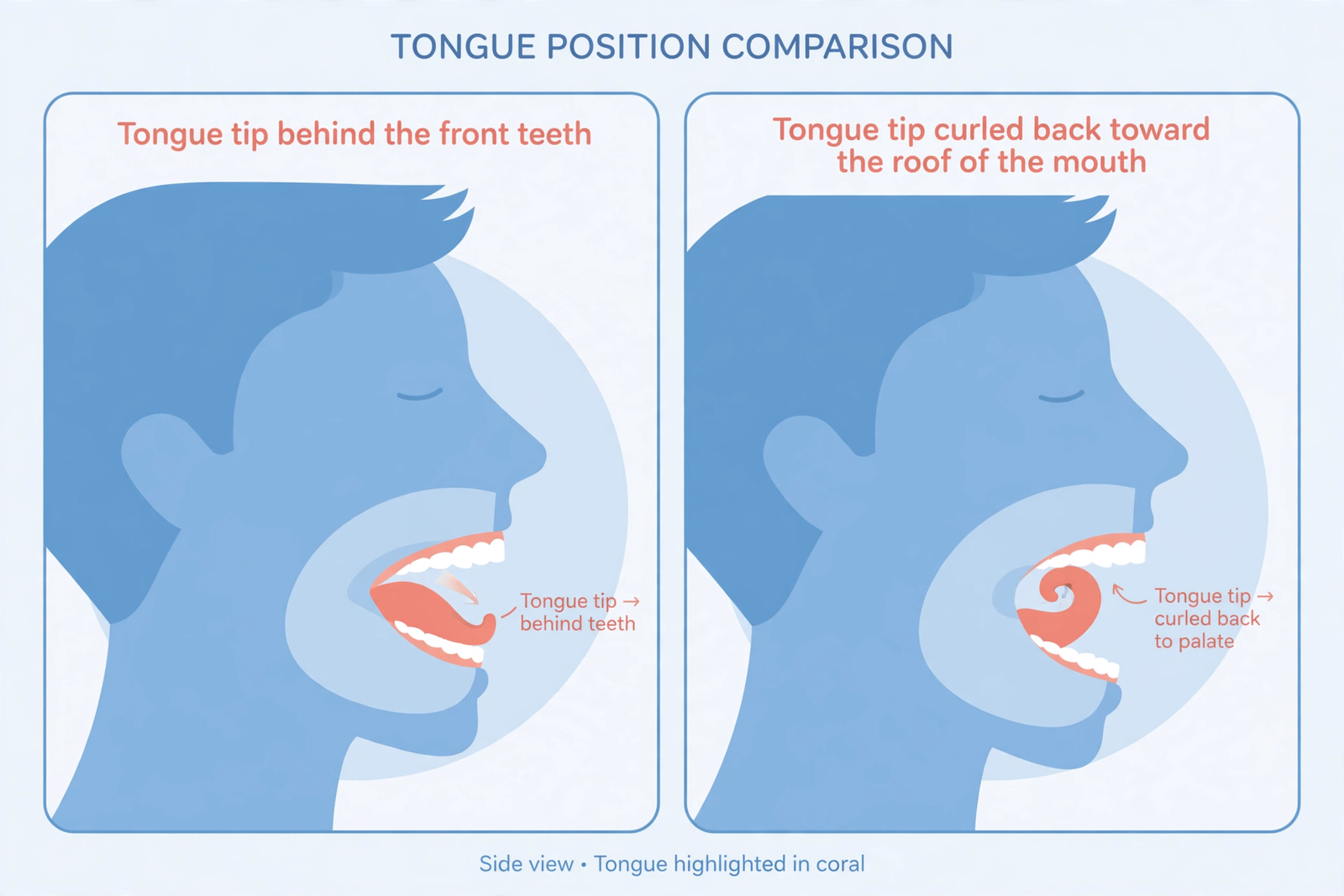
Forget the letters for a minute. Think of your mouth as a room with two doors. For z, the tongue tip knocks on the front door. For zh, it knocks on the ceiling, further back. That is the whole secret.
### The z sound: [ts], tongue tip behind your front teeth
Say the English word “cats” very slowly. Feel the end of it, that sharp “ts”. Now say just that “ts” on its own, at the start of a syllable. That is z.
Technically, z is an unaspirated alveolar affricate, written [ts] in the International Phonetic Alphabet. In plain words: put the tip of your tongue right behind your upper front teeth, press it lightly against the ridge just behind the teeth, then release it with a short burst of air. The sound is crisp and bright, and it sits at the front of your mouth. There is no puff of air like the “ts” in a loud “tsunami”, and no buzzing like an English “z” in “zoo”. Chinese z is short, clean, and dry.
Try it now: zā, zé, zǐ, zù. Keep the tongue tip forward, touching the back of your teeth. If your tongue drifts back even a little, you have already started saying zh.
### The zh sound: [ʈʂ], tongue tip curled back
Now for zh. Lift the tip of your tongue off your teeth and curl it back and up, toward the hard roof of your mouth, the bumpy part behind the ridge. Keep the tip pointing up and back, not touching anything, and push air out over it. The sound that comes out is deeper, heavier, and rounder than z, a little like an English “j” in “jam” said with the tongue pulled back.
Technically, zh is an unaspirated retroflex affricate, written [ʈʂ]. “Retroflex” just means the tongue tip bends back. That bend is what makes the sound darker. Say zhā, zhē, zhǐ, zhù, and notice how the sound seems to come from further inside your mouth than z does. Your lips may round slightly, and that is fine. It is the tongue that does the work.
A quick check you can do with your hand: say z, then zh, with your palm an inch from your lips. For both sounds you should feel only a small puff of air, because both are unaspirated. If you feel a big blast, you have drifted into c (the aspirated partner of z) or ch (the aspirated partner of zh). Those two are a later lesson. For today, keep the air small and let the tongue do the talking.
## The minimal pairs that prove the difference matters
A minimal pair is two words that differ in exactly one sound. These six pairs are the heart of this lesson. Read them out loud, slowly, and feel your tongue move between the two positions.
| z word | Pinyin | Meaning | zh word | Pinyin | Meaning |
|—|—|—|—|—|—|
| 早 | zǎo | morning | 找 | zhǎo | to look for |
| 字 | zì | character, written word | 治 | zhì | to cure, to treat |
| 走 | zǒu | to walk | 肘 | zhǒu | elbow |
| 足 | zú | foot | 竹 | zhú | bamboo |
| 再 | zài | again | 寨 | zhài | stockade, a fenced village |
| 责 | zé | responsibility | 折 | zhé | to break, to snap |
Look at the first pair. 早上好 (zǎoshang hǎo) means “good morning”. If you say it with zh instead of z, your listener hears 找上好, which is not a phrase at all, and they will pause, confused, trying to work out what you meant. Same story with 走路 (zǒu lù, to walk) and 肘 (zhǒu, elbow). One sound, two words, no overlap.
Notice something else: every pair above shares the same tone. zǎo and zhǎo are both third tone. zì and zhì are both fourth tone. The tone is identical, so the tone cannot save you. Only the consonant tells the listener which word you said. That is why this pair of sounds deserves its own lesson.
## Z words to learn first
Start with the z side. These six words are common, useful, and worth saying correctly from day one. Listen to the audio, then repeat each word right after the speaker.
| Chinese | Pinyin | English meaning |
|—|—|—|
| 早 | zǎo | morning, early |
| 字 | zì | character, written word |
| 走 | zǒu | to walk |
| 足 | zú | foot |
| 再 | zài | again |
| 责 | zé | responsibility |
| 自己 | zìjǐ | oneself |
| 早上好 | zǎoshang hǎo | good morning |
| 走路 | zǒu lù | to walk, to go on foot |
| 这是一个字 | zhè shì yí gè zì | This is a character |
A few of these words are already in your first lessons. 早, 走, 再, 字, and 自己 all appear in the first two levels of the HSK 2.0 syllabus, the six-level system most textbooks still follow. (HSK 3.0, the newer nine-level system, rearranges the levels, but the words themselves are the same.) So getting z right now pays off in every lesson that follows. When you say 早上好 to your teacher tomorrow, say it with the tongue tip forward, behind your teeth, and the greeting will land exactly as you meant it.
## Zh words to learn first
Now the zh side. Same drill: listen first, then repeat. Feel the tongue tip lift and curl back before each word.
| Chinese | Pinyin | English meaning |
|—|—|—|
| 找 | zhǎo | to look for |
| 治 | zhì | to cure, to treat |
| 肘 | zhǒu | elbow |
| 竹 | zhú | bamboo |
| 寨 | zhài | stockade, a fenced village |
| 折 | zhé | to break, to snap |
| 找朋友 | zhǎo péngyou | to look for a friend |
| 竹子 | zhúzi | bamboo |
| 医生治病 | yīshēng zhì bìng | The doctor treats an illness |
The last row is a real sentence, and it is worth saying out loud three times. 医生 (yīshēng, doctor) plus 治病 (zhì bìng, to treat an illness) gives you two zh sounds in one natural sentence. If you can say that sentence cleanly, your zh is in good shape.
## Listen and repeat: hear the contrast side by side
This is the most important audio clip in the whole post. It plays each pair back to back, z first, then zh. Listen to the whole clip once with your eyes closed. Then play it again and repeat each pair out loud, right after the speaker.
早,找。字,治。走,肘。足,竹。再,寨。责,折。
(Zǎo, zhǎo. Zì, zhì. Zǒu, zhǒu. Zú, zhú. Zài, zhài. Zé, zhé.)
Can you hear it now? The z member of each pair sounds brighter and sharper, right at the front of the mouth. The zh member sounds deeper and rounder, further back. If the two still sound the same to you, do not worry. That is normal on day one. Play the clip five times, and each time, watch your own tongue in a mirror while you copy the speaker. Your ear catches up faster than you expect, usually within a few days of short daily practice.
## The mistakes almost every learner makes
**Merging both sounds into one.** This is the number one mistake, and Vietnamese speakers are especially prone to it. Both sounds collapse toward something like Vietnamese “ch” or “tr”, so zǎo and zhǎo come out identical, and the listener has to guess from context. The fix is the tongue drill in the next section, not more vocabulary. Your tongue needs a new habit, and habits are built by repetition, not by reading.
**Saying zh with the tongue too far forward.** Many learners curl the tongue only halfway, so zh lands somewhere between z and zh, and native speakers hear a blurry sound they cannot place. Exaggerate at first. Curl the tip further back than feels natural. It will feel silly, and it will sound right.
**Saying z like an English “z”.** English “z” in “zoo” buzzes, because your vocal cords vibrate through the whole sound. Chinese z has no buzz. It is a short, dry “ts”. If your z sounds like a bee, switch it to the “ts” in “cats” and you are there.
**Forgetting the tone.** Remember, every pair in the table above shares the same tone. So a perfect consonant with the wrong tone still gives you the wrong word. Say zǎo with a falling fourth tone and you have said 造 (zào, to make). Keep the tone and the consonant together as one package.
**Practising silently.** You cannot learn a sound by reading about it. If you have read this far without saying a single word out loud, stop now and say the six pairs. Your mouth needs the workout, not your eyes.
## A tongue drill you can do in two minutes
You need no equipment, just a mirror and two minutes. Do this once a day for a week.
First, say “ts, ts, ts” ten times, tongue tip behind your teeth. That is your z anchor. Then say “juh, juh, juh” ten times with the tongue tip curled back and up. That is your zh anchor, close enough to train the muscle.
Next, alternate: “ts, juh, ts, juh”, ten times, speeding up a little each round. Feel the tongue tip travel forward and back. That travel is the whole difference between the two sounds, and once your tongue knows the route, your mouth will find it without thinking.
Finally, run the six pairs from the table: zǎo, zhǎo; zì, zhì; zǒu, zhǒu; zú, zhú; zài, zhài; zé, zhé. Say each pair three times. When you can do all six pairs cleanly, without pausing to think about your tongue, the drill has done its job.
## 5 short exercises to lock it in
Work through these in order. They take about ten minutes together, and they are the difference between knowing the rule and owning the sound.
**Exercise 1: Listen and repeat.** Play the contrast clip above three times. Repeat each pair out loud right after the speaker, and record yourself on your phone on the third round. Play your recording back. Can you hear the difference in your own voice? If not, play the clip once more and copy it again.
**Exercise 2: Match the meaning.** Cover the pinyin column in the minimal pairs table with your hand. Look at each character and say it out loud, then check the pinyin. Do all six, then do them backwards, from zh to z. If you miss one, say that pair five times before moving on.
**Exercise 3: Say the practice sentences.** These four sentences use both sounds in real context. Listen to the audio first, then read each sentence out loud three times.
早上,我去找朋友。(Zǎoshang, wǒ qù zhǎo péngyou. In the morning, I go to look for my friend.)
他自己走路回家。(Tā zìjǐ zǒu lù huí jiā. He walks home by himself.)
竹子长得很高。(Zhúzi zhǎng de hěn gāo. Bamboo grows very tall.)
我再看一遍。(Wǒ zài kàn yí biàn. I will look at it one more time.)
Check your tones as you go: 早上 (zǎoshang) is third tone plus light tone, 找 (zhǎo) is third tone, 走路 (zǒu lù) is third plus fourth. Say the sentence slowly first, then at normal speed.
**Exercise 4: Fill in the missing sound.** Read each word and decide whether it starts with z or zh. Answers are at the end of this section.
1. ___ǎo shang hǎo (good morning)
2. Wǒ ___ǎo péngyou. (I look for a friend.)
3. ___úzi hěn gāo. (Bamboo grows tall.)
4. Tā ___ìjǐ ___ǒu lù. (He walks by himself.)
5. Yīshēng ___ì bìng. (The doctor treats an illness.)
Answers: 1. z (早上), 2. zh (找), 3. zh (竹子), 4. z, z (自己走路), 5. zh (治). If you got all five, your ear is already working. If you missed one, go back to the contrast clip and listen to that pair again.
**Exercise 5: Teach it to someone.** Explain the tongue positions to a friend, a classmate, or a family member, and get them to say zǎo and zhǎo. Teaching forces your own mouth to demonstrate the difference, and that is the fastest way to make the sound automatic. If nobody is around, teach your phone camera. It still works.

## Quick Quiz
Test yourself on zh vs z in Chinese. Click an answer to see if you are right, and your score is at the top.
Score: 0/5
1. Which sound is made with the tongue tip curled back toward the roof of the mouth?
2. What does 早 (zǎo) mean?
3. Which word means “bamboo”?
4. Which pinyin spells the word for “to walk”?
5. What is the main difference between z and zh?
## FAQ
**Is zh pronounced like the English “j”?**
Close, but not the same. English “j” in “jam” uses the middle of the tongue against the hard palate. Chinese zh curls the tongue tip back instead, which gives a deeper, rounder sound. Think of it as a “j” said with the tongue pulled back, and you will be close enough for a native speaker to understand you.
**Why do I keep mixing up z and zh?**
Because your first language probably has one sound where Chinese has two, so your ear has never needed to split them. Vietnamese speakers often collapse both toward “ch” or “tr”. The fix is physical: practise the tongue drill every day, and listen to the contrast clip with your eyes closed until the two sounds feel different.
**Which one should I learn first, z or zh?**
Learn z first. It sits at the front of the mouth, it is easier to feel, and once your tongue knows where “forward” is, “further back” makes sense. Most learners get a clean z within a day and a clean zh within a week.
**Do native speakers really notice if I mix them up?**
Yes, because the two sounds change the word. Saying zhǎo when you mean zǎo turns “morning” into “to look for”, and your listener has to stop and guess. They will usually work it out from context, but it costs them effort, and in a fast conversation that effort adds up.
**How long until zh vs z feels natural?**
For most beginners, about one to two weeks of short daily practice, two minutes a day with the tongue drill and the contrast clip. The pairs in this post, especially zǎo and zhǎo, are worth repeating every day until the switch feels automatic.
**Where can I check the full pinyin chart?**
Use the [Pinyin chart on LingoBubbo](https://lingobubbo.com/bang-pinyin/) to see every initial and final together, and find the z and zh rows to compare them with the other initials. It is the fastest way to see how the whole system fits together.
## Your turn: say it out loud today
You now know where your tongue goes for each sound, you have six pairs that prove the difference matters, and you have a two-minute drill plus five exercises to make it stick. The next step is small: say 早上好 out loud, with the tongue tip forward, and then say 我去找朋友 with the tongue curled back. Two sentences, two tongue positions, and you have already done the hard part.
Keep going with the [Chinese lessons on LingoBubbo](https://lingobubbo.com/tieng-trung/), where pronunciation like this appears in short dialogues you can practise every day, and use the [Pinyin chart](https://lingobubbo.com/bang-pinyin/) whenever you meet a new initial and want to hear how it fits the system. If this guide helped you hear the difference, send it to a friend who is learning Chinese too, because zh vs z is the pair almost every beginner gets wrong, and a two-minute drill is the easiest fix in the language. And tell us in the comments: which pair still trips you up, zǎo and zhǎo, or a different one?