
You learned 20 new words on Monday. By Friday, you can remember three, and one is the word for “hello”. The problem is not your memory. It is the way you review. Staring at a list is not reviewing; it is waiting to forget. Here is how to review vocabulary so the words stick — seven methods to mix and match.
Why the old way of reviewing fails
Most of us review the same way: read the list twice, close the book. But recognition is not recall. Seeing 谢谢 (xièxie, “thank you”) on a page is not the same as producing it when you want to thank someone. Memory fades fast at first, then more slowly — and each time you pull a word back, it sticks longer. Good review asks your brain to do something: remember, say, write, use.
Seven ways to review vocabulary — at a glance
| Method | Time needed | Best for |
|---|---|---|
| 1. Spaced repetition | 5 min a day | New words that fade |
| 2. Sentence-writing | 10 min | Words you can’t use |
| 3. Teaching it back | 5 min | Finding your gaps |
| 4. Labelling the house | 2 min setup | Everyday nouns |
| 5. Audio shadowing | 5–10 min | Pronunciation |
| 6. Word-of-the-day chain | 3 min a day | Linking words |
| 7. Weekly test-yourself quiz | 10 min a week | Checking what stuck |
How to review vocabulary: the 7 methods, one by one
1. Spaced repetition: meet the word again in time
Review each word just before you’d forget it. New words come back tomorrow, then after a few days, then after a week. A flashcard app does the scheduling, or use a paper box: right answers go back, misses stay in front. Short and often — ten minutes a day — beats one long session.
Listen: review before you forget it
2. Sentence-writing: give every word a real life
A word on its own is easy to forget. Put it in a sentence about your day and it sticks. Learning 窗户 (chuānghù, “window”)? Write: “I opened the window this morning because it was hot.” One sentence per word, five words a day.
Listen: one sentence about your day
3. Teach it back: explain it to someone else
If you can explain a word to another person, you know it. Pick three words and teach them to a friend, your child, or even the cat: what it means, one sentence with it. Saying it out loud shows you the gaps at once.
Listen: teach the word back
4. Label the house: let your home do the reminding
Write words on sticky notes and put them on the things they name. The mirror gets 镜子 (jìngzi). The door gets 门 (mén). The lamp gets 灯 (dēng). Every time you walk past, you read it without trying. Once you can say it without looking, move the note to something new.

5. Audio shadowing: say it while you hear it
Some words live in your eyes but never reach your mouth. Play one short sentence from a native speaker and repeat it at the same time, matching the rhythm. Three times, then try it alone. It works while you cook or wait for the bus.
6. Word-of-the-day chain: link today to yesterday
Each day, learn one new word and connect it to yesterday’s word in one sentence. Yesterday: “rain”. Today: “umbrella”. Your sentence: “I took my umbrella because of the rain.” After a week you have a silly seven-word story.
7. Weekly test-yourself quiz: ten honest minutes
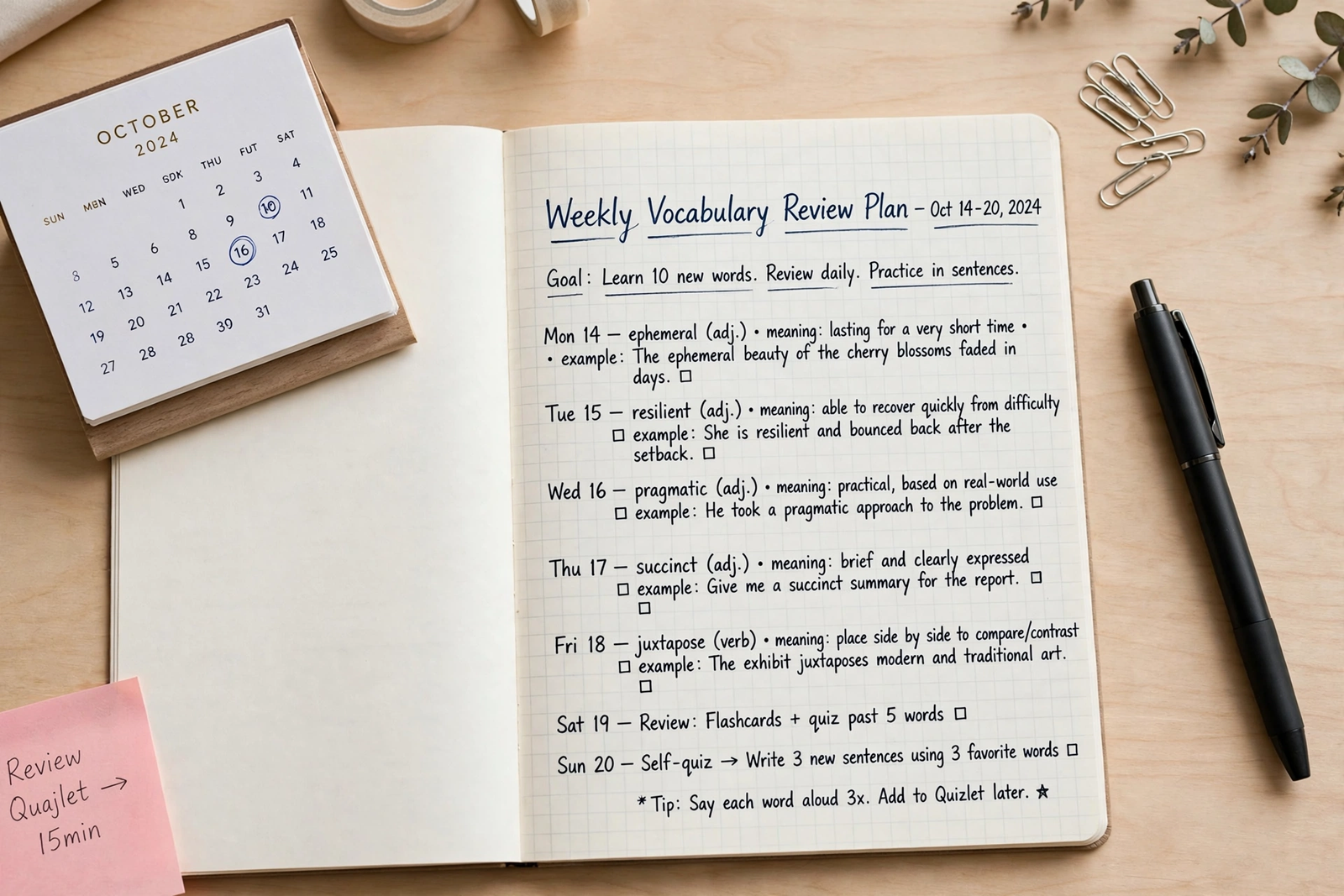
Once a week, test yourself. Cover the answers and say or write what each word means before you peek — no peeking early, that is the whole point. Write down your score: 12 out of 15, say. The words you missed go back into the spaced-repetition pile.
Listen: ten minutes a day
Three mistakes that waste your review time
1. Reviewing only the newest words. New words feel urgent, but last week’s words are quietly slipping away. Mix older words into every review.
2. Reviewing with your eyes only. Reading a list only trains recognition. Say the word, write it, or use it in a sentence.
3. Cramming the night before a test. A late-night marathon can carry you through tomorrow’s quiz, but the words will be gone by next week.
Your weekly vocabulary checklist
Stick this on the fridge:
☐ Flashcards five minutes, five days this week
☐ One sentence for each of five new words
☐ Taught three words back to someone
☐ Three sticky-note labels up or moved
☐ Shadowed one audio sentence three times
☐ One word a day added to the chain
☐ Saturday quiz, score written down
Quick answers about reviewing vocabulary
How many words should I review each day?
Five to ten new words a day is plenty, plus a quick pass over older words. Fewer words, reviewed properly, beat a long list.
How often should I review a new word?
Soon after you first meet it, then the next day, then after a few days, then a week later. Still remember it after a week? Let it rest longer. Forgot it? Bring it back to the front — forgetting is normal, and catching it early is the trick.
Is it better to review alone or with someone?
Both. Alone is best for the daily routine. With someone is best for testing yourself honestly — a partner will not let you peek, and teaching a word shows instantly whether you really know it.
Start tonight: pick five words from this week and try one method. When you are ready to learn new words worth reviewing, explore our lessons at LingoBubbo — and if Chinese is your language, the Chinese programme gives you fresh words every day, ready to review with these methods.
Quick quiz: how well do you review vocabulary?
Tap an answer and see right away if you have got it.
Question 1. What is the main idea of spaced repetition?
Question 2. Which method helps most when you recognise a word but cannot use it?
Question 3. What should you do with a sticky-note label once you know the word without looking?
Question 4. How long should a daily review session be?
Question 5. What makes a weekly self-test useful?