
Ask any Spanish learner what trips them up most, and sooner or later you will hear the same two words: ser and estar. Both mean “to be.” Both are everywhere. And picking the wrong one can turn “I am bored” into “I am a boring person.” That is the whole problem with ser vs estar — and the good news is that one simple question sorts out almost every case.
Here is the question: is this how something is, or how something is right now? A lasting trait takes ser. A temporary state or a location takes estar. That is the heart of it — everything below is that idea, worked out with real examples.
Ser vs estar: the one-question test
Try it: Soy alta. I am tall. Height is not changing tomorrow, so it is ser. Estoy cansada. I am tired. Tiredness passes after a nap, so it is estar. Es de Madrid. He is from Madrid. Where you are from does not change, so it is ser. Está en casa. She is at home. She could be somewhere else in an hour, so it is estar.
Teachers often shorten this to “ser = permanent, estar = temporary,” and that gets you most of the way. But “permanent” is a little too strong. A better pair of words is identity and condition. Ser tells you what something is. Estar tells you how something is doing, or where it is.
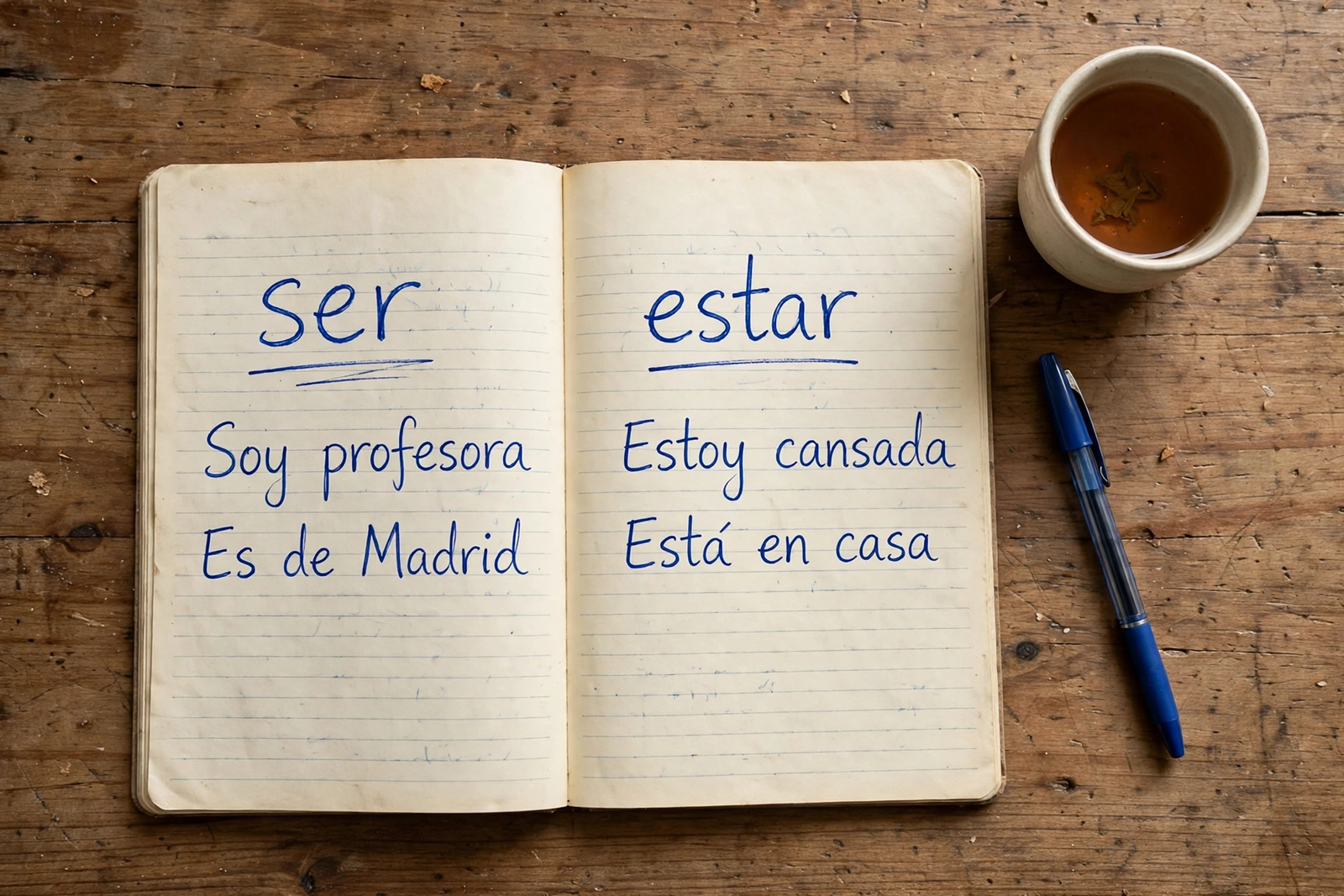
When to use ser
Reach for ser in these situations, and you will be right nearly every time:
| Use ser for… | Example | Meaning |
|---|---|---|
| Who someone is — job, identity | Soy profesora. | I am a teacher. |
| What something is like — character, traits | Es muy amable. | She is very kind. |
| Where someone is from, nationality | Somos de México. | We are from Mexico. |
| What something is made of, or its colour | La mesa es de madera. | The table is made of wood. |
| Time, dates and events | Son las tres. | It is three o’clock. |
| Where an event takes place | La fiesta es en mi casa. | The party is at my house. |
Notice the last two rows. Time is always ser: son las tres, es lunes. And an event’s location is ser too — the party is at my house — even though a person’s location is estar. An event is something that happens somewhere, and that counts as part of what the event is.
When to use estar
Now the other side. Estar covers feelings, conditions, and locations:
| Use estar for… | Example | Meaning |
|---|---|---|
| How someone feels | Estoy contento. | I am happy (right now). |
| Physical condition or health | Está enfermo. | He is ill. |
| Where a person or thing is | El libro está en la mesa. | The book is on the table. |
| Ongoing actions (with -ando / -iendo) | Estoy estudiando. | I am studying (right now). |
Location is the most common everyday use. ¿Dónde estás? — where are you? — always takes estar, because where you are changes all day long. If it can move, it is probably estar.
The adjectives that change their meaning
Here is where ser vs estar gets genuinely interesting. Some adjectives mean one thing with ser and something quite different with estar. These pairs are worth learning as a set, because native speakers use them constantly:
Es aburrido means he is a boring person. Está aburrido means he is bored right now. Same word, very different insult. Es listo means he is clever. Está listo means he is ready. Es malo means he is a bad person; está malo means he is unwell. Es rica means she is rich; está rica usually means the food is delicious.
The pattern holds every time: ser + adjective describes a person’s nature, estar + adjective describes their current state.
The exceptions worth knowing
A few uses break the simple rule. Estar muerto — to be dead — uses estar even though death is about as permanent as it gets; Spanish treats it as a state. Similarly, estar casado (to be married) uses estar, even though marriage is meant to last — Spanish sees marriage as a state you are in, not a trait you are born with.
On the other side, some things that look temporary still take ser. Es joven — he is young — is ser, even though youth does not last. Age is treated as part of who someone is at this point in their life. And ser is used for prices: ¿Cuánto es? (how much is it?).

How to practise so it sticks
Rules alone will not fix this — your mouth needs the habit. Try this for a week. First, describe three people you know using only ser: their jobs, their personalities, where they are from. Then describe how those same three people are doing today using only estar: tired, happy, busy, at home, at work. Say it out loud — hearing yourself switch verbs back and forth builds the instinct.
Second, keep a one-line diary in Spanish each evening. “Hoy estoy cansada, pero soy feliz” — today I am tired, but I am a happy person. One sentence a day, mixing both verbs, does more than an hour of grammar drills on a Sunday.
Quick Quiz
Test yourself on ser vs estar. Click an answer to see if you are right — your score is at the top.
Score: 0/5
1. Why does Estoy cansada (I am tired) use estar?
2. Which verb is used for telling the time, as in Son las tres?
3. What does Está listo mean?
4. Which verb is used for where an event takes place, as in La fiesta es en mi casa?
5. Which phrase uses estar even though it sounds permanent?
Quick answers
Is there a simple trick to remember ser vs estar?
Ask: is this identity or condition? Identity — who or what something is — takes ser. Condition — how it feels, where it is, what it is doing — takes estar. That one question covers most everyday sentences.
Why do some adjectives change meaning with ser and estar?
Because the verb changes what the adjective describes: with ser it is a person’s nature (aburrido = boring), with estar it is their current state (aburrido = bored). Learn the common pairs as a set.
Which verb do I use for location?
Estar, almost always — for people and things. The one exception is events: a party or a meeting takes ser (la fiesta es en mi casa), because the location is part of what the event is.
Will native speakers understand me if I mix them up?
Almost always, yes — and they will usually smile, not correct you. But getting them right is one of the fastest ways to sound natural.
Ser and estar stop being scary the moment you stop treating them as a list to memorise and start treating them as a question to ask: who is this, or how is it right now? Keep asking it, keep talking, and one day the right verb will simply come out first. If you want guided practice, our Spanish programme builds both verbs into everyday dialogues from the very first lessons.