
You walk into your partner’s family lunch in Madrid. Twelve people are talking at once, someone kisses you on both cheeks, and a smiling woman you have never met before points at you and says, “¡Tú eres el novio de mi hija!” You smile and nod, wondering: who is this woman, and what did she just call me? That is the moment Spanish family words for gatherings stop being a vocabulary list and start being survival skills.
Why family words matter most at the table
At a Spanish family gathering, names are not enough. People introduce each other by relationship, not by first name. “Este es mi cuñado” tells everyone in the room exactly where you belong. If you only know “hola” and “gracias”, you will spend the whole afternoon smiling at strangers and hoping nobody asks you a question.
The good news is that family words are some of the easiest Spanish to learn. They follow clear patterns, they repeat all afternoon, and every person at the table is a living flashcard.
Spanish family words gatherings use first: the inner circle
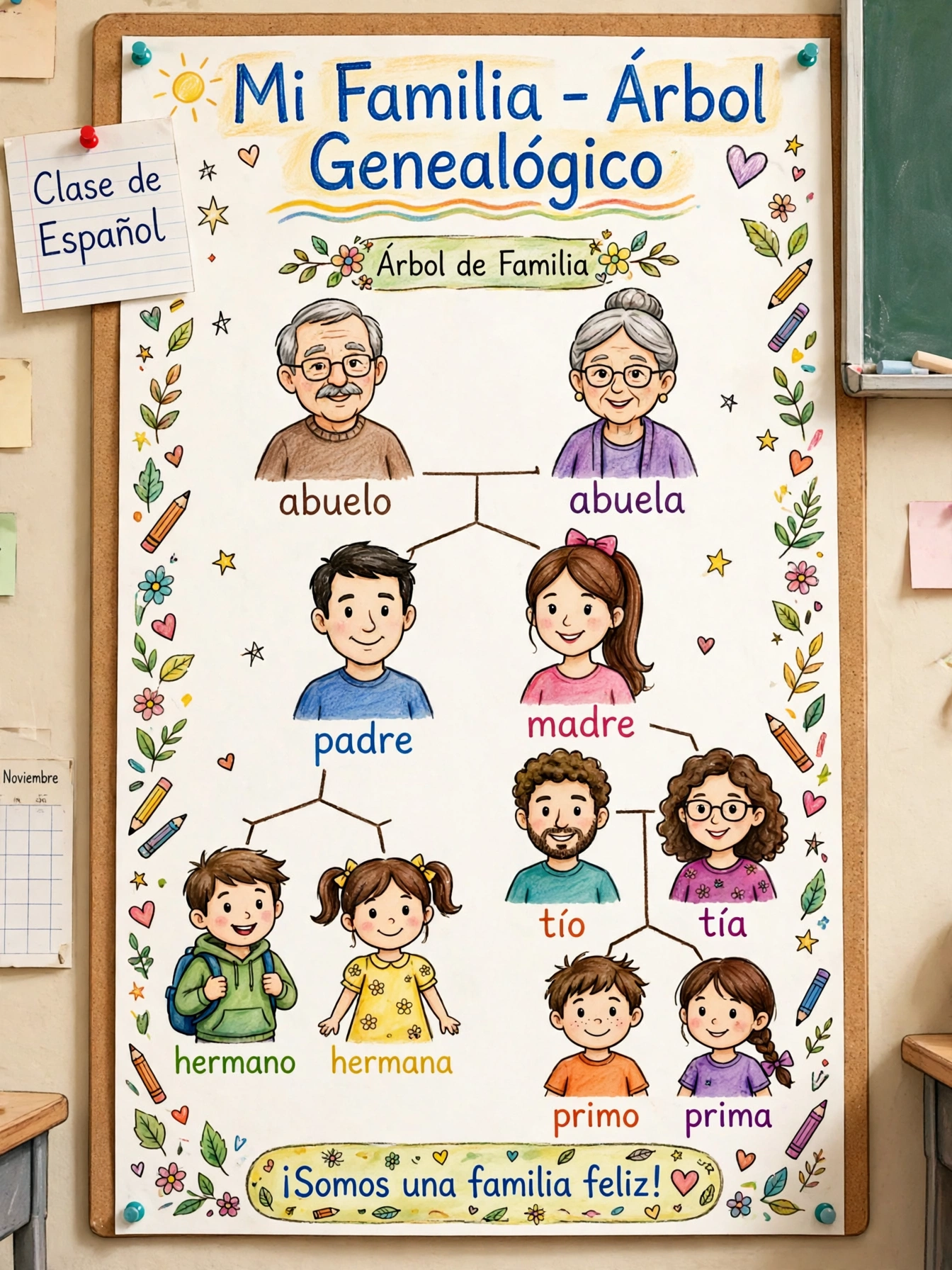
These are the people you will hear named first, usually within the first five minutes of arriving:
| Spanish | Who it is |
|---|---|
| el padre | father |
| la madre | mother |
| los padres | parents |
| el hermano | brother |
| la hermana | sister |
| los hermanos | siblings, brothers and sisters |
| el hijo | son |
| la hija | daughter |
| los hijos | children, sons and daughters |
| el abuelo | grandfather |
| la abuela | grandmother |
| los abuelos | grandparents |
| el nieto | grandson |
| la nieta | granddaughter |
| los nietos | grandchildren |
Watch the pattern: el goes with the men, la with the women, and the plural form covers the whole group. Los abuelos means both grandparents together, just as los hijos means all the children. Say them out loud with the article every time: “el abuelo” sounds like you mean it; “abuelo” on its own sounds unfinished.
Listen: grandma welcomes you — "Hola, soy la abuela. Bienvenidos a mi casa."
The wider family: uncles, cousins and in-laws
Once the inner circle is clear, the table fills up with the wider family. These are the words that trip learners up most, because English hides differences that Spanish makes explicit:
| Spanish | Who it is |
|---|---|
| el tío | uncle |
| la tía | aunt |
| el primo | male cousin |
| la prima | female cousin |
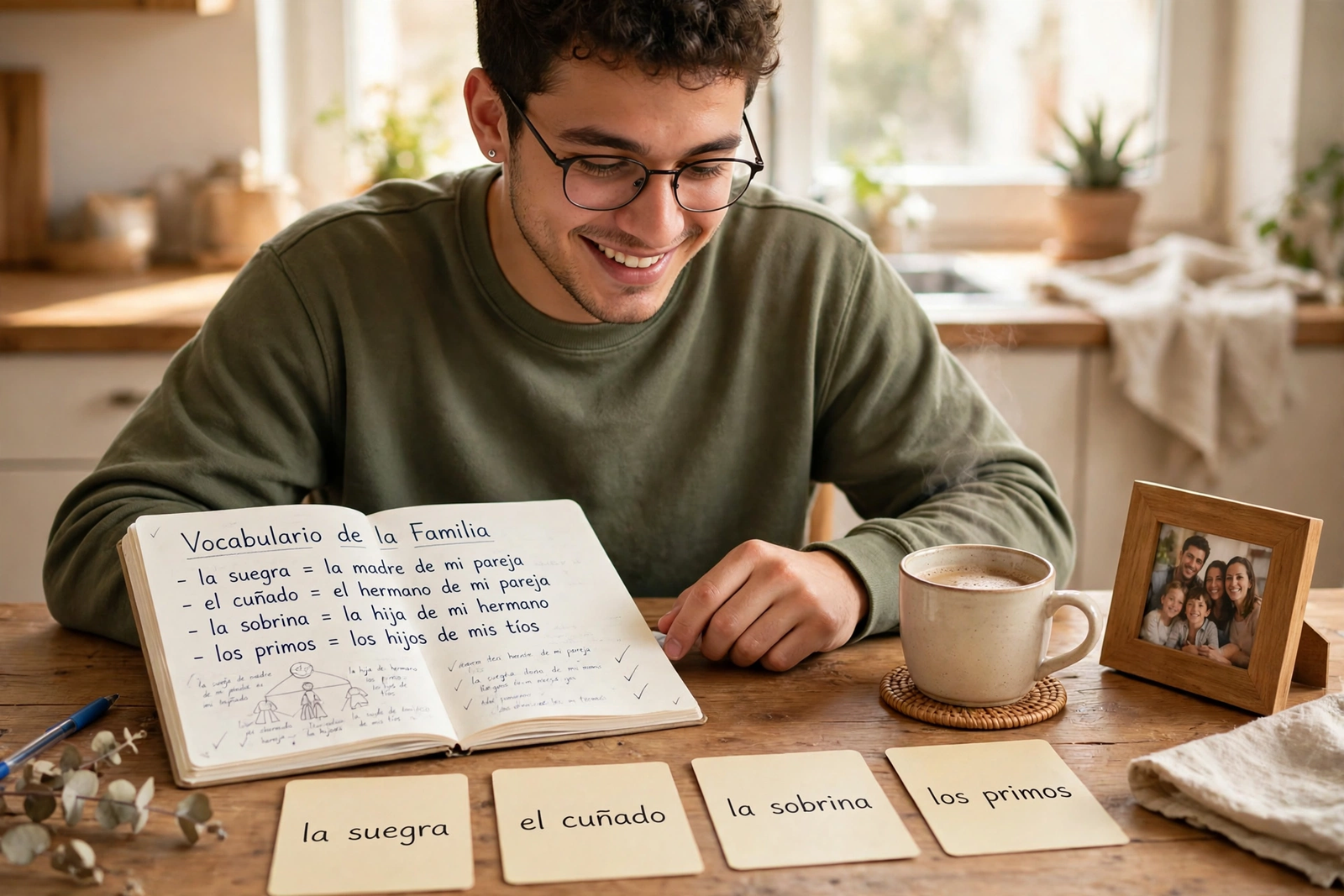
| los primos | cousins |
| el sobrino | nephew |
| la sobrina | niece |
| el suegro | father-in-law |
| la suegra | mother-in-law |
| los suegros | parents-in-law |
| el cuñado | brother-in-law |
| la cuñada | sister-in-law |
| el yerno | son-in-law |
| la nuera | daughter-in-law |
Two of these deserve extra attention. La suegra, the mother-in-law, shows up in a thousand Spanish jokes, so people will laugh kindly if you use the word correctly. And el yerno and la nuera, son-in-law and daughter-in-law, are words many learners never meet until they need them. Learn them now, while nobody is watching.
Listen: "Mi suegra cocina muy bien. Mi cuñado es muy simpático."
Say it at the table: phrases that make you family
Vocabulary gets you understood. Phrases get you invited back. Try these at your next gathering:
¿Cómo estás, abuela? — “How are you, grandma?” Use the first name or the family word, never just the word alone, and people melt.
¿Dónde está mi primo? — “Where is my cousin?” A perfect question for finding the one person your own age at the table.
Mi tío trae el postre. — “My uncle is bringing dessert.” Say it with confidence and watch the room light up.
Esta es mi familia. — “This is my family.” Four words, and suddenly you belong. Try introducing the people around you by name and relationship: “Este es mi abuelo, y ella es mi prima.”
Listen: "¿Dónde está mi primo? ¿Y mi tía? Mi tío trae el postre."
Three mistakes that give learners away
1. Mixing up primo and prima. Spanish marks gender on every family word, and getting it wrong changes who you mean. Mi primo is your male cousin; mi prima is your female cousin. Point at the right person when you practise.
2. Calling everyone tío. In casual speech some families call older friends “tío” as a nickname, but at a first gathering it can confuse everyone. Use tío for a real uncle until someone tells you otherwise.
3. Dropping the article. Saying “suegra cocina bien” instead of “mi suegra cocina muy bien” sounds like a telegram. The possessive mi does the social work: it says this person is yours, part of your family. Use it.
Your 5-minute checklist before the next gathering
Run through this the morning of the lunch:
☐ I can name the inner circle: padre, madre, hermano, hermana, abuelo, abuela
☐ I can name the wider family: tío, tía, primo, prima, sobrino, sobrina
☐ I can say suegra, cuñado, yerno and nuera without hesitating
☐ I can ask “¿Dónde está mi primo?” and “¿Cómo estás, abuela?”
☐ I listened to all four audio clips and repeated each one out loud
☐ I can introduce my family: “Esta es mi familia”
Listen: "Esta es mi familia. Mi abuelo, mi abuela, mis padres y mis primos."
Quick answers about Spanish family words
What is the difference between los primos and las primas?
Los primos means cousins as a mixed group, men and women together, and it is the form you will hear most at a gathering. Las primas means only the female cousins. The same rule works for los hermanos (siblings) and los abuelos (grandparents): the masculine plural covers the whole group.
How do I address my partner’s parents in Spanish?
Call them by their first names unless they invite you to use a family word. If they say “llámame mamá”, go with it and enjoy the moment. Until then, mi suegro and mi suegra are for talking about them, not to them.
Do Spanish families really use all these words at one lunch?
Yes, and usually within the first hour. Big family lunches are the main stage for this vocabulary: introductions, stories about who married whom, and grandparents telling the grandchildren who everyone is. That is exactly why gatherings are the best classroom for these words.
Ready to put these words to work? Our Spanish programme takes you from your first family words to full conversations, one small step at a time. Bring your family tree with you, and we will help you describe every branch of it.
Quick quiz: who’s who at the table?
Tap an answer and see right away if you have got it.
Question 1. What does la suegra mean?
Question 2. What does el cuñado mean?
Question 3. What does los primos mean?
Question 4. What does la sobrina mean?
Question 5. What does el yerno mean?