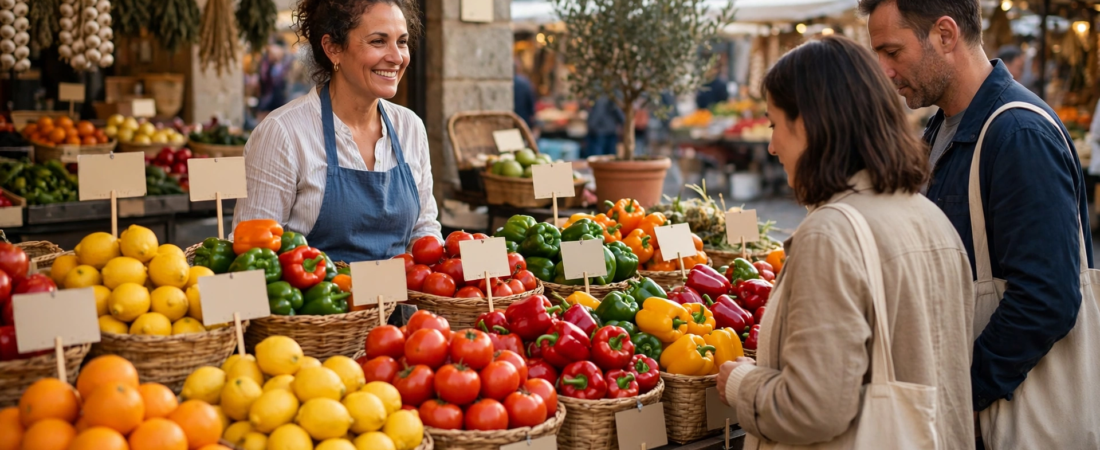
The vendor at the market in Oaxaca holds up two mangoes and says, “Son treinta pesos.” You freeze. Was that thirteen or thirty? Spanish numbers shopping prices: that one sound is the difference between a bargain and a bad day. The good news: shopping needs far fewer numbers than you think, and they follow a pattern you can learn fast.
Markets, shops and stalls all run on the same five moves: ask the price, hear the number, decide, pay, check your change. This guide teaches you the numbers for each move and the traps that catch every beginner at least once.
The numbers you actually need
You do not need to count to a thousand to shop. You need one to twenty, the tens, and three big words.
| Number | Spanish | Sounds like |
|---|---|---|
| 1 | uno | OO-noh |
| 2 | dos | dohs |
| 3 | tres | trehs |
| 4 | cuatro | KWA-troh |
| 5 | cinco | SEEN-koh |
| 6 | seis | SAY-ees |
| 7 | siete | SYEH-tay |
| 8 | ocho | OH-choh |
| 9 | nueve | nweh-vay |
| 10 | diez | dyehs |
| 11 | once | OHN-say |
| 12 | doce | DOH-say |
| 13 | trece | TREH-say |
| 14 | catorce | kah-TOR-say |
| 15 | quince | KEEN-say |
| 16 | dieciséis | dyeh-see-SAY-ees |
| 20 | veinte | VAYN-tay |
| 30 | treinta | TRAYN-tah |
| 40 | cuarenta | kwah-REN-tah |
| 50 | cincuenta | seen-KWEN-tah |
| 60 | sesenta | seh-SEN-tah |
| 70 | setenta | seh-TEN-tah |
| 80 | ochenta | oh-CHEN-tah |
| 90 | noventa | noh-VEN-tah |
| 100 | cien | SYEN |
| 1,000 | mil | meel |
Now the pattern: twenty-one is veintiuno, thirty-five is treinta y cinco, forty-eight is cuarenta y ocho — tens plus y plus ones. Learn the tens, add a small number, and you can say any price under a hundred.
Asking the price
Two questions cover every shop in the Spanish-speaking world.
¿Cuánto cuesta? — “How much does it cost?” For one thing: ¿Cuánto cuesta esta camisa? “How much does this shirt cost?”
¿Cuánto cuestan? — “How much do they cost?” For more than one thing: ¿Cuánto cuestan estas manzanas? “How much do these apples cost?”
The answers follow the same rule. One thing: Cuesta cinco euros. Several things: Cuestan diez euros. And the total is usually Son doce euros. — “That is twelve euros.” If you only remember one price sentence, make it that one.
Prices in Spain are in euros, the small coins céntimos: dos euros con cincuenta is two euros fifty. In Mexico, Argentina and Colombia the currency is the peso — same word, different values.
Listen: asking the price — how much does it cost, and how much do they cost
Hearing the price and counting your change
Hearing a number in a busy market is harder than saying one. Vendors speak fast, and the number comes once. Listen for the ending: -ce usually means a teen, -nta usually means a ten. And repeat the number back as a question — ¿Treinta? — the vendor will nod or correct you.
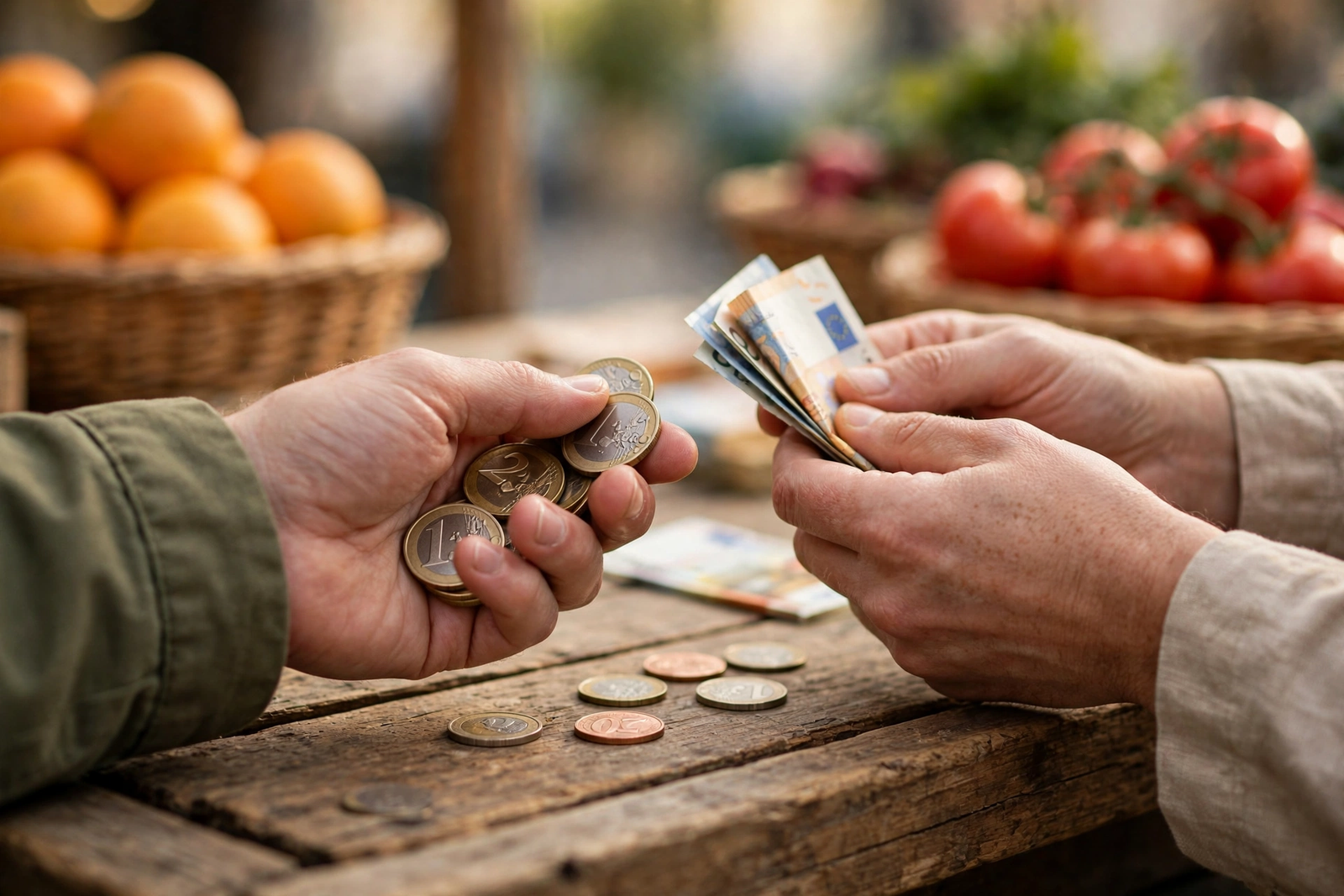
When you pay, the change matters. In Spain it is la vuelta, in Mexico and most of Latin America el cambio. Count it before you walk away. If it is wrong, a smile and Creo que hay un error — “I think there is a mistake” — fixes it.
Cash still rules in markets, so carry small notes and coins — a vendor with a basket of oranges may not have change for a fifty. Ask before you buy: ¿Tiene cambio de cincuenta? — “Do you have change for fifty?”
Bargaining without being rude
In a Madrid department store, the price is the price. In a market in Oaxaca, a friendly haggle is part of the fun. The rule: be warm, be quick, never argue.
☐ ¿Me lo deja en ocho euros? — “Will you let me have it for eight euros?”
☐ Es un poco caro. — “It is a bit expensive.”
☐ ¿Es lo menos? — “Is that the lowest price?”
☐ ¿Me hace un descuento? — “Can you give me a discount?”
☐ Me lo llevo por diez. — “I will take it for ten.”
That last one is the closer. Name your price, smile, and wait. If the vendor shakes their head, meet in the middle or walk away with a Gracias, voy a pensarlo — “Thanks, I will think about it.” Sometimes they call you back.
Listen: bargaining phrases — will you let me have it for eight, it is a bit expensive, can you give me a discount
A tiny market dialogue to steal
Here is a whole purchase in six lines. Learn it and you can buy anything sold by weight.
A: Buenos días. ¿Cuánto cuestan los tomates? “Good morning. How much are the tomatoes?”
B: A dos euros el kilo. “Two euros a kilo.”
A: Me pone un kilo, por favor. “Give me a kilo, please.”
B: Son dos euros. “That is two euros.”
A: Aquí tiene cinco. “Here is five.”
B: Su cambio, tres euros. Gracias. “Your change, three euros. Thank you.”
Two phrases to steal: a dos euros el kilo is how prices by weight are always given, and Me pone… is the market version of ordering — the same verb you use at a bar works at a stall.
Listen: a short market dialogue — tomatoes at two euros a kilo, paying five and getting three back
Three number traps that catch every beginner
| Trap | Why it catches you | The fix |
|---|---|---|
| Trece (13) vs treinta (30) | They share the “tre” sound and rush past in fast speech | Listen for the ending: -ce is a teen, -nta is a ten |
| Cien vs ciento | Cien is exactly 100; ciento only appears inside bigger numbers | 100 is cien; 120 is ciento veinte |
| Un vs uno | Uno shortens to un before a masculine noun | Un kilo, un euro — but alone, always uno |
The thirteen-versus-thirty trap costs real money. Say both out loud five times: trece, treinta, catorce, cuarenta, quince, cincuenta. The teens end in a soft hiss, the tens in a firm “ta”.
Listen: the numbers out loud — ten to fifty, one hundred, one thousand, and the teen-versus-ten pairs
Quick answers about Spanish numbers shopping prices
How do I ask “how much” in Spanish?
Use ¿Cuánto cuesta? for one item, ¿Cuánto cuestan? for several. The total is usually Son… euros or Son… pesos, depending on the country.
Is it okay to bargain in Spanish-speaking countries?
In markets and small stalls, yes — a friendly haggle is expected. In shops and supermarkets the price is fixed. Start with ¿Me lo deja en…? and keep it warm and quick.
What is the difference between “el cambio” and “la vuelta”?
Both mean your change after paying. La vuelta is used in Spain, el cambio in Mexico and most of Latin America.
Numbers are the most practical words in any language — money never stops moving. Learn one to twenty and the tens, practise the price questions out loud tonight, and your next market trip can happen entirely in Spanish. When you are ready, our Spanish programme builds on exactly this speak-first method, one small conversation at a time.
Quick quiz: can you shop in Spanish?
Tap an answer and see right away if you have got it.
Question 1. How do you ask “How much does this shirt cost?”
Question 2. What does “treinta” mean?
Question 3. What is “la vuelta” in Spain?
Question 4. How do you say 120 in Spanish?
Question 5. Which phrase means “Will you let me have it for eight euros?”