
It is 96 degrees outside in Los Angeles. Your passenger climbs in, wiping sweat from their forehead, and you want to ask one simple thing: would you like the air conditioning on? The words are right there in your head, in Vietnamese, but the English version will not come out. So you say nothing. You just turn the AC on and hope they like it. Sound familiar? This guide fixes that. Learning how to ask passengers about the air conditioning in English takes fifteen short phrases, two dialogues, and a little practice — and by the end of this post you will have all three, with audio and a quiz to check yourself.
These phrases are for Uber and Lyft drivers, taxi drivers, shuttle drivers, and anyone who drives passengers for work in the United States. They are short, polite, and natural. Nobody in a car speaks in long textbook sentences, and you do not need to either.
## Why this one question matters so much
Think about your last ten rides. How many of them started with the passenger saying something about the temperature? Probably more than you think. Somebody too hot, somebody too cold, somebody who wants the fan stronger, somebody who wants it off completely. The air conditioning is the first thing a passenger feels in your car, before the music, before the small talk, before anything else. A comfortable passenger is a happy passenger, and a happy passenger is the one who leaves five stars and a tip.
There is a second reason this question matters. It is the easiest English conversation in your whole working day. It is one question, one answer, and maybe one small adjustment. You do not need perfect grammar. You do not need a big vocabulary. You need about five sentences, said slowly and clearly, and you will use them on almost every single ride. If you are building your work English one situation at a time, this is the best place to start: the payoff comes on the very next ride.
And here is something drivers often miss. Passengers notice when you ask. “Would you like the air conditioning on?” tells the passenger you care about their comfort before they even have to ask. That is the difference between a three-star ride and a five-star ride, and it costs you exactly one sentence.
## 15 phrases for the air conditioning
Learn these fifteen first. They cover the whole conversation: asking the question, hearing the answer, adjusting the temperature, and checking back. Say each one out loud as you read it.
| Who says it | What to say |
|—|—|
| Driver | Would you like the air conditioning on? |
| Driver | Is the temperature okay for you? |
| Driver | Would you like it a little cooler? |
| Driver | Would you like it a little warmer? |
| Driver | Is it too cold back there? |
| Driver | Is it too warm for you? |
| Driver | Let me turn the air conditioning up a bit. |
| Driver | I’ll turn the fan up a little. |
| Driver | Let me know if you’d like me to turn it down. |
| Driver | I’ll turn the air conditioning off if you like. |
| Passenger | Yes, please. A little cooler would be great. |
| Passenger | Could you turn it up a bit? |
| Passenger | It’s perfect, thank you. |
| Passenger | Actually, it’s a little too cold. Could you turn it down? |
| Passenger | No, thank you. I’m fine. |
A quick pronunciation note for Vietnamese speakers: in “Would you like the air conditioning on?” the words “would you” blend together in fast speech and sound almost like “wouldja.” Do not worry about that. Say each word clearly — “Would. You. Like.” — and every passenger will understand you. Slow and clear always beats fast and unclear. In “Is the temperature okay for you?” the key word is “temperature,” and Americans say it in four quick beats: TEM-per-a-cher. Practice that one word five times and the whole sentence gets easier.
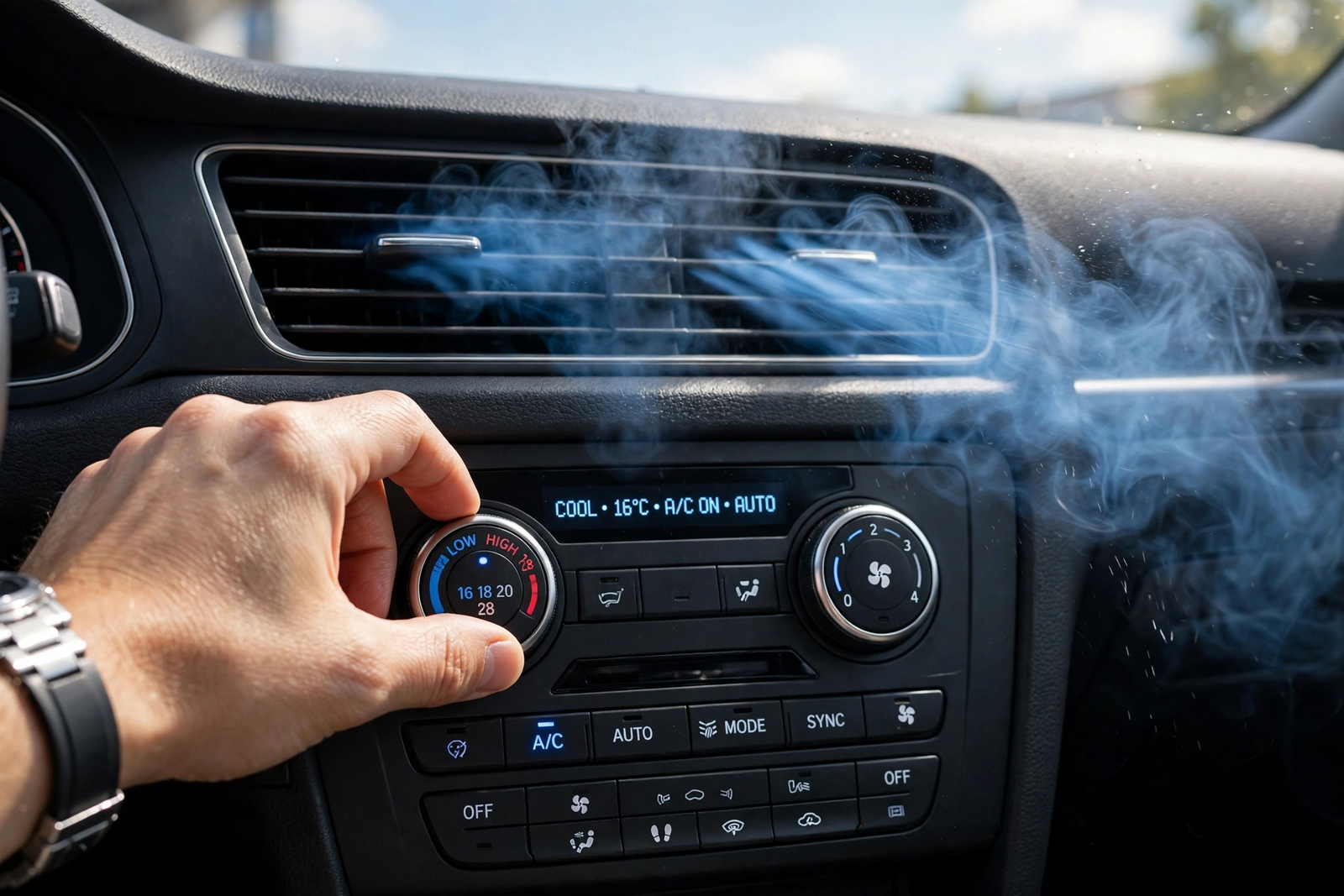
## The question: “Would you like the air conditioning on?”
Everything starts with one sentence. “Would you like the air conditioning on?” is the most useful sentence in a rideshare car, and the audio below says it four ways, so you can pick the version that feels most natural to you.
Would you like the air conditioning on? Is the temperature okay for you? Would you like it a little cooler, or a little warmer? Just let me know.
Listen to it three times. The first time, just listen. The second time, repeat each sentence right after the speaker. The third time, say the whole thing together with the recording. That third round is where the rhythm sinks in.
Here is the trick to asking this question well: ask it the moment the passenger sits down and buckles up, before you start driving. One question, then wait for the answer. If the passenger says “Yes, please,” turn the AC on and ask “Is this okay?” after a minute. If the passenger says “No, thank you,” leave it off and check again later. The question takes five seconds. The comfort lasts the whole ride.
One more habit to build: learn the word “temperature” before anything else. It is the one word in this whole conversation that passengers always understand, and it is the word you will use in every version of the question. Temperature. TEM-per-a-cher. Say it with me five times.
## What passengers say back
Your passenger will answer with one of a few short sentences. Learn to recognize them, and you will never be caught guessing.
Yes, please. A little cooler would be great. Could you turn it up a bit? It’s perfect, thank you.
Four answers, and they cover almost every ride. “Yes, please” means turn it on. “A little cooler would be great” means turn it up. “Could you turn it up a bit?” means the same thing, said as a polite request. “It’s perfect, thank you” means stop touching the controls — it is just right.
Watch out for one quiet answer: “I’m fine.” Sometimes it means the temperature is fine. Sometimes it means the passenger does not want to bother you. If you hear “I’m fine” and the passenger is still fanning themselves with their hand, or still wearing a heavy jacket on a hot day, ask once more after a minute: “Are you sure? I can turn it up a little.” One follow-up question is polite. Three is too many.
## Dialogue 1: A hot afternoon in the car
Here is the whole conversation on a hot day. The driver is A, the passenger is B. Read it out loud, playing both parts.
A: Hi, welcome. Would you like the air conditioning on?
B: Yes, please. It’s really hot today.
A: Of course. Is this temperature okay for you?
B: Could you turn it up just a little bit?
A: Sure, no problem. Let me know if it gets too cold.
B: It’s perfect now. Thank you so much.
Notice the rhythm of this conversation. Ask the question, hear the answer, adjust once, and check back. One adjustment, not five. “Let me know if it gets too cold” is the sentence that ends the conversation politely — it tells the passenger the door is open if they change their mind, without you having to ask again every two minutes. And “It’s perfect now” is the sentence you want to hear. When you hear it, stop adjusting. The temperature is right.
Also notice “Could you turn it up just a little bit?” The words “just a little bit” make the request soft and polite. Passengers use them all the time, and you can use them too: “Let me turn it up just a little bit.” Small words, big difference in how friendly you sound.
## Dialogue 2: Too cold in the back seat
Not every passenger wants more cold air. Somebody in a light shirt, somebody coming from an air-conditioned office, somebody with a small child — they might want it warmer. Here is that conversation.
A: Is the temperature okay back there?
B: Actually, it’s a little too cold for me. Could you turn it down a bit?
A: Of course. Is that better?
B: Yes, that’s much better. Thank you.
A: No problem. Let me know if you’d like it warmer.
Three things to steal from this dialogue. First, “Is the temperature okay back there?” — the words “back there” show you are thinking about the passenger’s seat, not your own. Drivers feel the front seat. Passengers feel the back seat. They are often different temperatures. Second, “Actually, it’s a little too cold for me” — the word “actually” softens a complaint. It means “to be honest,” and it turns a complaint into a friendly request. Third, the ending: “Let me know if you’d like it warmer.” Same polite close as Dialogue 1, in the opposite direction. Learn that one sentence and you can close any temperature conversation in the car.
## Turn up or turn down? The one thing that confuses everyone
Here is the trap. “Turn up the air conditioning” and “turn down the air conditioning” mean the opposite of what many learners expect. “Turn up” means make it stronger — colder air, more fan. “Turn down” means make it weaker — warmer air, less fan. The words “up” and “down” describe the power, not the temperature. Up means more cooling. Down means less cooling.
Remember it this way: you turn UP the power to get more cold. A passenger who says “Could you turn it up a bit?” is hot and wants more cold air. A passenger who says “Could you turn it down a bit?” is cold and wants less. Get this backwards and you will freeze a passenger who is already cold, or leave a sweating passenger waiting for cold air that never comes. If you are ever unsure, just ask: “Cooler or warmer?” Two words, and the passenger will point you in the right direction.
## 4 mistakes that make you sound like a phrasebook
**Saying “open the air conditioner.”** In Vietnamese you say “bật điều hòa,” and the direct translation feels like “open.” In American English, machines are not opened, they are turned on. Say “turn on the air conditioning.” “Open” is for doors and windows, not for the AC.
**Mixing up turn up and turn down.** Remember: up means more cooling, down means less cooling. When a passenger says “turn it up,” reach for more cold air. When they say “turn it down,” ease off. If you mix them up once, the passenger will correct you with a smile. If you mix them up every ride, passengers will stop asking and just suffer in silence.
**Asking “Do you want cold?”** It is understandable, but it sounds blunt, like a yes-or-no test. “Would you like the air conditioning on?” is warmer, more polite, and more professional — and it is the sentence passengers expect from a driver. “Would you like” is the magic phrase for almost every service question in English. Learn it once and use it everywhere.
**Never asking at all.** The biggest mistake is not a wrong sentence. It is silence. Some drivers never ask about the temperature because they are afraid of saying it wrong. But a passenger would much rather hear imperfect English than sit in silence, too hot to enjoy the ride. Ask the question. If the words come out a little crooked, the passenger will still understand you, and they will respect you for trying.
## Your 7-day practice plan
– **Day 1:** Memorize “Would you like the air conditioning on?” Say it 20 times out loud, with “temperature” clear every time.
– **Day 2:** Add “Is the temperature okay for you?” and “Let me know if you’d like me to turn it down.” Practice the question and the check-back as one flow.
– **Day 3:** Listen to audio clip 1 and 2 and repeat each sentence right after the speaker, without looking at the text.
– **Day 4:** Read Dialogue 1 out loud, playing both parts, three times. Practice saying “Could you turn it up just a little bit?” until it feels easy.
– **Day 5:** Read Dialogue 2 out loud three times. Practice the ending: “Let me know if you’d like it warmer.”
– **Day 6:** Role-play with a friend or family member. One of you is the driver, one is the passenger. Swap roles, and try both situations: too hot and too cold.
– **Day 7:** Say the whole flow from memory, out loud, without looking at this post: the question, the adjustment, and the check-back. If you can do it, use it on your very next ride.

## Quick Quiz
Test yourself on asking passengers about the air conditioning in English. Click an answer to see if you are right — your score is at the top.
Score: 0/5
1. Which is the best way for a driver to ask about the air conditioning?
2. A passenger says “Could you turn it up a bit?” What do they want?
3. Which sentence is correct English?
4. A passenger is too cold. What is the most polite thing they can say?
5. After adjusting the air conditioning, what is a good polite closing sentence?
## FAQ
**What is the difference between “air conditioning” and “AC”?**
They mean the same thing. “AC” is just the short form. “Air conditioning” is the full, slightly more formal version. In a car, either one works, and passengers use both.
**How do I say “bật điều hòa” in English?**
“Turn on the air conditioning.” The verb is “turn on,” never “open.” You turn on the AC the same way you turn on a light.
**Does “turn up the AC” mean colder or warmer?**
Colder. “Turn up” means more power, so more cold air. “Turn down” means less power, so warmer air. The words describe the power, not the temperature.
**What if the passenger does not answer my question?**
No problem. Some passengers are on the phone or listening to music. Turn the AC on to a medium setting, and check again after a few minutes with “Is the temperature okay for you?” A second gentle question is polite, not pushy.
**Should I ask about the air conditioning on every ride?**
Yes. It takes five seconds, and it is the fastest way to show a passenger you care about their comfort. Even a short ride feels better when the temperature is right.
## Your turn: ask the question on your next ride
You now have fifteen phrases, two full dialogues, four audio clips to copy, and a seven-day plan. You do not need all of them tomorrow. You need one: “Would you like the air conditioning on?” Say it the next time a passenger gets into your car, and listen to the answer that comes back. Then add the check-back the day after, and the “turn it up” and “turn it down” the day after that. In a week, the whole temperature conversation will feel natural, and your ratings will feel the difference.
Keep learning with the [English lessons on LingoBubbo](https://lingobubbo.com/tieng-anh/), where work phrases like these appear in short dialogues you can practice every day. Our companion guide on [how to answer work phone calls in professional English](https://lingobubbo.com/cach-nghe-dien-thoai-cong-viec-bang-tieng-anh-chuyen-nghiep/) covers another situation you meet at work every day. If this guide helped you, send it to a friend who drives for Uber or Lyft, or anyone who talks with passengers in English — one good question about the temperature is the easiest skill in the language, and it pays off on the very first ride. And tell us in the comments: what do your passengers ask for most, cooler air, warmer air, or nothing at all?