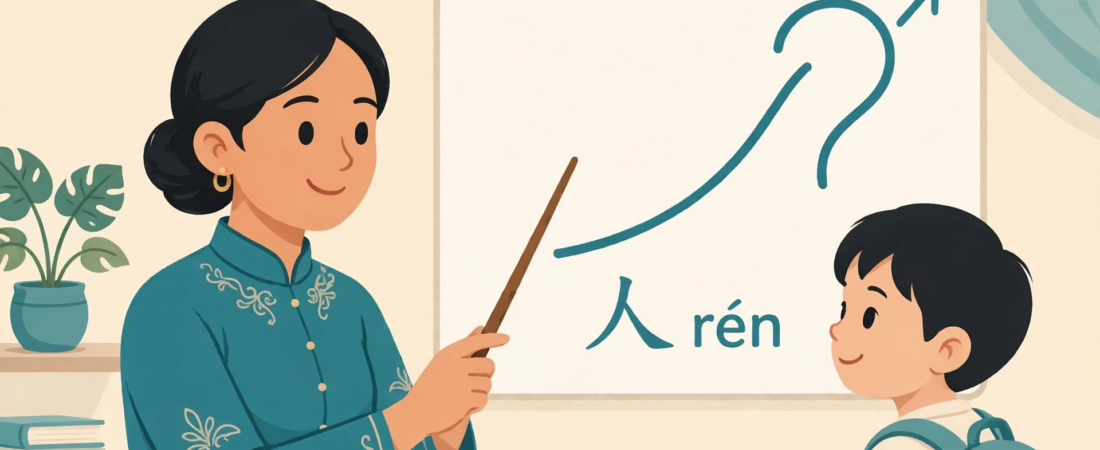
Have you ever said “mua” (buy) and had the listener think you said “bán” (sell)? In Chinese, rise in pitch just slightly wrong and the meaning changes completely. Tone 2 — the rising tone — is the tone Vietnamese learners overdo the most: assuming the higher you rise, the more correct it is, when in fact it turns into an inquisitive, questioning voice that sounds very odd to the ear. This article shows you how to rise on tone 2 in Chinese just enough, so it sounds natural like a native speaker, with examples, follow-along audio, and small exercises to practise tonight.
This article is for people new to Chinese, at HSK 1–2 level, under both standards currently in circulation: HSK 2.0 (the old standard, from 2011) and HSK 3.0 (the new standard, built on the Chinese proficiency framework published in 2021; the latest HSK exam syllabus released by the Center for Language Education and Cooperation in November 2025, applying to exams from 13/12/2026). Tones are identical under both standards, so whichever textbook you learn from, you can use this article. To grasp the whole tone system before going deeper, see the Chinese pinyin chart on LingoBubbo.
What is tone 2? Listen first, then picture it
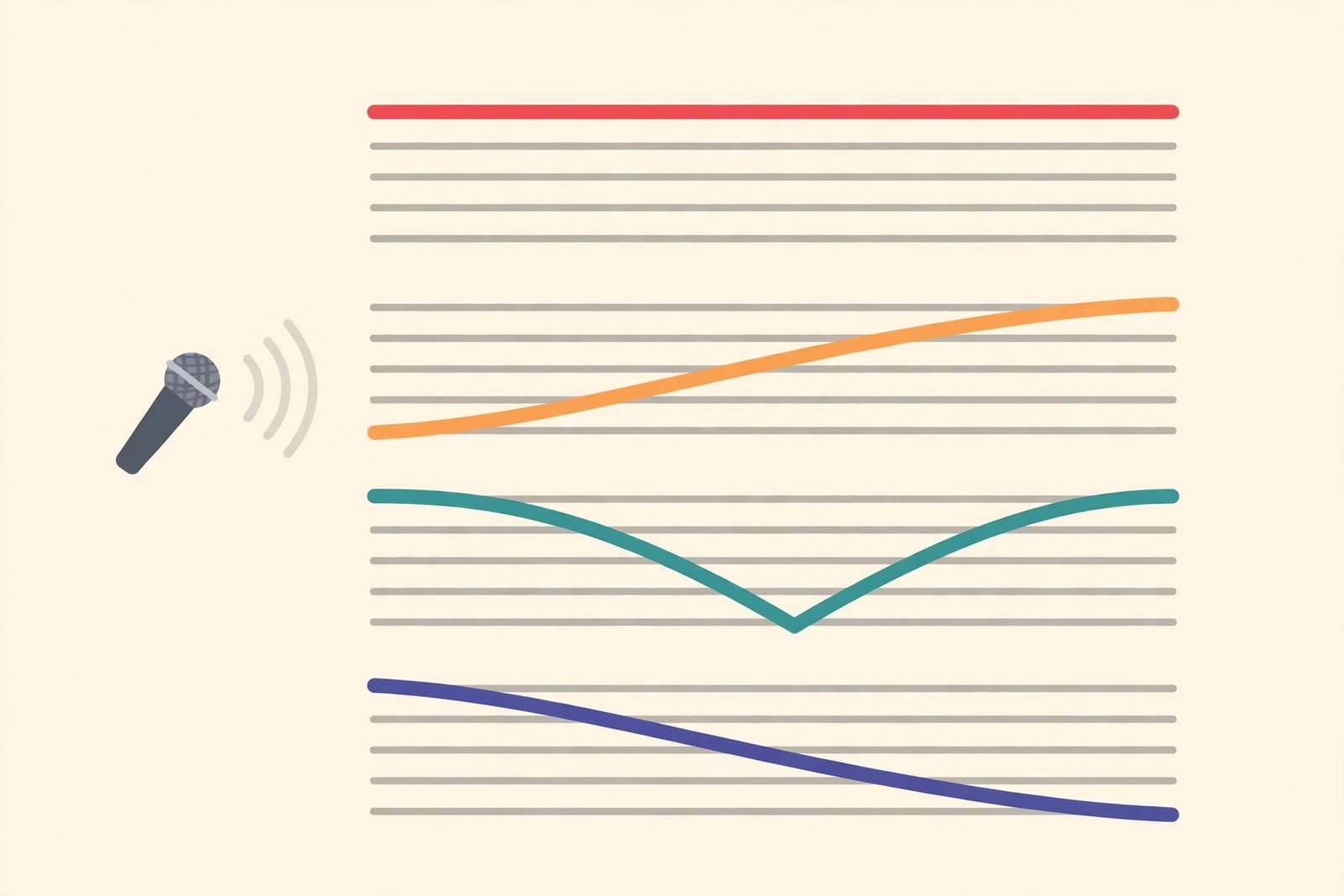
Standard Chinese has 4 main tones and 1 neutral tone. Tone 2, marked with an acute accent (´), is the tone that rises: your voice starts at a mid level and then shoots up high. Imagine asking “huh?” when you didn’t hear clearly — that rising voice is quite close to tone 2. But only “quite close”, because tone 2 doesn’t rise sky-high like a Vietnamese question, and it doesn’t drag on and on either.
Listen to the tone-2 words below and read along. Note: each word has only one syllable carrying tone 2 — read slowly and listen to how the pitch of the voice changes.
- 人 (rén) — person
- 来 (lái) — to come, to arrive
- 明 (míng) — bright, clear
- 天 (tiān) — sky, day
- 白 (bái) — white
- 学 (xué) — to study
- 您好 (nín hǎo) — hello (polite greeting)
- 明天见 (míngtiān jiàn) — see you tomorrow
Did you notice 您好? Read as one phrase, 您 (nín, tone 2) stands before 好 (hǎo, tone 3), so it sounds very natural, not forced at all. That is tone 2 doing its job: opening a greeting with a light rising beat — friendly without being fawning.
Tone 2 among the 4 tones: set them side by side and it becomes clear
Learning the tones one by one, in isolation, is hard to remember. Set all 4 tones side by side on the same syllable and your ear will tell them apart at once. The table below uses the syllable “ma” as the example — four tones, four completely different meanings.
| Tone | Symbol | Pitch contour | Example | Meaning |
|---|---|---|---|---|
| Tone 1 | ¯ | high, level | mā 妈 | mother |
| Tone 2 | ´ | rises | má 麻 | hemp; numb |
| Tone 3 | ˇ | down then up | mǎ 马 | horse |
| Tone 4 | ` | going down | mà 骂 | to scold |
Listen carefully: tone 1 keeps the voice high and level, tone 2 rises from the middle, tone 3 dips down and only then ticks back up, tone 4 drops straight down. Tone 2 starts at around the middle of your voice range — not from the lowest point, and not from the highest. This is the point Vietnamese learners get wrong most often; see the section below.
3 mistakes Vietnamese learners make most often with tone 2
Rising too high, for too long. Many learners read tone 2 as if they were asking a long question: “rénnn?” rising all the way to the ceiling and then lingering. The listener will think you’re asking something back, not saying a word. Fix: rise quickly and neatly, decisively; the finishing point is only a little higher than the starting point — about a third in music, not an octave.
Starting too low. Some learners start tone 2 from the very bottom of their voice, sounding like tone 3 before rising. The result is a word that sounds heavy and weary. Fix: start at the level of your normal speaking voice, the way you say a relaxed “yeah”, and rise from there.
Reading tone 2 as the Vietnamese acute accent. The Vietnamese acute accent rises very fast and sharply; Chinese tone 2 rises more slowly and softly, as if you were lifting a light object rather than jerking it up hard. Try reading “lái” without “chopping” your voice down — keep the breath even from the beginning of the word to the end.
A quick way to check: record yourself reading and listen back. If it sounds like you’re asking “huh?”, you’re overdoing the rise. If it sounds like ordinary storytelling, with just a slight lift at the end, you’ve got it right.
Practise tone 2 in word pairs: easy to remember, hard to forget
The fastest way to practise is to read in pairs: one tone-2 word standing next to a word with a different tone. Your ear will compare and adjust on its own. Read each pair 3 times, each time a little faster than the time before.
- 明天 (míngtiān) — tomorrow. Both syllables rise: míng (tone 2) + tiān (tone 1). It sounds like a slope rising up and then holding high.
- 人民 (rénmín) — the people. Two tone 2s in a row: rén (tone 2) + mín (tone 2). Don’t read the second word lower than the first — both of them rise.
- 学习 (xuéxí) — to study. Also two tone 2s in a row. This is a word you will use every day, so practise it until it is really accurate.
- 白天 (báitiān) — daytime. bái (tone 2) + tiān (tone 1).
- 来吧 (lái ba) — come on. lái (tone 2) + ba (neutral tone, read light and quick).
As for the case of two tone 2s in a row (such as 学习, 人民, 明天), it is the most standard test of all. Beginners often read the first word right but let the following one “drop”, or the other way round. The secret: treat the two words as a single breath, the voice rising continuously rather than up, then down, then up again.
Tone 2 in sentences: only when you read the whole sentence is it real
Reading single words accurately isn’t enough — inside a sentence, tone 2 also has to keep its rhythm. Read the sentences below, paying attention to the bold words carrying tone 2.
- 你好吗? (Nǐ hǎo ma?) — How are you? (你 nǐ, tone 3, turns into tone 2 when it stands before a tone 3 — see the tone-change section below.)
- 他来吗? (Tā lái ma?) — Is he coming?
- 我们明天去。 (Wǒmen míngtiān qù.) — We are going tomorrow.
- 你明天来吗? (Nǐ míngtiān lái ma?) — Are you coming tomorrow?
- 明天是星期一。 (Míngtiān shì xīngqīyī.) — Tomorrow is Monday.
Can you feel how, in a question, tone 2 and the question word “吗” create different feelings? 吗 (ma) is a question particle, read in the neutral tone, while the tone 2 in 来 or 明 is part of the word itself. Don’t let the question mark at the end of the sentence “pull” all the tone 2s in the sentence up high along with it — every word keeps its own pitch.
Tone change: when does tone 3 turn into tone 2?
This is a small rule that appears constantly. When two tone 3s stand next to each other, the first tone 3 turns into tone 2. The most famous example: 你好 (nǐ hǎo) is read as “ní hǎo”. Similarly: 很好 (hěn hǎo) is read as “hén hǎo”, 可以 (kěyǐ) is read as “kéyǐ”.
This rule matters because it explains why you hear native speakers say “ní hǎo” while the book writes “nǐ hǎo”. Written pinyin keeps the original tone; in speech, the first tone changes. Every HSK 1 learner meets this case in the listening exam, so remember it well: when you meet two tone 3s in a row, read the first one as tone 2.
Exercises: practise right away for 5 minutes — answers with explanations
Do the 5 exercises below, mark them yourself, then listen to the audio again to check. The answer sits right after each exercise — but try to do them yourself first.
Exercise 1 — Circle the word carrying tone 2. (a) 妈 mā (b) 麻 má (c) 马 mǎ (d) 骂 mà — Answer: (b) 麻 má — tone 2 is the rising tone, marked with the acute accent; 妈 is tone 1, 马 is tone 3, 骂 is tone 4.
Exercise 2 — Choose the correct pinyin for “tomorrow”. (a) míngtiān (b) mǐngtiān (c) mìngtiān — Answer: (a) míngtiān — both 明 and 天 carry rising tones (tone 2 and tone 1); there is no tone 3 or tone 4.
Exercise 3 — Read the following sentence and circle the word read as tone 2 because of the tone change. “你好,很高兴认识你。” — Answer: 你 (nǐ) in 你好 is read as “ní” because it stands before 好 (hǎo, tone 3) — two tone 3s in a row, so the first one changes into tone 2.
Exercise 4 — Fix the mistake. You read “rén” stretched up really high, as if asking “huh?”. What is the mistake and how do you fix it? — Answer: rising too high and for too long. Fix: start at your normal speaking voice, rise quickly, neatly and decisively, with the finishing point only a little higher than the starting point.
Exercise 5 — Translate into Chinese. “We are going tomorrow. Are you coming?” — Answer: 我们明天去。你明天来吗?(Wǒmen míngtiān qù. Nǐ míngtiān lái ma?) Note that 明天 (míngtiān) and 来 (lái) both carry tone 2 — rise lightly, don’t stretch them out.

Summary table: tone 2 in a single table
Screenshot this table or copy it into your notebook — this is everything most important about tone 2.
| Point to remember | Content |
|---|---|
| Symbol | Acute accent (´), for example: rén, lái, míng |
| Pitch contour | Start at the middle level, rise, and finish slightly higher — quick and neat, don’t stretch it out |
| Common mistakes | Rising too high, starting too low, reading it as the Vietnamese acute accent |
| Best pairs to practise | 学习 xuéxí, 人民 rénmín, 明天 míngtiān (two tone 2s in a row) |
| Related tone change | Two tone 3s in a row → the first one is read as tone 2 (你好 read as “ní hǎo”) |
| Practise every day | Read the 5 word pairs + 3 sentences in the article, record yourself and listen back, 5 minutes a day |
Send this table to a study friend who is practising pronunciation — a table that pins down the whole of tone 2 is well worth sharing. You can also review the entire tone system with the article Chinese pinyin chart, or practise listening further with the HSK 1 listening lessons on LingoBubbo.
Quick quiz: do you have tone 2 yet?
Tap the answer you choose — you’ll know right away whether it’s right or wrong.
Your score: 0/5 — tap an answer to check it right away.
Question 1. What pitch contour does Chinese tone 2 have?
Question 2. Which of the words below carries tone 2?
Question 3. How does “你好” sound when read as one phrase?
Question 4. What is the most common mistake Vietnamese learners make when reading tone 2?
Question 5. What is the correct reading of “明天” (tomorrow)?
Frequently asked questions about tone 2 in Chinese
How do tone 2 and the Vietnamese acute accent differ? The Vietnamese acute accent rises very fast and sharply; Chinese tone 2 rises more slowly and softly, with the finishing point only a little higher than the starting point. Try reading "lái" without "chopping" your voice down and you are heading in the right direction.
How do you read two tone 2s in a row? Read both of them rising, in a single breath — for example 学习 (xuéxí) or 人民 (rénmín). Don't let the second word "drop" lower than the first.
Should you learn tone 2 by the HSK 2.0 or HSK 3.0 standard? The tones are identical under both standards, so whichever textbook you learn from, you can use this article. Only the vocabulary and the number of words at each level differ between the two standards.
How long should you practise tone 2 each day? 5 minutes is enough: read the 5 word pairs and 3 sentences in the article, record yourself and listen back to compare. What matters is practising evenly every day, not practising for a very long time once.
After finishing tone 2, what should you learn next? Learn tone 3 and its tone-change rule, because tone 3 is the hardest tone and often goes together with tone 2 in greetings. The article Chinese pinyin chart has all 4 tones for you to compare.
Tone 2 is not hard — what is hard is that we keep assuming we must rise really high to get it right. From tonight, try reading 明天, 学习, 来 with a light rising rhythm, quick and neat, then record yourself and listen back. Just one week of practising 5 minutes a day and your ear will recognise on its own what a proper tone 2 sounds like. Tell me in the comments: which word did you read correctly right away, and which one do you still stumble over? And send this article to a study friend who is practising Chinese pronunciation, so you can both rise just enough. To keep learning along the path, start from LingoBubbo's Chinese page — every lesson already comes with vocabulary, audio and a quiz.