You have been learning Spanish for a long time, yet your conversation still sounds like a textbook? Just one idiom at the right moment and the person opposite you will nod along at once — because idioms are the clearest sign that you are not just learning grammar, you are truly living with the language.
Spanish idioms are sayings that native speakers use every day; their meaning cannot be guessed word by word, but use one correctly just once and listeners instantly know you are not a beginner. This post picks the 20 most common idioms, with the literal meaning, the real meaning and an example sentence so you can use them right away. Every group has audio for you to listen to and copy, and there is a quick quiz at the end to test your memory. Learn just the first 5 by heart and your conversations will already feel completely different.
Listen first: what do the first 7 Spanish idioms sound like?
Before reading the list, listen to the first 7 idioms inside real example sentences. Listen once to get used to the sound and notice where the stress falls — then read the explanation for each one below.
🎧 Listen to the first 7 idioms: feelings, tiredness and asking for help

Spanish idioms about feelings and states
The first five are about people’s feelings and states — the easiest group to use, because every day brings moments when you are tired, daydreaming, or unable to sleep.
1. Estar en las nubes — to be in the clouds
Real meaning: daydreaming, not concentrating, your head somewhere else entirely. Example: “Juan está en las nubes hoy.” (Juan is daydreaming today.) Teachers often use this sentence to call out a student who is drifting off in class — gentle, and everyone understands.
2. Estar hecho polvo — turned into dust
Real meaning: worn out, completely exhausted. Example: “Después del viaje estoy hecho polvo.” (After the trip I am exhausted.) This is much stronger than “estoy cansado” (I am tired) — use it when you are truly wiped out, like after walking all day in Madrid and coming back to the hotel wanting only to collapse onto the bed.
3. Estar como una cabra — like a goat
Real meaning: a bit mad, eccentric — but said jokingly among friends, not as an insult. Example: “¡Estás como una cabra!” (You are completely mad!) A close friend invites you to jump into a lake at midnight? This is the sentence for exactly that moment.
4. No pegar ojo — to not glue an eye shut
Real meaning: to not sleep at all, to not get a wink of sleep. Example: “Anoche no pegué ojo.” (Last night I did not get a wink of sleep.) Remember to conjugate the verb in the past tense: pegué, not pego, when you are talking about last night.
5. Tener buena pinta — to look good
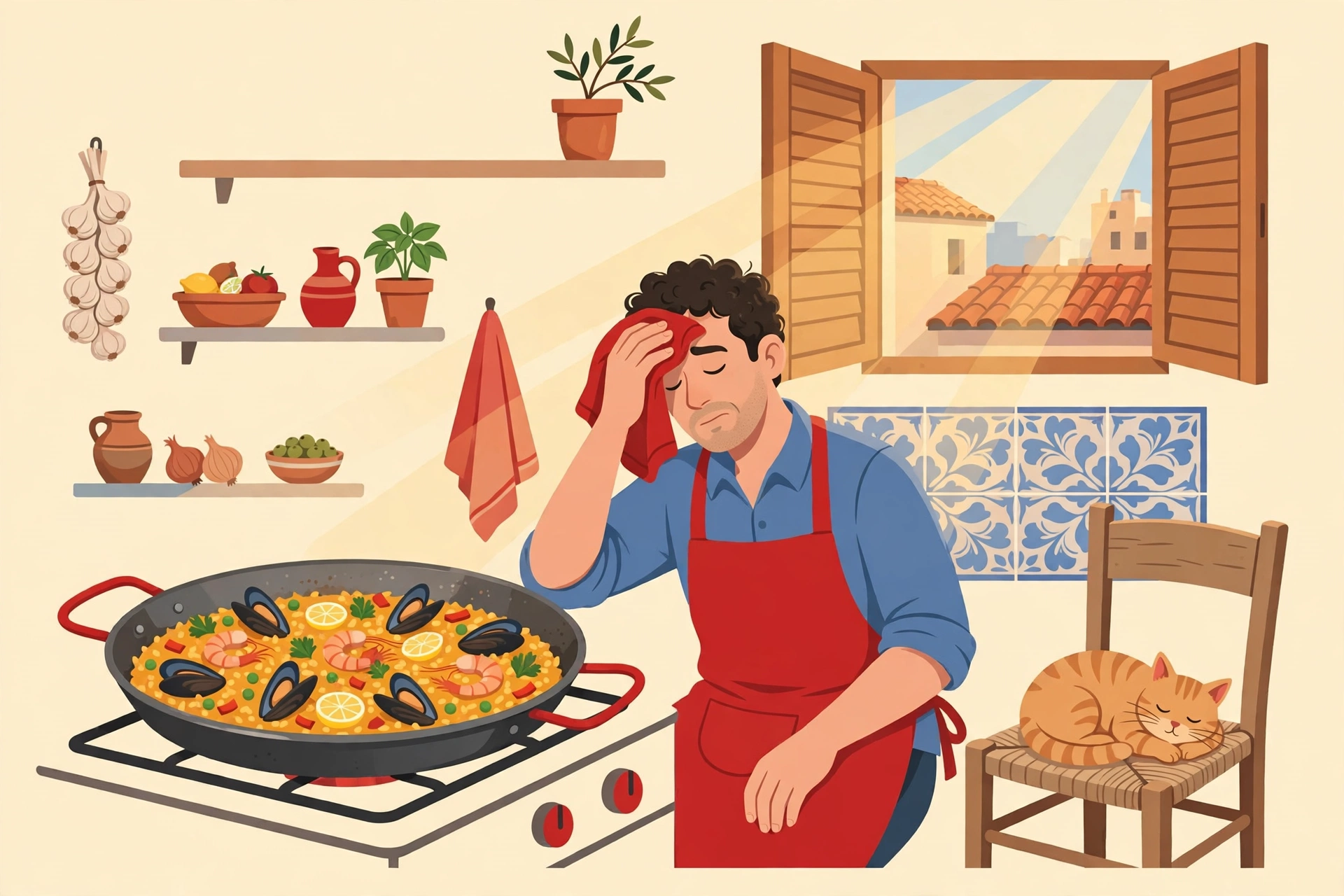
Real meaning: looks tasty, looks appealing — used for both food and people. Example: “Esta paella tiene muy buena pinta.” (This paella looks so tasty.) Sitting in front of a steaming pan of paella in Valencia, this sentence pops out more naturally than any compliment in a textbook.
Idioms about actions and behaviour
This group is full of sentences you will use when interacting with other people: asking for help, apologising for a slip of the tongue, urging someone to concentrate. Learning this group means learning to “live” in Spanish, not just learning words.
6. Echar una mano — to throw a hand
Real meaning: to lend a hand, to help out. Example: “¿Me echas una mano?” (Can you give me a hand?) This is the most polite and friendly way to ask for help in Spanish — it works with friends, colleagues and neighbours alike. To be even more polite, add “por favor” at the end.
7. Meter la pata — to put your foot in it
Real meaning: to say the wrong thing, to make a silly blunder. Example: “Metí la pata en la reunión.” (I put my foot in it in the meeting.) Everyone “meters la pata” sometimes — says something they should not have said and wishes the ground would swallow them up. Know this idiom and you also have a very natural way to apologise: “Perdón, metí la pata.”
8. Tomar el pelo — to pull hair
Real meaning: to tease, to joke around with someone. Example: “¡No me tomes el pelo!” (Stop teasing me!) Don’t translate it word by word and think someone is really pulling your hair. Spaniards say this with a smile far more often than with annoyance.
9. Ponerse las pilas — to put your batteries in
Real meaning: to focus, to get down to work seriously, to recharge your energy. Example: “¡Ponte las pilas, que el examen es mañana!” (Pull yourself together — the exam is tomorrow!) The sentence sounds like someone pressing a “start” button for you — Spanish mums say it to their children more times than anyone can count.
10. Hablar por los codos — to talk through your elbows
Real meaning: to talk a lot, to talk nonstop. Example: “Mi abuela habla por los codos.” (My grandmother talks a lot.) The image is really funny: talking so much that even your elbows have to join in. Use it to describe someone affectionately; don’t use it to criticise a stranger.
11. Ser uña y carne — to be nail and flesh
Real meaning: inseparably close, joined at the hip. Example: “María y Ana son uña y carne.” (María and Ana are inseparable.) How could a nail ever be separated from the flesh? — that is exactly the point of this idiom. Use it for a close friendship, a sisterly bond, or two people who are always together.
🎧 Listen to the next 7 idioms: from teasing to money
Idioms about money and the ways of the world
Money and the ways of the world are the two topics people talk about most — and the idioms in this group are also the ones you will hear most often in real life.
12. Costar un ojo de la cara — to cost an eye from your face
Real meaning: outrageously expensive, costing an arm and a leg. Example: “Este coche cuesta un ojo de la cara.” (This car costs a fortune.) In Vietnamese people say “outrageously expensive” — expensive enough to cut your throat — while in Spanish they say “it costs an eye from your face”: a different image, but the same wince at the price.
13. Ser pan comido — to be eaten bread
Real meaning: easy as pie, a piece of cake. Example: “El examen fue pan comido.” (The exam was a piece of cake.) A small tip: an easy exam is “pan comido”, while a hard one is “fue un hueso duro de roer” (a tough bone to gnaw) — a handy opposite pair to memorise together.
14. No tener ni idea — to not have even an idea
Real meaning: to have no idea at all, to not have a clue whatsoever. Example: “No tengo ni idea de dónde está.” (I have no idea where it is.) The word ni here stresses “not even the slightest bit” — much more honest than simply saying “no sé” (I don’t know).
15. Más vale tarde que nunca — better late than never
Real meaning: exactly what the literal words say: arriving late is still better than not arriving at all. Example: “Llegó tarde, pero más vale tarde que nunca.” (He arrived late, but better late than never.) This sentence is both a consolation and a gentle excuse when you turn up late to an appointment.
16. No hay mal que por bien no venga — every cloud has a silver lining
Real meaning: every bad thing also brings something good along with it. Example: “Perdió el trabajo, pero encontró uno mejor: no hay mal que por bien no venga.” (He lost his job but found a better one: every cloud has a silver lining.) The longest sentence on the list, and also the most “philosophical” one — Spaniards use it whenever they comfort someone who has run into misfortune.
Four all-time favourite sentences to use every day
The last four are not exactly long idioms, but they are the catchphrases you will hear every day in Spain. Learn these four by heart and you have your “ticket in” to any everyday conversation.
17. ¡Qué guay! — how cool!
Real meaning: wonderful, great, so cool — very common in Spain. Example: “¡Qué guay tu coche nuevo!” (Your new car is so cool!) When someone shows off something new, all you need to burst out with is “¡Qué guay!” — no longer sentence needed.
18. Me da igual — it is all the same to me
Real meaning: I don’t mind, anything is fine, either way is OK. Example: “¿Café o té? Me da igual.” (Coffee or tea? I don’t mind.) This sentence saves you in every situation where you have to choose but truly have no preference — remember to say it in a relaxed tone, not a cold one, or people may think you are annoyed.
19. ¡Venga! — come on, let’s go
Real meaning: depending on the context, the meaning changes: urging someone along (“come on, let’s go”), encouraging them (“come on, you can do it”), or slightly impatient (“oh, come on”). Example: “¡Venga, que llegamos tarde!” (Come on, we are running late!) This is one of the most versatile words in Spanish — from the intonation alone you can guess whether someone is hurrying you along or cheering you on.
20. ¡Ojalá! — if only!
Real meaning: if only, I hope so, let’s hope that is the case. Example: “Ojalá no llueva mañana.” (I hope it doesn’t rain tomorrow.) This word comes from the Arabic “inshallah” (God willing) — a little piece of fascinating history behind a word of just two syllables. The verb after “ojalá” goes in the subjunctive, but when speaking quickly in real life, a standalone “¡Ojalá!” is quite enough.
🎧 Listen to the last 6 sentences: life’s ups and downs and everyday catchphrases

A regional note: how does Spain differ from Latin America?
Some idioms carry a regional flavour — “¡Qué guay!” and “¡Venga!” are very much Spain, while in Latin America people would use “¡Qué padre!” (Mexico) or “¡Dale!” with a similar meaning. When talking with Latin Americans you will still be understood, but choosing the right local word scores you even more points. Conversely, “me da igual” and “no tener ni idea” work anywhere — no fear of sounding out of place. The general rule: listen to what local people say and copy them — that is the fastest way to learn idioms, faster even than learning by heart.
If you still get tripped up by easily confused word pairs in Spanish, re-read the post Telling ser/estar and por/para apart: the 2 classic “trap” pairs of Spanish on LingoBubbo. And when you need to use Spanish in real life — for example, seeing a doctor in the US — the post 20 Spanish sentences for when you see a doctor in the US will help you say exactly what you need at the most stressful moment.
Summary table of the 20 Spanish idioms
Send this table to friends who are learning Spanish with you — learning together sticks in the memory far longer than learning alone.
| Idiom | Literal meaning | Real meaning |
|---|---|---|
| Estar en las nubes | to be in the clouds | daydreaming, not concentrating |
| Estar hecho polvo | turned into dust | worn out, exhausted |
| Estar como una cabra | like a goat | a bit mad, eccentric (said jokingly) |
| No pegar ojo | to not glue an eye shut | to not sleep at all |
| Tener buena pinta | to look good | looks tasty, looks appealing |
| Echar una mano | to throw a hand | to lend a hand |
| Meter la pata | to put your foot in it | to say the wrong thing, to make a silly blunder |
| Tomar el pelo | to pull hair | to tease, to joke around |
| Ponerse las pilas | to put your batteries in | to focus, to get down to work |
| Hablar por los codos | to talk through your elbows | to talk a lot, nonstop |
| Ser uña y carne | to be nail and flesh | inseparably close |
| Costar un ojo de la cara | to cost an eye from your face | outrageously expensive |
| Ser pan comido | to be eaten bread | easy as pie |
| No tener ni idea | to not have even an idea | to have no idea at all |
| Más vale tarde que nunca | better late than never | better late than never |
| No hay mal que por bien no venga | there is no bad thing that does not bring something good | every cloud has a silver lining |
| ¡Qué guay! | — | awesome, so cool (Spain) |
| Me da igual | — | it is all the same to me, I don’t mind |
| ¡Venga! | — | come on, let’s go, you can do it |
| ¡Ojalá! | — | if only, I hope so |
Quick practice
Pick the right idiom for each situation: (1) You are worn out after a long day. (2) You want to ask a friend to give you a hand. (3) The exam was far too easy. Answers: (1) Estar hecho polvo — “Estoy hecho polvo.” (2) Echar una mano — “¿Me echas una mano?” (3) Ser pan comido — “Fue pan comido.”
Start with the first 5 idioms, use them in conversation this week, then add 5 more each week. Before long, your Spanish will no longer sound like a textbook. One very effective way to remember them: whenever you come across a real situation during the day — tired, hungry, a slip of the tongue, needing help — ask yourself “which idiom can say this?” and say that sentence out loud in Spanish. An idiom only truly becomes yours when it is attached to a real moment of your own.
Frequently asked questions
Is it hard to learn Spanish idioms?
Not as hard as you think — because every idiom is tied to a concrete image (in the clouds, turned into dust, nail and flesh), remember the image and you remember the sentence. The hardest part is not to translate word by word; just learn each whole phrase as a single block and you will be fine.
Should I learn the idioms of Spain or of Latin America first?
Pick one side to start with, depending on who you talk to more. Most of the idioms in this post work in both places; only a few, like “¡Qué guay!”, are strongly Spanish, and the post notes that clearly.
What if I use an idiom in the wrong context?
It doesn’t matter at all — native speakers usually laugh it off and correct you, because they can see you are trying to speak like them. Get it wrong once and you remember it for life; that is still the fastest way to learn.
Quick Quiz
Let’s see how many idioms you remember! Choose one answer for each question — right or wrong, you get feedback straight away. Score: 0/5
1. After a long day, you say “Estoy hecho polvo” — what does it mean?
2. Which sentence do you say when you want to ask a friend to give you a hand?
3. “El examen fue pan comido” — what was the exam like?
4. What does “¡No me tomes el pelo!” mean?
5. Where is “¡Qué guay!” most common?
How many points did you get? If you didn’t reach 5/5, listen to the 3 audio clips above again and take the quiz once more — the second attempt usually sticks far better than the first. Idioms only truly become yours when you dare to use them in real life: this week, pick the first 5 and use them in real conversations, even if it is only texting friends. Keep building your Spanish a little more every day at the LingoBubbo Spanish learning centre, and don’t forget to share this post with friends who are learning Spanish: the more these 20 idioms are used together, the longer they stay in your memory. Is there an idiom you keep hearing but are still not quite sure about? Leave a comment below, and I will explain it in a future post. Happy learning!