Ten minutes a day. Seven days. That is the whole 7-day Chinese tone challenge, and by the end of the week you will hear the difference between 妈 (mā, mother) and 马 (mǎ, horse) without thinking about it, and you will say them right most of the time. No hour-long study sessions, no tone drills that put you to sleep, no waiting until you “know more Chinese” before you open your mouth. Tones are the first thing every Chinese learner meets, and they are also the thing most learners quietly avoid. This plan fixes that, ten minutes at a time, one small win per day. If you are a parent helping your child, or a beginner learning on your own, this challenge was built for you.
Why tones feel hard, and why 10 minutes a day is enough
Here is the honest reason tones feel hard: your ear has not learned to listen for pitch yet. In English, pitch carries emotion. A rising voice means a question, a falling voice means you are done talking. In Chinese, pitch carries meaning. Change the pitch and you change the word. That is all there is to it, and it sounds scary until you realize your ear can learn the new job in about a week of short, focused listening.
Short matters more than long here. Ten minutes of real listening and speaking beats an hour of staring at a tone chart. Your brain needs many small meetings with tones, not one long lecture. That is why this challenge runs seven days instead of one afternoon. Each day has one job, one set of sounds, and one tiny test you can pass before dinner.
One more thing before we start: you do not need perfect tones to be understood. You need clear enough tones. Native speakers are generous listeners. If your tones are close and your words are in a sensible sentence, people understand you. The goal of this week is not perfection. The goal is to stop guessing.
The four tones in 60 seconds
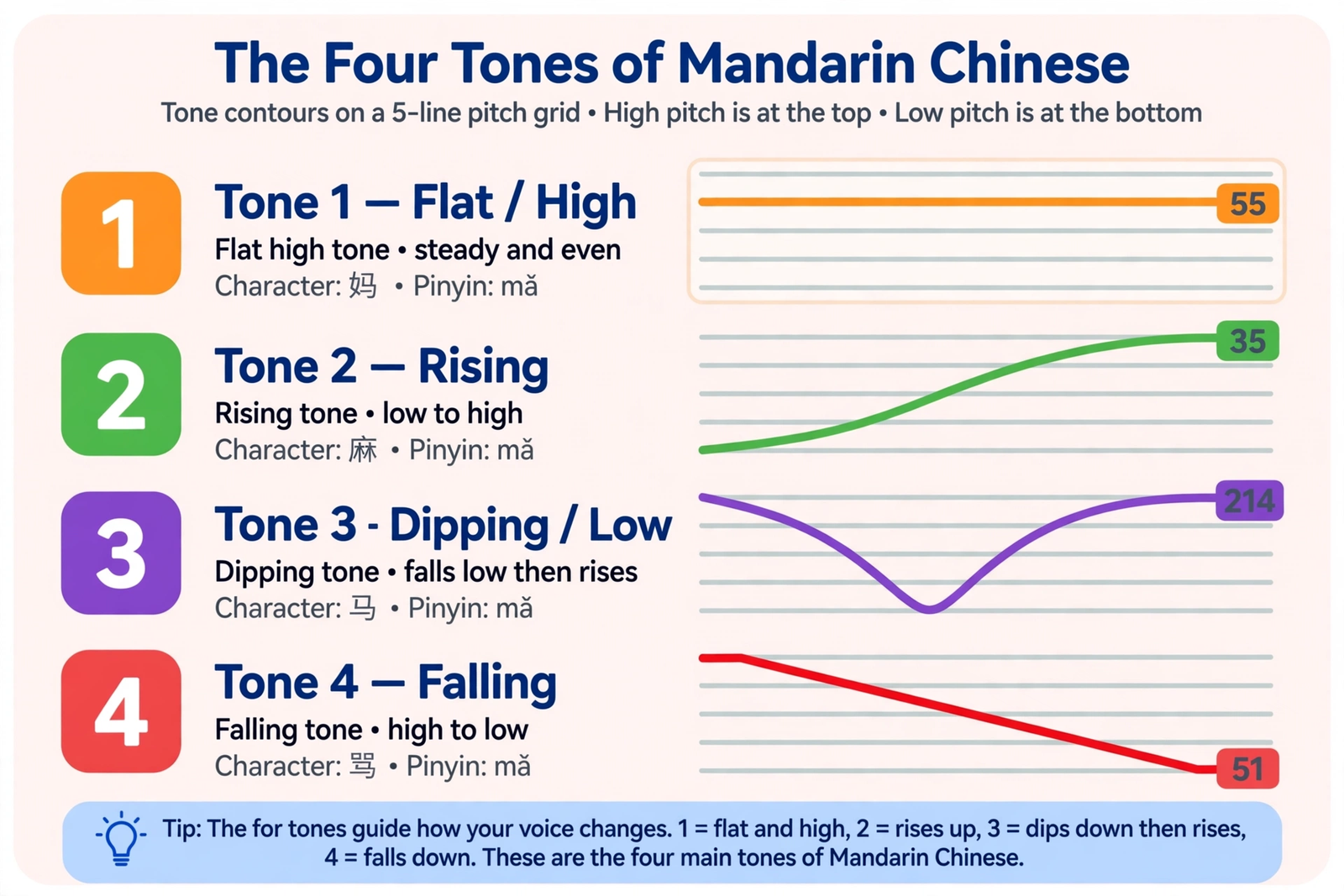
Mandarin has four main tones, plus a light neutral tone that shows up in the second half of common words. Here they are, all on the same syllable, so you can hear how one sound becomes four different words.
| Tone | Mark | How it moves | Example | Pinyin | Meaning |
|---|---|---|---|---|---|
| 1st tone | ā | High and flat, like singing one note | 妈 | mā | mother |
| 2nd tone | á | Rising, like asking “what?” | 麻 | má | hemp / numb |
| 3rd tone | ǎ | Dips down, then rises a little | 马 | mǎ | horse |
| 4th tone | à | Falls sharply, like a firm “no!” | 骂 | mà | to scold |
| Neutral | a | Light and quick, no clear pitch | 吗 | ma | question particle |
Listen to all four now, back to back. Say each one right after the speaker, and exaggerate. Big and silly beats small and careful when you are learning tones.
妈,麻,马,骂。 (mā, má, mǎ, mà.)
Did you feel the difference in your throat? The first tone sits high and steady. The second climbs. The third drops low before it comes back up. The fourth drops like a stone. Your throat already knows how to make all four sounds. You use them in English every day. What is new is using them on purpose, on the same syllable, to mean different things.
A quick note on the third tone, because it confuses everyone: in real speech, the third tone often does not rise back up at all. It just dips low. So 马 (mǎ) in the middle of a sentence sounds more like a low “maa” than a dip-and-rise. And when two third tones meet, like in 你好 (nǐ hǎo), the first one turns into a second tone when you say it out loud: ní hǎo. The writing keeps nǐ hǎo, but your mouth says ní hǎo. Do not worry about memorizing that rule today. Just notice it when you hear it.
Your 7-day plan, day by day
This is the heart of the challenge. Each day takes about ten minutes. Do it at the same time every day if you can, right after breakfast or right before bed. Same time, same chair, same ten minutes. Your brain loves a routine.
Day 1: Meet the four tones. Listen to audio clip 1 three times. Each time, say the four words along with the speaker: mā, má, mǎ, mà. Then say them on your own, in order, three times. That is your whole job today. If you can say all four and hear that they are different, day 1 is done.
Day 2: One tone at a time. Today you only practice two tones: the first and the fourth. Say 妈 (mā, mother) high and flat, then 骂 (mà, to scold) falling hard. Back and forth, ten times. These two are the easiest to tell apart, and winning early matters. End the day by writing the two characters on a sticky note and putting it on your fridge.
Day 3: The pair that changes everything. Today is the famous pair: 买 (mǎi, to buy) and 卖 (mài, to sell). Same sounds, different tone, opposite meaning. Listen carefully. One buys, one sells, and mixing them up at a market is the classic beginner story everyone laughs about later.
买东西,卖东西。买书,卖书。
(mǎi dōngxi, mài dōngxi. mǎi shū, mài shū.)
To buy things, to sell things. To buy books, to sell books.
Say each pair after the speaker. 买 (mǎi) dips low. 卖 (mài) falls hard. If you can hear the difference between those two, your ear has already started its new job.
Day 4: Tone pairs in real words. Today, practice the pairs that show up in daily life. Say these out loud, slowly, three times each: 书 (shū, book) and 树 (shù, tree); 好 (hǎo, good) and 号 (hào, number); 水 (shuǐ, water) and 睡 (shuì, to sleep). Notice how many everyday words are just one tone away from a completely different word. That is why tones matter, and it is also why they are fun. You are not memorizing rules. You are learning to hear the difference between a book and a tree.
Day 5: Your first tone sentence. Today you put it together. Listen to this sentence and copy it, three times, right after the speaker.
我要买水。
(Wǒ yào mǎi shuǐ.)
I want to buy water.
Four words, three different tones, one real sentence you could actually use in a shop. Say it slowly first, then at normal speed. Then swap the last word: 我要买书 (Wǒ yào mǎi shū, I want to buy books). Same pattern, your words in it. If you can say one tone sentence clearly, you can say a hundred. They are all built the same way.
Day 6: Listen and catch the tone. Today you only listen. Play audio clip 1 again and point at the right number, 1, 2, 3, or 4, as each word plays. Then ask someone in your family to say 妈,麻,马,骂 in a random order while you guess the tone. Getting it wrong is the point. Every wrong guess teaches your ear something, and by the end of ten minutes you will be guessing right far more often than you expect.
Day 7: Show what you learned. Last day. Listen to this sentence and say it after the speaker, then say it on your own.
爸爸妈妈去买菜。
(Bàba māma qù mǎi cài.)
Dad and Mom go buy vegetables.
Then go back and say the Day 1 set, mā, má, mǎ, mà, one more time. Compare how it feels now with how it felt on Day 1. That difference is the whole challenge. Seven days, ten minutes a day, and tones have stopped being a mystery.

Five short exercises you can do today
You do not have to wait until Day 7 to start. These five exercises fit inside one ten-minute session, and you can repeat them on any day of the challenge.
1. The four-tone ladder. Say mā, má, mǎ, mà in order, then backwards: mà, mǎ, má, mā. Do it three times, a little faster each time. If your voice cracks on the third tone, good. That means you are really dipping low.
2. The buy-sell game. Say 买 (mǎi, to buy) and 卖 (mài, to sell) ten times, alternating. Then cover the characters and have someone point at one while you say it. If you are on your own, write the two characters on two cards, shuffle them, and flip one at a time.
3. Copy the water sentence. Listen to audio clip 3 again and say 我要买水 (Wǒ yào mǎi shuǐ, I want to buy water) after the speaker, three times. Then change the last word to something you like: tea, books, rice. One sentence pattern, your life in it.
4. Tone detective. Play audio clip 2 and write down which tone you hear for each word before you look at the pinyin. Two minutes, no pressure. The detective game is the fastest way to train your ear, because guessing and checking beats just listening.
5. Teach someone else. Tell a family member or a friend the difference between 买 and 卖. Teaching forces you to hear the difference clearly, and it is the best test there is. If you can explain it, you know it.
Want to double-check the pinyin of any word in this challenge before you practice it? The Pinyin chart tool on LingoBubbo lets you look up the sounds and tones for every word here, and it is the tool we link to throughout this plan whenever a new sound shows up.
Four mistakes that slow everyone down
Practicing tones silently. Tones live in your mouth, not in your eyes. Reading a tone chart without saying the sounds out loud is like learning to swim by reading about water. Say every example in this post out loud. Your neighbors can wait.
Treating all four tones as equally hard. They are not. The first and fourth tones are easy to hear and easy to say. The second and third tones are the tricky pair, because a third tone in fast speech often sounds like a low second tone. Spend your time where the trouble is: tones two and three.
Trying to be perfect on day one. Nobody’s tones are perfect after one day, and they do not need to be. Clear beats perfect. If a listener can tell your 买 from your 卖, you have already won the only game that matters.
Skipping the listening days. Day 6 looks like a rest day. It is not. Listening is half the skill. Many learners can say tones fine but cannot hear them, and then they cannot tell when they are wrong. Ten minutes of listening trains the ear that corrects the mouth.
Your 7-day challenge at a glance
| Day | Your job | The sounds | Win condition |
|---|---|---|---|
| Day 1 | Meet the four tones | mā, má, mǎ, mà | You can say all four and hear they differ |
| Day 2 | First vs fourth tone | 妈 mā, 骂 mà | You can switch between high-flat and falling |
| Day 3 | The buy-sell pair | 买 mǎi, 卖 mài | You can hear buy vs sell |
| Day 4 | Tone pairs in daily words | 书/树, 好/号, 水/睡 | You can say three pairs clearly |
| Day 5 | First tone sentence | 我要买水 | You can say a full sentence with mixed tones |
| Day 6 | Listen and catch the tone | All four, mixed | You guess the tone right most of the time |
| Day 7 | Show what you learned | 爸爸妈妈去买菜 | You say the sentence and the Day 1 set with confidence |
Print this table, or copy it into your notebook, and tick each day off as you finish it. Seven ticks and the challenge is done. Send it to a friend who keeps saying “tones are too hard for me.” They are not too hard. They just need seven days and ten minutes a day.
Quick Quiz
Test yourself on the four Chinese tones. Click an answer to see if you are right — your score is at the top.
Score: 0/5
1. Which pinyin has the first tone?
2. What does 马 (mǎ) mean?
3. Which pair changes the meaning from “buy” to “sell”?
4. How many main tones does Mandarin Chinese have?
5. Which sentence means “I want to buy water”?
FAQ
Do I really need to learn tones as a beginner?
Yes, and the earlier the better. Tones are part of the word, not decoration on top of it. Learning them from day one means you never have to unlearn flat pronunciation later. Ten minutes a day for one week is enough to build the habit.
What if I cannot hear the difference between tones at all?
That is normal on day one. Most adult ears need a few days of short listening before the differences pop out. Start with the easiest pair, first tone versus fourth tone, and add the others one at a time. By day six, most learners hear far more than they expect.
Should children do this challenge too?
Yes, with one change: keep it playful. Turn day six into a guessing game with points, and let your child be the teacher on day seven. Kids often hear tones faster than adults, because their ears are still flexible. Just keep each session short and fun.
What comes after the 7 days?
Keep the habit, but shrink it. Two minutes a day of saying one tone sentence is enough to hold what you built. If you want a bigger road map, our 30-day self-study plan for absolute beginners picks up right where this challenge ends and takes you toward your first real conversations.
What if I still mix up 买 and 卖 after the challenge?
You are in good company. Even intermediate learners mix them up when they speak fast. Slow down, exaggerate the tone, and say the full sentence. Context helps too: nobody buys at a shop and sells at the same time, so the sentence around the word usually makes the meaning clear.
Your turn: start day 1 today
You now have the plan, the sounds, the audio clips, and the five exercises. All that is left is ten minutes. Not tomorrow, not next Monday, today. Listen to the four tones, say them out loud, and tick off day 1. Then do it again tomorrow. Seven days from now, tones will feel like something you can do, not something you are afraid of.
Keep learning with the Chinese lessons on LingoBubbo, where short dialogues like the ones in this challenge appear in every lesson. If this challenge helped you, send it to a parent or a friend who is learning Chinese and keeps saying tones are too hard. And tell us in the comments: which day of the challenge are you on, and which tone still gives you the most trouble?