Have you ever memorized a hundred Spanish words, then walked into a café and ended up just smiling and pointing at the menu? This challenge exists to cure exactly that. For seven days, every time you go to the market or a café, you speak only Spanish. No slipping back into English, no replacing words with hand gestures — unless you are truly stuck, in which case the rescue phrases at the end of this post will save you. After seven days, you will be surprised at how much more you can say than after a whole month of studying on paper.
Why the market and the café? Because those are the two places where you have to talk: you have to ask, choose, and pay. And because DELE A1 — the very first level of Spanish — revolves around exactly these everyday situations: greetings, shopping, food and drink. In other words, you do not need to wait until you are “good enough to speak.” The market and the café are your free A1 classroom.
Why the Market and the Café Are Your Free A1 Classroom
A textbook gives you words. A market gives you a reason to use them. When you ask ¿Cuánto cuesta? and the vendor answers with a real price, your brain files that phrase away as something useful, not something to memorize for a test. When you order un café con leche and a cup actually arrives, the words stop being homework and start being a tool.
There is another advantage: the conversations are short and predictable. A market exchange is usually five or six sentences. A café order is three or four. You are never trapped in a long discussion you cannot follow. And the people on the other side of the counter are used to learners — a smile and a simple sentence in their language goes a long way.
One honest note before you start: in a supermarket, prices are already printed, so nobody haggles. Bargaining only happens at traditional markets and street stalls, and even there you should ask gently and politely, never push hard on the price. This challenge teaches you to communicate, not to bargain at all costs.
The Rules of the Game
The rules are simple, but you are not allowed to break them:
- Scope: the challenge applies only at the market and the café. At home or at work, speak whatever you like — do not turn the whole week into a punishment.
- Spanish only: from the first greeting to the last thank-you. If you forget a word, describe your way around it in Spanish (forgot the word for “bag”? say “the thing for carrying this”), or use a rescue phrase from the last section.
- One mission per day: complete that day’s mission and you win the day. You do not need to speak beautifully — you need to speak for real.
- Write it down: every evening, write three sentences you managed to say that day — in Spanish, mistakes included. That notebook is your proof of progress.
Your Survival Phrases for the Market
Memorize this set and you can survive in any Spanish-speaking market:
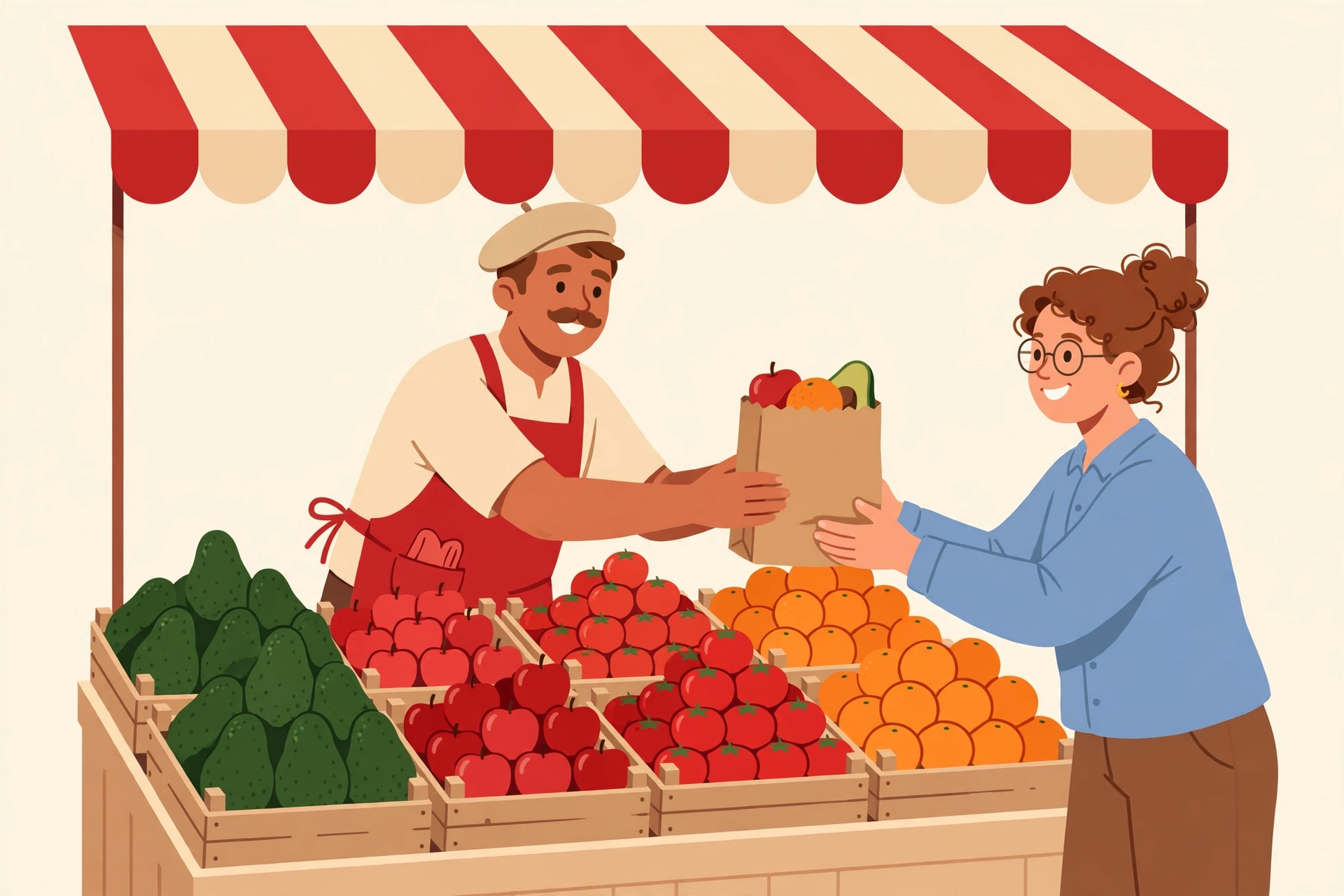
- Buenos días. — Good morning. (In the afternoon, say Buenas tardes.)
- ¿Cuánto cuesta? — How much does this cost? (Asking about one item.)
- ¿Cuánto cuestan? — How much do these cost? (Asking about several items — notice that cuesta becomes cuestan in the plural.)
- Quiero un kilo de manzanas, por favor. — I would like a kilo of apples, please. (Swap manzanas for what you need: tomates means tomatoes, plátanos means bananas, aguacates means avocados.)
- Medio kilo de tomates, por favor. — Half a kilo of tomatoes, please.
- ¿Tiene aguacates maduros? — Do you have ripe avocados? (Maduro means ripe — this one word can save you from buying fruit that is still hard and green.)
- Me llevo esto. — I’ll take this.
- ¿Puedo pagar con tarjeta? — Can I pay by card?
- ¿Me puede dar una bolsa, por favor? — Could you give me a bag, please?
- ¡Qué rico! — How delicious! (Say it after a taste — every vendor loves hearing this.)
- No, gracias, solo estoy mirando. — No, thank you, I’m just looking. (The politest escape line when you are not ready to buy.)
Want to sound one level more polite? Swap Quiero… (I want…) for Me gustaría… (I would like…). Both are correct; Me gustaría sounds softer when you are talking to an older vendor or someone you have just met.
Listen: the market survival phrases — greetings, prices, buying, and paying
Listen once, then say each phrase out loud yourself. Your mouth needs the practice as much as your memory does, and hearing the questions in a row trains your ear for the real thing.
Your Survival Phrases for the Café
Ordering coffee is the easiest win in the whole challenge. These phrases will make you sound like a regular:

- Un café con leche, por favor. — A coffee with milk, please. (The safest choice anywhere in the Spanish-speaking world.)
- Me gustaría un café americano, sin azúcar. — I would like a black coffee, no sugar.
- Para llevar, por favor. — To take away, please. (Staying in? Say Para tomar aquí.)
- ¿Tienen leche de avena? — Do you have oat milk? (Leche de avena is oat milk; lactose-free milk is leche sin lactosa.)
- Un café grande / pequeño, por favor. — A large / small coffee, please.
- La cuenta, por favor. — The bill, please.
- ¡Qué rico está este café! — This coffee is so delicious!
A fun fact to know: in Colombia, ordering a tinto gets you a cup of black coffee — not a glass of red wine. Every Spanish-speaking country has its own little coffee vocabulary, but café con leche is understood everywhere.
Listen: the café phrases — ordering, sizes, milk options, and the bill
Pronunciation: 5 Rules That Carry the Whole Week
You do not need to sound like a native speaker before you start talking. These five rules are enough for people to understand you right away:
- The letter h is silent: hola is pronounced “oh-lah,” not “hoh-lah.”
- The letter j sounds like a soft “kh”: jamón (ham) sounds close to “kha-MOHN.”
- The letters ll usually sound like “y”: calle (street) is pronounced “CA-yeh” — in most of Latin America, ll is simply the “y” sound.
- The letter ñ sounds like “ny”: mañana (tomorrow) is pronounced “ma-NYA-na.”
- The classic pair pero and perro: pero (but) taps the tongue once, lightly, while perro (dog) rolls it. Mixing these two up can cause a very funny misunderstanding — worth a few minutes of practice in front of a mirror.
If you want to warm up before day one, review the Spanish alphabet on the LingoBubbo Spanish hub and listen along. A little pronunciation practice now saves a lot of confusion later.
The 7-Day Plan: One Step Higher Each Day
Each day has a single mission. Do that one thing, and the day is a win.
- Day 1 — Just greet and thank. Every greeting, goodbye, and thank-you at the market and the café in Spanish: Buenos días, Gracias, Adiós. It sounds small, but this is the most important ice-breaking step of all.
- Day 2 — Order one complete coffee. One full sentence, for example Un café con leche, por favor. Para llevar. Order, pay, say thank you — all in Spanish.
- Day 3 — Ask the price of three things at the market. Walk around and ask the price of at least three different items with ¿Cuánto cuesta? or ¿Cuánto cuestan? You do not have to buy anything yet.
- Day 4 — Buy one thing with a full sentence. Upgrade from asking to actually buying: Quiero un kilo de manzanas, por favor. Pay, then say Gracias and Adiós.
- Day 5 — Add a description. Today every order and purchase must include one describing word: maduro (ripe), sin azúcar (no sugar), grande (large), pequeño (small). For example: Me gustaría un café grande, sin azúcar.
- Day 6 — Handle not understanding. Today, use a rescue phrase at least once on purpose: ask someone to speak more slowly, to repeat something, or to explain a new word. Speaking smoothly is not the point — day six trains the skill of getting stuck and carrying on anyway.
- Day 7 — The grand finale: a full Spanish morning. From the moment you step into the market until you leave the café, not one word of English escapes your lips. In the evening, write five sentences in Spanish telling the story of your day.
When You Get Stuck: 4 Rescue Phrases
Getting stuck is part of the challenge, not a failure. Keep these four phrases ready and you will never freeze:
- ¿Puedes hablar más despacio, por favor? — Could you speak more slowly, please?
- ¿Puedes repetir, por favor? — Could you repeat that, please?
- ¿Cómo se dice ___ en español? — How do you say ___ in Spanish? (Fill in the blank with the English word.)
- Lo siento, estoy aprendiendo español. — I’m sorry, I’m learning Spanish. (This one almost always earns you a smile and extra patience.)
Listen: the four rescue phrases plus a day-five coffee order
Score Yourself at the End of the Week
Do not grade yourself harshly. At the end of day seven, just answer these three questions honestly:
- How many Spanish sentences did you say without looking at your notes? (More than twenty is excellent for a first week.)
- Was there a moment when you understood what the vendor said without having to guess? (That is your first real listening milestone — worth celebrating.)
- Which day scared you the most, and which sentence got you through it? (That fear is the biggest lesson of the week.)
What Comes After Day 7
If you finish all seven days, the natural next challenge is to widen your Spanish-only zone to a restaurant, a bakery, or a pharmacy. And if you want to speak even more accurately, do not skip the two pairs of words that confuse beginners the most — our guide to Ser vs Estar and Por vs Para: Two Classic Spanish Traps Explained Simply will help you avoid the mistake almost every Spanish learner makes. To keep building your verb toolbox, the 100 everyday Spanish verbs in the present tense guide gives you a full table to build sentences from — try describing your whole market morning using only verbs from that list.
So, are you up for the challenge? Start tomorrow: walk into your usual café, order a café con leche in Spanish, and see what happens. If you want a structured path after these seven days, the LingoBubbo Spanish hub brings together the learning path, the alphabet, and lessons for every level, all free. Have a wonderful week of markets and coffee — ¡Buena suerte! (Good luck!)
Quick Quiz
Five questions on the challenge in this post. Pick one answer per question — you get instant feedback either way. Score: 0/5
1. You want to ask the price of several apples. Which question is correct?
2. What does “Me gustaría un café americano, sin azúcar” mean?
3. A vendor offers you something you do not want to buy. What is the polite reply?
4. What is the mission on Day 3 of the challenge?
5. You are stuck and need the vendor to slow down. Which phrase do you use?
How did you score? If you missed a question, scroll back to that section and re-read the phrases — then try them out loud tomorrow at your own market or café. Real conversations are the best review, so keep practicing in the LingoBubbo Spanish hub, and share this challenge with a friend who keeps saying they will “start speaking Spanish someday.”