
You are halfway through a TOPIK 1 listening question. A woman is buying apples at a market; the vendor asks her something, and she answers with a word you have never seen. You know 사과 means apple — but the rest slides past you, and the next question has already started. That is the whole TOPIK 1 vocabulary problem: it is not the hard words that catch you, it is the ordinary ones you never got around to learning.
Here is the short version. TOPIK 1 is the beginner level of the Test of Proficiency in Korean, covering levels 1 and 2, and it tests listening and reading only — no writing section. The commonly cited core vocabulary is around 800 words. That sounds big until you realise most are words you already meet in daily life: greetings, family, food, numbers, places, and a handful of everyday verbs. Learn them in groups that match real situations and the list stops feeling like a mountain.
What TOPIK 1 actually tests
TOPIK comes in two grades: TOPIK I covers levels 1 and 2, with two sections — listening and reading. TOPIK II covers levels 3 to 6 and adds a writing section. So at TOPIK 1 you never write an essay — but you read short passages and follow spoken dialogues, and both are pure vocabulary tests in disguise. The grammar is simple on purpose; the questions check whether you know the words.
That is good news: grammar takes months to internalise, but vocabulary you can build in weeks. The 800-word figure is a guide, not an official exact count — treat it as a target. If you can read and hear roughly 800 everyday Korean words without stopping to translate, you are ready.
TOPIK 1 vocabulary: the core list, grouped for real life
Most word lists are alphabetical, which is the worst way to learn — you do not meet words alphabetically in real life, you meet them in situations. Here is the core list grouped the way you will actually use it: one group at a time, said out loud, used in a sentence the same day.
| Group | Korean | Romanization | Meaning |
|---|---|---|---|
| Greetings | 안녕하세요 | annyeonghaseyo | hello |
| Greetings | 감사합니다 | gamsahamnida | thank you |
| Greetings | 죄송합니다 | joesonghamnida | sorry |
| Family & people | 가족 | gajok | family |
| Family & people | 어머니 | eomeoni | mother |
| Family & people | 아버지 | abeoji | father |
| Family & people | 친구 | chingu | friend |
| Food & drink | 밥 | bap | rice |
| Food & drink | 물 | mul | water |
| Food & drink | 커피 | keopi | coffee |
| Numbers & time | 하나 | hana | one |
| Numbers & time | 둘 | dul | two |
| Numbers & time | 오늘 | oneul | today |
| Numbers & time | 내일 | naeil | tomorrow |
| Places | 학교 | hakgyo | school |
| Places | 집 | jip | home |
| Places | 병원 | byeongwon | hospital |
| Everyday verbs | 가다 | gada | to go |
| Everyday verbs | 오다 | oda | to come |
| Everyday verbs | 먹다 | meokda | to eat |
| Everyday verbs | 마시다 | masida | to drink |
| Everyday verbs | 공부하다 | gongbuhada | to study |
Notice how much work the verbs do: 가다, 오다, 먹다, 마시다 and 공부하다 appear in almost every beginner dialogue, so five verbs unlock dozens of sentences.
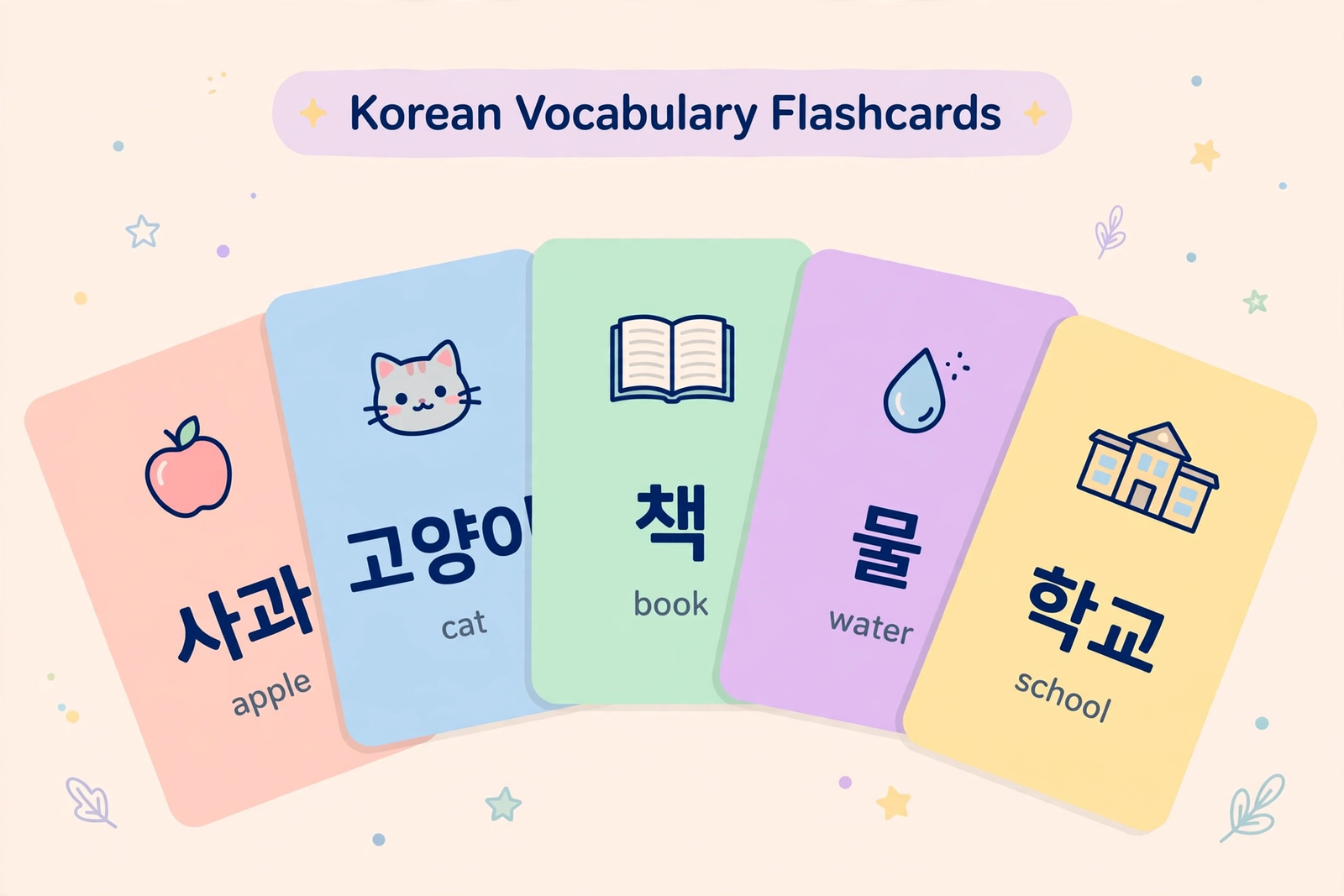
How to learn 800 words without drowning
Do not try to memorise fifty words in one evening — vocabulary goes in on Monday and out by Thursday that way. Ten words a day beats a hundred once a week, and at ten a day the core list takes about eleven weeks — a neat fit for a TOPIK 1 preparation plan.
Learn each word three ways: the Hangul, the sound, and a sentence. Read 학교 (hakgyo) aloud, then use it: “내일 학교에 가요” — “Tomorrow I go to school.” Three words from the table, practised at once.
Review matters more than the first meeting: a word seen once is a stranger; a word seen on day one, day three and day seven is yours. Keep a short list of the words you keep forgetting and drill those before bed.
The mistakes that cost beginners marks
Learning words in isolation. A word without a sentence is a fact without a home. If you only know that 밥 means rice, you will still freeze when the dialogue says “밥 먹었어요?” — “Have you eaten?” Learn the word inside a phrase and the phrase does the remembering for you.
Ignoring the verbs. Beginners love nouns — easy to picture, easy to flashcard. But the questions that trip people up are almost always about what someone did: went, came, ate, drank, studied. If your list is all nouns, your sentences have no engine.
Leaning on romanization. Romanization is training wheels: if you never take it off, you never really ride. Read the Hangul first and check the romanization only when you are stuck. By test day, the exam paper shows you Hangul — so should your practice.

Your two-week starter plan
☐ Learn the greetings first — 안녕하세요, 감사합니다, 죄송합니다 — and use them out loud every day.
☐ Add one group per day: family, food, numbers and time, places, verbs.
☐ Write one sentence per new word, using words you already know.
☐ Read a TOPIK 1 sample listening script and circle every word from the table.
☐ At the end of week two, cover the meanings and read the Hangul column only.
Two weeks in, you will have the skeleton of the core list in place and the rest will start to look familiar — so many words are built from the same roots. 밥 shows up in 아침밥 (breakfast) and 점심밥 (lunch); 학교 shows up in 학생 (student) and 선생님 (teacher). Learn the roots and the vocabulary grows by itself.
Quick Quiz
Test yourself on TOPIK 1 vocabulary. Click an answer to see if you are right — your score is at the top.
Score: 0/5
1. Which sections does TOPIK 1 test?
2. About how many core words does the post cite for TOPIK 1?
3. What does 학교 mean?
4. Why does the post warn against learning words in isolation?
5. At ten words a day, about how long does the core list take?
Quick answers
How many words do I need for TOPIK 1?
Around 800 everyday words is the commonly cited figure for TOPIK 1 — a guide, not an official exact count, but a useful target. If you can read and hear those words without translating in your head, you are ready.
Do I need to write in Hangul for TOPIK 1?
No — TOPIK 1 tests listening and reading only, with no writing section. You still need to read Hangul quickly and confidently, though: the whole exam is printed in it, and slow reading is the most common reason beginners run out of time.
What if I only know about 400 words?
You are halfway there, and the second half is easier than the first — the most frequent words do the most work, so 400 solid words already carry you through a surprising share of the test. Ten new words a day closes the gap in six weeks.
Is TOPIK 1 the same as TOPIK I?
Yes — TOPIK I is the grade covering levels 1 and 2, and TOPIK 1 is the beginner level within it. Same exam: listening and reading, no writing, aimed at beginners.
Eight hundred words sounds like a lot until you meet them in groups that match your day — a greeting on the way in, food on the table, a friend at school. Start with the table above, ten words a day, and let the sentences do the rest. Our Korean programme teaches TOPIK 1 vocabulary the same way, through real dialogues, so the words you learn are the words you will hear on test day.