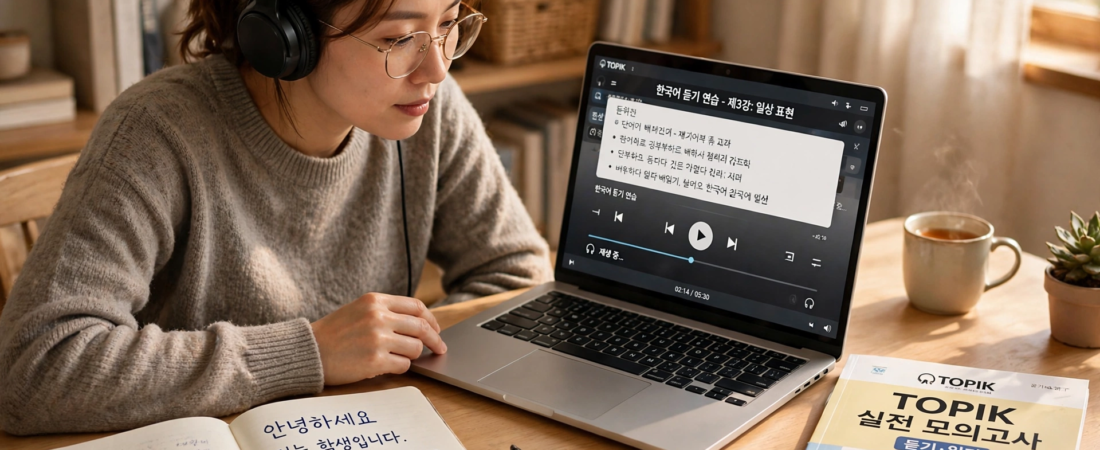
Thirty questions. Forty minutes. Every recording plays exactly once. That is the TOPIK I listening test, and it surprises more learners than any other section, because reading lets you pause and think while listening does not wait for you.
The good news: TOPIK listening practice tips work because this section is the most trainable part of the exam. The speakers are slower than real life, the topics are everyday, and the questions ask about facts, not tricks.
What the TOPIK listening test actually looks like
TOPIK comes in two levels. TOPIK I, for levels 1 and 2, has 30 listening questions in 40 minutes. TOPIK II, for levels 3 to 6, has 50 in 60 minutes. Listening comes first in both papers, and in both the audio plays exactly once, with no replay and no pause. That single fact shapes everything about how you should practise.
The questions stay close to daily life: meeting times, announcements, phone calls, weather, and shopping. You need fast ears for ordinary words, numbers, times, and places.
TOPIK listening practice tips: the three kinds of audio you will hear
Nearly all TOPIK listening falls into three kinds of audio. Recognise each one, and you will know what to listen for.
1. Everyday conversations
Most of the test is two people talking about ordinary plans, and the question usually asks about a time, a place, or a decision. Listen to this short exchange and notice how much sits in three small sentences.
지금 몇 시예요? 세 시예요. 버스는 네 시에 와요.
Jigeum myeot siyeyo? Se siyeyo. Beoseuneun ne sie wayo.
“What time is it now? It is 3 o’clock. The bus comes at 4.”
Short dialogue, what time it is and when the bus comes
The question could ask any of these: What time is it now? When does the bus come? Train your ear to catch numbers and times first, because exam questions love exactly these details.
2. Announcements — the loudspeaker voice
Announcements are the audio type beginners fear most, because the voice sounds formal and the sentences run long. In practice they are the easiest to predict: which station, which door, what to do next.
다음 정거장은 홍대입구역입니다. 내리실 문은 오른쪽입니다.
Daeum jeonggeojangeun Hongdae-ipgu-yeogimnida. Naerisil muneun oreunjjogimnida.
“The next station is Hongik University Station. The doors that will open are on the right.”
Subway announcement, next station and which side the doors open
Learn these announcement words: 다음 (daeum, next), 정거장 (jeonggeojang, station), 문 (mun, door), 오른쪽 (oreunjjok, right side). Once you know them, an announcement stops sounding like noise and starts sounding like a timetable.

3. News and weather — short and factual
The short talks in the later parts often sound like a newsreader: a few facts, delivered in order, with no small talk. Weather reports are the classic example.
오늘 서울의 날씨는 맑고, 최고 기온은 스물다섯 도입니다.
Oneul Seoul-ui nalssineun malkgo, choego gioneun seumuldaseot doimnida.
“Today the weather in Seoul is clear, with a high of 25 degrees.”
Weather report, clear skies in Seoul and a high of 25 degrees
News audio rewards a different habit: listen for the facts in order. Who, what, when, how much. The question asks for one of those four.
Five listening habits that actually work
Read the question before the audio starts. You get a few seconds of silence before each recording. Use them. If the question asks about a time, listen for a number; if it asks about a place, listen for a station name. Guessing blind wastes your one play.
Catch the question words. Most TOPIK listening questions begin with one of these: 누구 (who), 무엇 (what), 어디 (where), 언제 (when), 왜 (why), 어떻게 (how). Hear the question word and you already know what kind of answer to hunt for.
Let one missed word go. This is the hardest habit and the most important. One unknown word is one word, but stopping to think about it costs you the next two sentences, and the answer is usually there.
Listen twice in practice, never in the test. At home, play a clip once and answer, then play it again and check what you missed. That gap is where your learning lives, and on test day the single play will feel normal.
Shadow the audio out loud. Repeat what you hear a half-second behind the speaker, like an echo. It feels silly for a week, then your mouth starts recognising sounds your eyes never taught it.
The six question words that unlock half the test
Nearly every TOPIK listening question starts with one of these six words. Learn them cold.
| Korean | Romanization | Meaning | You will hear it when the question asks… |
|---|---|---|---|
| 누구 | nugu | who | a person |
| 무엇 | mueot | what | a thing |
| 어디 | eodi | where | a place |
| 언제 | eonje | when | a time |
| 왜 | wae | why | a reason |
| 어떻게 | eotteoke | how | a method |
Listen to the three question words in action, and say them back out loud. Hearing them fast only comes from hearing them often.
Three questions, who called, what did you buy, where are you going
Your four-week TOPIK listening plan
Fifteen to twenty minutes a day is enough, building from slow dialogues to real-speed news one small step at a time.
| Week | Daily practice | Minutes |
|---|---|---|
| Week 1 | Slow TOPIK dialogues; note every time and place | 15 |
| Week 2 | Announcements and weather; shadow each clip once | 15 |
| Week 3 | Full practice section, timed, one play only | 20 |
| Week 4 | Real news clips; one timed test every other day | 20 |
Keep a small notebook for the words you keep missing, usually the same ten or twenty. Once they are yours, whole sentences unlock, and by week four the exam pace feels familiar, not frightening.

Quick answers about TOPIK listening practice
How long is the TOPIK listening section?
TOPIK I listening is 30 questions in 40 minutes; TOPIK II is 50 questions in 60 minutes. In both levels the audio plays once.
Does the audio really play only once?
Yes. Every TOPIK listening recording plays once, with no pause or replay, which is why timed, one-play practice matters more than extra vocabulary.
What should I do if I miss a word during the test?
Keep listening, mark your best guess, and move on. One missed word costs one question; freezing over it can cost you the next three.
Quick quiz: TOPIK listening practice
Tap the answer you choose. You will know right away if it is correct.
Question 1. How many listening questions does TOPIK I have?
Question 2. How many times does the TOPIK listening audio play?
Question 3. What does “다음 정거장은 홍대입구역입니다” mean?
Question 4. Which question word asks “when”?
Question 5. What should you do if you miss a word during the test?
Listening is the one TOPIK skill you cannot cram the night before, but fifteen minutes a day builds it faster than you think. Start tonight: pick one short Korean clip, listen once, and write down the number or time you heard. For a guided path with audio lessons and practice built in, explore our Korean programme or try our English programme for learners who love the same everyday, speak-first method.