
# What to Say in English When Your Passenger Changes the Destination Mid-Ride
You are halfway to downtown when your passenger leans forward and says, “Actually, can we go to the airport instead?” Your hands are on the wheel, the GPS is talking, and you have about three seconds to answer in English. This guide gives you the exact words for that moment: what to say when a passenger changes the destination mid-ride, how to ask them to update the app, how to talk about the extra time, and how to finish the trip with a smile.
The Situation: Your Passenger Changes Destination Mid-Ride
It happens on almost every shift. A passenger changes destination mid-ride because their plans changed, they typed the wrong address, or a friend just texted them a new meeting place. Sometimes they want to stop at a store first. Sometimes they want to go to a different home, a hospital, or the airport.
Here is the good news: you do not need perfect English for this. You need about ten short sentences, said calmly, in the right order. First, you say yes and stay friendly. Then you ask the passenger to update the destination in the app. Then you confirm the new address, the new time, and the new route. That is the whole job.
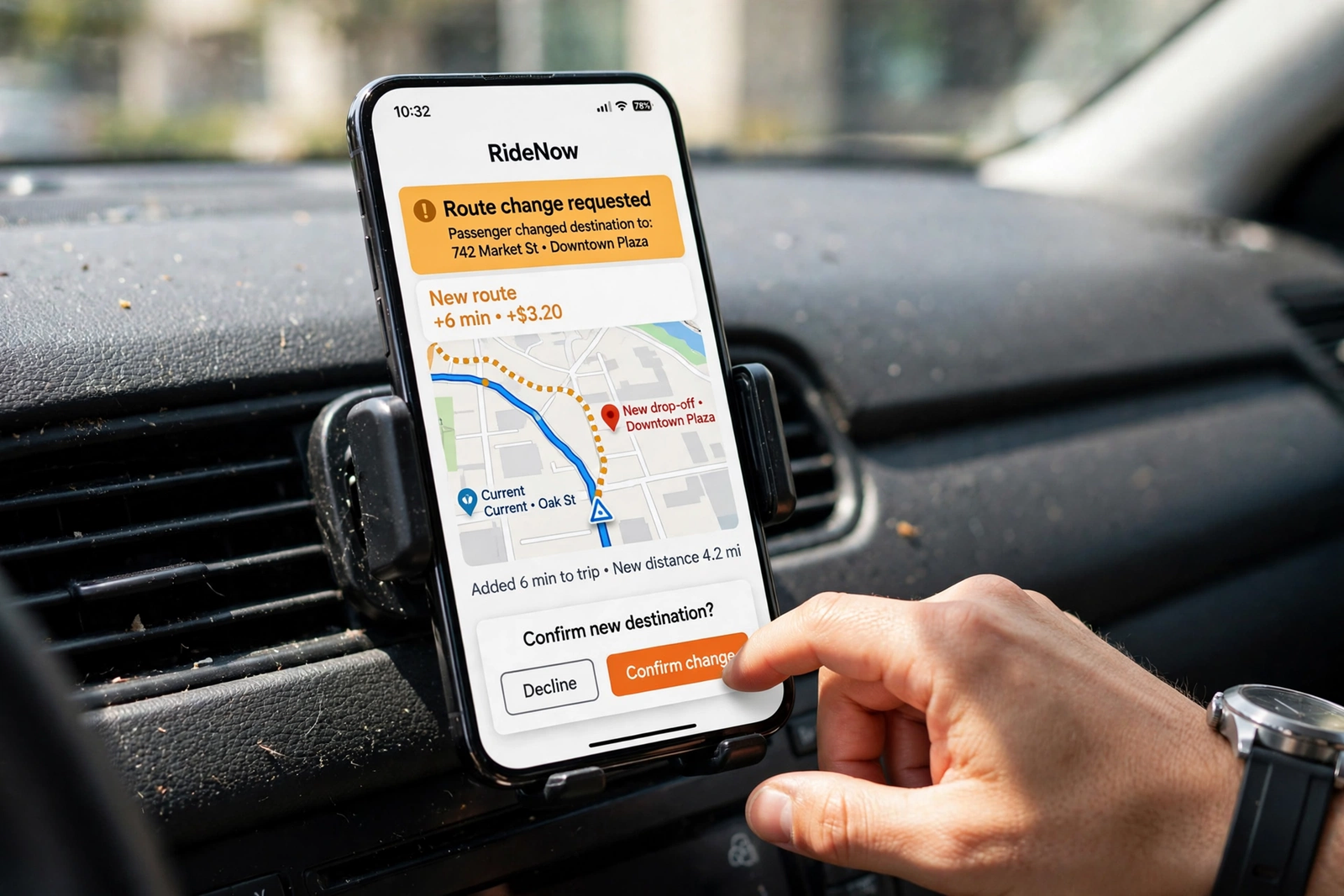
One thing to remember before we start: in the United States, the passenger should change the destination in the rideshare app. That keeps the trip record correct. Your words just guide them to do it. You are not making a promise about the fare, the time, or the route — the app shows those numbers. Your English only needs to keep the conversation smooth and clear.
What the Passenger Usually Says
Before you answer, it helps to recognize what you will hear. Passengers say the same few things, almost word for word. Listen for the key words: “instead,” “change,” “wrong address,” and “how much longer.”
| What the passenger says | What it means in Vietnamese |
|---|---|
| “Can we change the destination, please?” | Chúng ta có thể đổi điểm đến được không? |
| “I need to go to the airport instead.” | Tôi cần đi sân bay thay vì chỗ kia. |
| “Sorry, I put in the wrong address.” | Xin lỗi, tôi đã nhập sai địa chỉ. |
| “Can you take me to Main Street instead?” | Bạn có thể chở tôi đến đường Main thay vì chỗ kia được không? |
| “How much longer will it take?” | Sẽ mất thêm bao lâu nữa? |
| “Can we stop at the store on the way?” | Chúng ta có thể ghé cửa hàng trên đường đi không? |
| “My friend just sent me a new address.” | Bạn tôi vừa gửi cho tôi địa chỉ mới. |
| “Actually, I need to go home first.” | Thật ra, tôi cần về nhà trước. |
Did you notice the pattern? “Instead” is the magic word. It means “thay vì” — the new place replaces the old place. When you hear “instead,” you know a change is coming. And “Can we…?” is a polite request, not a question about your ability. The passenger is asking for your help, not testing you.
What You Say Back as the Driver
Your first sentence sets the tone for the rest of the ride. Start with “No problem” or “Sure.” Those two little words tell the passenger that everything is fine. Then ask them to update the app. Here are the eight driver sentences to learn first.
| What you say | What it means in Vietnamese |
|---|---|
| “No problem. I can take you there.” | Không vấn đề gì. Tôi có thể chở bạn đến đó. |
| “Sure. Can you update the destination in the app, please?” | Được chứ. Bạn có thể cập nhật điểm đến trong ứng dụng được không? |
| “Let me check the new route.” | Để tôi kiểm tra lộ trình mới. |
| “It will take about ten more minutes.” | Sẽ mất thêm khoảng mười phút nữa. |
| “We will arrive around six thirty.” | Chúng ta sẽ đến nơi vào khoảng sáu giờ rưỡi. |
| “I will take the freeway to save time.” | Tôi sẽ đi đường cao tốc để tiết kiệm thời gian. |
| “I can’t take you there, but I can drop you off nearby.” | Tôi không thể chở bạn đến đó, nhưng tôi có thể thả bạn ở gần đó. |
| “No problem, I will drop you off at the new address.” | Không vấn đề gì, tôi sẽ thả bạn ở địa chỉ mới. |
Say sentence number two slowly, because it is the most important one: “Can you update the destination in the app, please?” It is polite, it is clear, and it puts the change where it belongs — in the app, where the fare and the route update by themselves. You do not need to argue about the price or guess the new fare. The app does that part.
What if the new place is too far, or outside the area you can drive to? Then use sentence number seven. It is honest and kind at the same time: “I can’t take you there, but I can drop you off nearby.” The word “but” gives the passenger a second option instead of a closed door. Most passengers accept that right away.
How to Pronounce the Key Words
You do not need a perfect American accent. You need to be understood. These are the words that carry the whole conversation, so practice them out loud before your next shift. Say each one slowly, then at normal speed.
| Word | Simple pronunciation | Meaning |
|---|---|---|
| destination | des-tuh-NAY-shun | điểm đến |
| instead | in-STED | thay vì |
| update | up-DAYT | cập nhật |
| route | ROOT (like “root”) | lộ trình, tuyến đường |
| arrive | uh-RYVE | đến nơi |
| freeway | FREE-way | đường cao tốc |
| airport | AIR-port | sân bay |
| address | uh-DRESS | địa chỉ |
A small tip that helps many drivers: stress the capital part. “Des-tuh-NAY-shun” — the loud part is “NAY.” When you stress the right syllable, Americans understand you even if the rest of the word is not perfect. Try it now: “Can you update the DESTINATION in the app, please?” Good. One more time, a little faster.
The Full Role-Play Dialogue
Now let us put everything together. Read this short dialogue out loud. First read the driver lines. Then read the passenger lines. Then listen to the audio and repeat after it, line by line. This is the closest thing to real practice without a real passenger in the back seat.
Driver: Hi, no problem. Where would you like to go instead?
Passenger: Actually, can we go to the airport instead of downtown?
Driver: Sure. Can you update the destination in the app, please?
Passenger: Of course. I just changed it. Do you see the new address?
Driver: Yes, I see it. It will take about twenty more minutes. Is that okay?
Passenger: That’s fine. Thank you so much.
Driver: You’re welcome. I’ll take the freeway to save time.
Notice how short the sentences are. Nobody in this dialogue speaks in long, complicated sentences, and that is exactly how real Americans talk in a car. Short is clear. Clear is polite. You do not need long sentences to sound professional — you need the right short ones, said with a friendly voice.
Practice tip: say the dialogue three times before your shift. The first time, read it slowly. The second time, say it without looking at the words. The third time, change one detail — the airport becomes a hospital, downtown becomes a friend’s house. If you can swap the place name and keep the rest of the sentence, you really know it.
The New Route, the New Time, and the New Fare
After the passenger updates the app, they often ask two questions: how long, and how much. You can answer the time question easily, because the GPS shows it. The fare question is different, so be careful with your words.
Say this about time:
– “It will take about fifteen more minutes.” – “We will arrive around seven o’clock.” – “The new route is a little longer, but it is faster.”
Say this about the fare, and nothing more:
– “That will be about five dollars more.” – “The app will show the new fare.”
That second sentence is your best friend. “The app will show the new fare.” It is true, it is polite, and it keeps you out of any argument about money. Never promise an exact price. Never say “It is free” or “It costs the same.” Let the app give the number. Your job is to drive and to keep the passenger calm, not to set the price.
And what about the passenger who wants to add a stop on the way? That is common too. Say: “Sure, we can stop for a few minutes. Please add the stop in the app.” Short, friendly, and again the app keeps the record straight.
Common Mistakes to Avoid
Even drivers with good English make these mistakes when they are in a hurry. Check yourself against this list after your next few trips.
1. Saying “Where you go?” instead of “Where would you like to go?”
“Where you go?” sounds rushed and a little rude, even when you do not mean it that way. Add the polite frame: “Where would you like to go instead?” It takes one extra second and it changes the whole feeling of the sentence.
2. Answering with only “OK” or “Yes.”
“OK” is not wrong, but it gives the passenger nothing to work with. They do not know if you understood the new address. Say the full short sentence instead: “Sure. Can you update the destination in the app, please?” Now they know exactly what to do next.
3. Guessing the new fare.
“I think it is ten dollars more” can turn into an argument at the end of the ride. Do not guess. Say “The app will show the new fare,” and let the app do the talking.
4. Driving to the new place before the app updates.
This is the practical mistake that causes the most trouble. If you drive before the passenger updates the app, the trip record, the fare, and the GPS can all disagree. Wait for the words “I just changed it,” check the screen, and then drive.
5. Forgetting to confirm out loud.
Always say what you see: “Yes, I see it. It will take about twenty more minutes.” That one sentence stops most confusion before it starts. The passenger relaxes, you relax, and the rest of the ride is easy.
Quick Checklist: When a Passenger Changes Destination
Save this table on your phone, or say it to yourself before each shift. Five steps, in order, every time.
| Step | What to do | What to say |
|---|---|---|
| 1 | Stay calm and friendly | “No problem. I can take you there.” |
| 2 | Ask for the app update | “Can you update the destination in the app, please?” |
| 3 | Confirm the new address | “Yes, I see it.” |
| 4 | Give the new time | “It will take about ten more minutes.” |
| 5 | Drive the new route | “I will take the freeway to save time.” |
If you remember nothing else from this lesson, remember step two. The app update protects you, it protects the passenger, and it makes the fare and the route correct without any argument. Everything else is just being friendly in English.

Quick Quiz
Try these five questions now. Click an answer to see right away if you are correct. Keep an eye on your score at the top.
Score: 0/5
1. Your passenger says, “Can we go to the airport instead?” What is the best reply?
2. Which sentence politely asks about the extra time?
3. “It will take about ten more minutes” means…
4. You cannot drive to the new place. What is the best thing to say?
5. Which is the most polite way to confirm the new address?
Keep Learning on LingoBubbo
A destination change is only one of the moments that come up on the road. If you liked this lesson, keep going with the related lessons on LingoBubbo. Start with the full ride from pickup to drop-off in 50 English Sentences for Uber and Grab Drivers, From Pickup to Drop-Off, and then learn what to say when the pickup itself goes wrong in English Sentences for When the Driver Cannot Find the Pickup Point. For more lessons like this one, visit the English lessons on LingoBubbo.
Now it is your turn. The next time a passenger changes destination mid-ride, try the five-step checklist and say the sentences out loud. Then come back and tell us in the comments: what did your passenger say, and which sentence from this lesson did you use? Share this lesson with a fellow driver who is learning English — it might save their next trip, too.
FAQ
What should I say first when a passenger changes the destination mid-ride?
Say “No problem” or “Sure,” then ask, “Can you update the destination in the app, please?” A friendly yes first keeps the passenger calm, and the app update keeps the fare and route correct.
Do I need to change the destination in the app myself?
No. The passenger should update the destination in the rideshare app. Wait until they say “I just changed it,” check the new address on your screen, confirm it out loud, and then drive.
How do I tell the passenger about the extra time?
Look at the GPS and say, “It will take about ten more minutes,” or “We will arrive around seven o’clock.” Use “about” and “around” because the time is an estimate, not a promise.
What if I cannot drive to the new destination?
Say, “I can’t take you there, but I can drop you off nearby.” It is honest, it is polite, and it gives the passenger a useful second option instead of a flat no.
How can I practice these sentences before my next shift?
Listen to the audio in this lesson and repeat each line out loud. Then read the role-play dialogue three times, changing the place name each time. Short daily practice like this works better than one long study session.