
What is the first Chinese word your child should learn outside? Probably not a word from a textbook. It is the tree in your front yard, or the flower on the kitchen table. Children remember words they can touch, smell, and point at — and trees and flowers are everywhere they go. This guide teaches 15 Chinese words about trees and flowers for kids, with pictures, slow audio, and games you can play in five to ten minutes. No homework, no pressure, just a walk in the garden that turns into a language lesson.
Every word below comes with its Chinese character, its pinyin (the pronunciation guide), and a simple English meaning. Listen to the audio clips together, repeat out loud, and let your child point at the real thing. That is the whole method. If you do it once a day for a week, most kids will remember at least ten of these fifteen words — and they will ask for more.
How to use this lesson with your child (5–10 minutes)
Keep it short and keep it playful. Sit together, look at one group of words at a time, and play the audio clip. Your child repeats each word after the clip. Then go find the real thing: a tree outside the window, a flower in a book, a leaf on the sidewalk. One group a day is plenty. Three groups in one sitting is too much — the words will blur together, and your child will get bored. Slow wins here.
A quick note for parents: you do not need to speak Chinese yourself. The audio clips say every word slowly and clearly. Your job is to press play, cheer your child on, and play the games at the end. If your child mispronounces a word, just replay the clip and try again together. There is no test, no grade, and no wrong way to practice at home.
8 tree words: big, small, and green
Trees are the easiest place to start because every child knows what a tree is. Start with the big word — 树 (shù), which means “tree” — and build from there. Listen to the clip first, then read the list together.
| Chinese | Pinyin | English | Try saying it |
|---|---|---|---|
| 树 | shù | tree | 这是一棵树。(This is a tree.) |
| 大树 | dà shù | big tree | 大树很高。(The big tree is tall.) |
| 松树 | sōngshù | pine tree | 松树是绿色的。(The pine tree is green.) |
| 柳树 | liǔshù | willow tree | 柳树很美。(The willow tree is beautiful.) |
| 叶子 | yèzi | leaf / leaves | 叶子是绿色的。(The leaves are green.) |
| 树枝 | shùzhī | branch | 树枝上有叶子。(There are leaves on the branch.) |
| 树干 | shùgàn | tree trunk | 树干很粗。(The tree trunk is thick.) |
| 苹果树 | píngguǒ shù | apple tree | 苹果树上有苹果。(There are apples on the apple tree.) |
Two quick tips before you move on. First, notice how 树 (shù) appears inside almost every tree word — 大树 is just 大 (big) + 树 (tree), and 苹果树 is 苹果 (apple) + 树 (tree). Once your child knows 树, half the list is already easy. Second, the tone on 树 is the falling fourth tone, shù — a firm drop, like saying “shoo!” to a cat. Children love practicing that one.

7 flower words: colors, petals, and gardens
Flowers are where the colors come in, and colors make everything stick. 红花 (hóng huā) is a red flower, and your child already knows red. Link the new word to a color they know, and the word has somewhere to live in their memory.
| Chinese | Pinyin | English | Try saying it |
|---|---|---|---|
| 花 | huā | flower | 这是一朵花。(This is a flower.) |
| 红花 | hóng huā | red flower | 红花很漂亮。(The red flower is pretty.) |
| 玫瑰花 | méiguī huā | rose | 玫瑰花很香。(The rose smells nice.) |
| 向日葵 | xiàngrìkuí | sunflower | 向日葵很大。(The sunflower is big.) |
| 荷花 | héhuā | lotus flower | 荷花在水里。(The lotus is in the water.) |
| 花瓣 | huābàn | petal | 花瓣是粉色的。(The petal is pink.) |
| 花园 | huāyuán | garden | 花园里有很多花。(There are many flowers in the garden.) |
One word here deserves a little story. 向日葵 (xiàngrìkuí), the sunflower, is made of three parts: 向 means “toward,” 日 means “sun,” and 葵 is the flower itself. So a sunflower is literally the flower that turns toward the sun. Tell your child that story once, and they will never forget the word. The lotus, 荷花 (héhuā), is the flower of summer ponds in China — if you have a picture book with a pond, show it while you say the word.
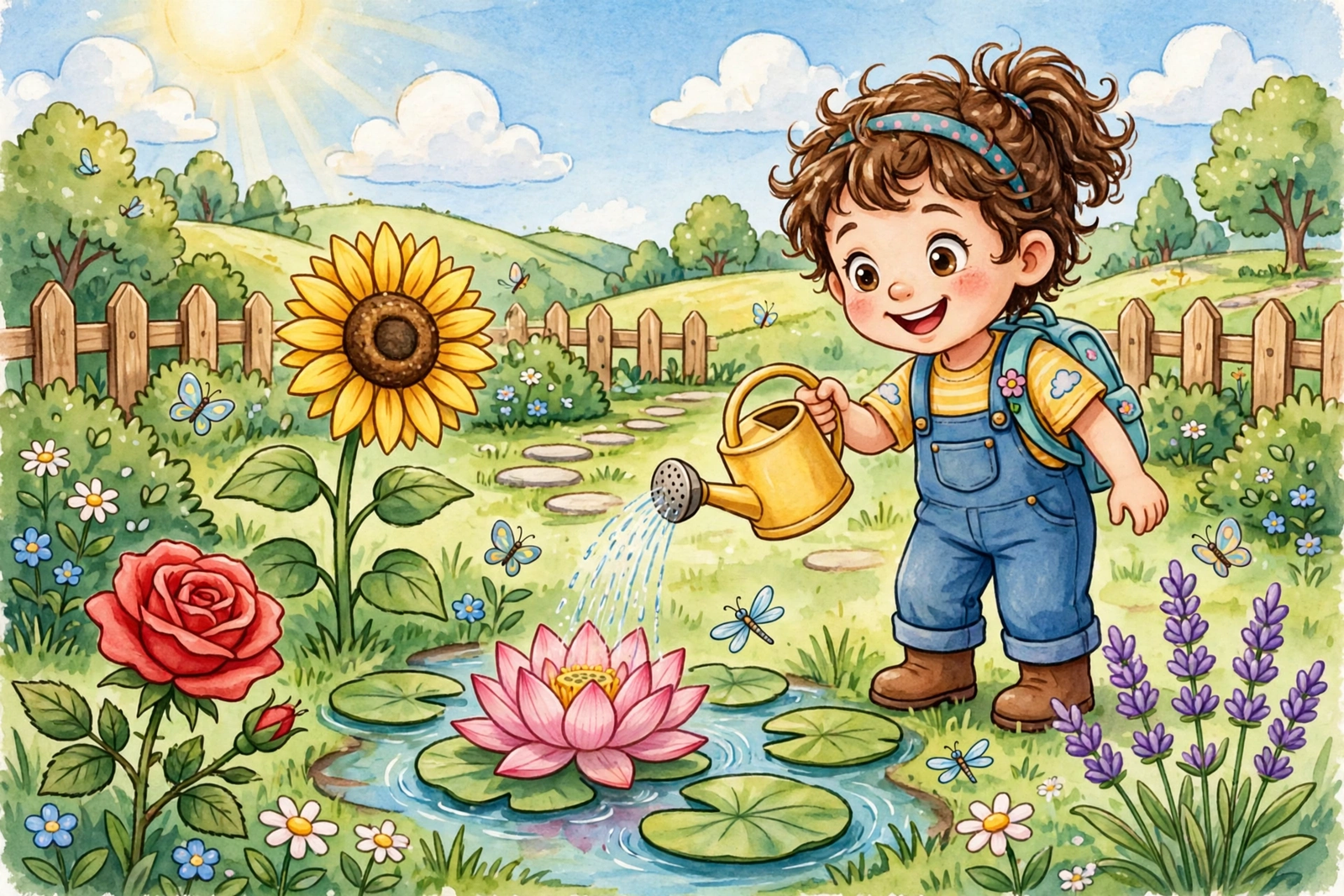
Put the words together: 4 little sentences
Single words are the start, not the finish. Short sentences show your child how the words actually work, and they are much more fun to say out loud. Listen to the clip, then say each sentence together — slowly first, then a little faster.
- 我喜欢花。 (Wǒ xǐhuan huā.) — I like flowers.
- 花园里有很多花。 (Huāyuán lǐ yǒu hěn duō huā.) — There are many flowers in the garden.
- 树很高,花很美。 (Shù hěn gāo, huā hěn měi.) — The tree is tall, and the flowers are beautiful.
- 春天来了,树开花了。 (Chūntiān lái le, shù kāi huā le.) — Spring has come, and the tree is blooming.
Do not worry about the extra words in these sentences — 喜欢 (xǐhuan, to like), 春天 (chūntiān, spring), 来了 (lái le, has come) — your child does not need to memorize them yet. They are the glue that holds the tree and flower words together, and your child will absorb them naturally by hearing the sentences a few times. The goal today is just to hear the words inside real sentences and enjoy saying them.
3 games to play in 5–10 minutes
Games are where the learning actually happens. A child who plays with a word three times remembers it better than a child who repeats it ten times from a list. Here are three games that work with these fifteen words, and none of them needs any preparation.
Game 1: Point and say. Go outside or look out the window. You say a word in English — “tree!” — and your child points at a tree and says 树 (shù). Then switch: your child says the English word, and you answer in Chinese. Five rounds, two minutes, done.
Game 2: What is missing? Lay out three pictures or three real leaves and flowers on the table. Your child closes their eyes, you take one away, and they open their eyes and say the missing word in Chinese. This one works beautifully with 叶子 (leaf), 花瓣 (petal), and 玫瑰花 (rose).
Game 3: The question chant. Listen to the last audio clip and chant along with it. It asks and answers, back and forth — what tree? A big tree. What flower? A red flower. Children love call-and-response, and the rhythm makes the words stick without any effort at all.
Quick Quiz
Try these five questions with your child now. Click an answer to see right away if you are correct. Keep an eye on your score at the top.
Score: 0/5
1. What does 树 (shù) mean?
2. Which word means “sunflower”?
3. What does 叶子 (yèzi) mean?
4. Which sentence means “There are many flowers in the garden”?
5. Which word is built from 树 (shù, tree) plus another word?
Frequently asked questions
What age is this lesson for?
The words suit children from about 4 to 12 years old. Younger children can learn the five simplest words — 树, 花, 叶子, 大树, 红花 — while older children can take on the full list of fifteen and the practice sentences.
How many words should my child learn in one day?
Five is a good day. Eight is a great day. Fifteen in one sitting is too many, and your child will forget most of them by dinner. Spread the list across three short sessions and play one game after each session.
Do I need to know Chinese to teach this?
No. The audio clips pronounce every word slowly and clearly. Listen together, repeat together, and point at real trees and flowers. That is the whole lesson.
What comes after trees and flowers?
Animals are the natural next step — children already love them, and the same point-and-say game works perfectly. Try our 15 wild animals in Chinese with pictures for kids next, or play the Chinese character and picture matching game to review everything your child has learned so far.
Keep going
Fifteen words, four audio clips, and three games — that is a full week of tiny lessons hiding inside one garden walk. Tomorrow, point at one tree and one flower on the way to school and ask your child for the Chinese words. If they remember even two, the lesson worked. Then come back and play the games again, or explore more word games on our Chinese word games page.
Which word did your child learn fastest — a tree word or a flower word? Tell us in the comments. Your answer might help another parent pick the perfect first word for their child.