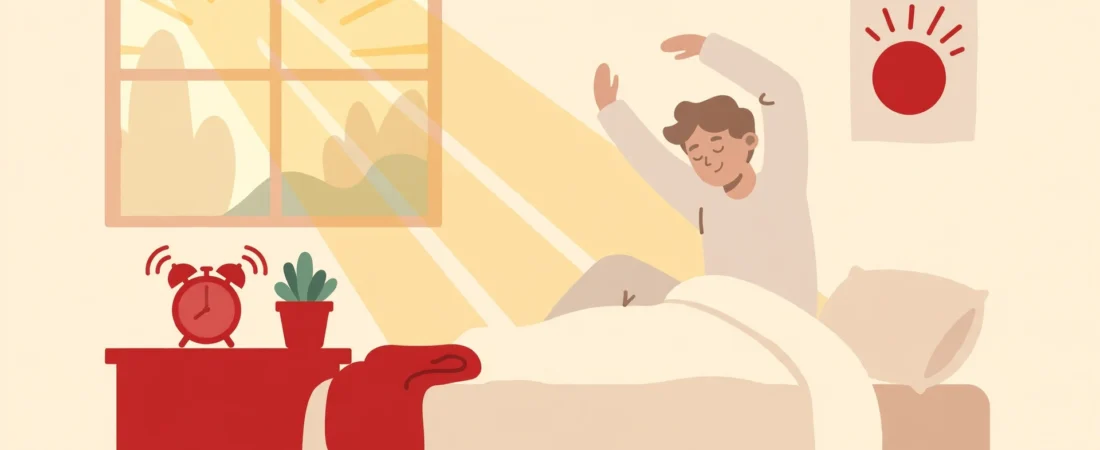
You open your eyes, turn off the alarm, get dressed, leave the house — and you’ve just “used” a good dozen phrasal verbs in your head without even noticing. Native speakers speak English with phrasal verbs far more than you’d think, and learning them is the fastest way to follow films and chat naturally.
A phrasal verb is a verb plus a preposition or adverb, and its meaning is often completely different from the verb’s original meaning. This post rounds up 20 phrasal verbs tied to an ordinary day in your life — learn them in the order of a day, remember them as a story, no learning by rote.
In the morning: waking up and getting ready
- wake up — to wake up: I wake up at 6 every day. (I wake up at 6 o’clock every day.)
- get up — to get out of bed: I wake up at 6 but I don’t get up until 6:30. (I’m awake at 6 but I don’t get out of bed until 6:30.) Note the difference between wake up (waking) and get up (getting out of bed).
- turn off — to turn off: Turn off the alarm, please! (Turn the alarm off, please!)
- put on — to put on: She puts on her jacket before going out. (She puts her jacket on before going out.)
- take off — to take off: Take off your shoes at the door. (Take your shoes off at the door.)
Out and about: getting around and getting things done
- drop off — to take someone somewhere and leave them there: I drop off my son at school at 7. (I drop my son at school at 7.)
- pick up — to pick someone up: I pick him up at 4 in the afternoon. (I collect him at 4 in the afternoon.)
- run out of — to run out, to be used up: We ran out of milk this morning. (We ran out of milk this morning.)
- look for — to look for: I’m looking for my keys. (I’m looking for my keys.)
- find out — to find out, to discover: I found out that the shop opens at 9. (I found out that the shop opens at 9.)
At home: tidying up and looking after everyone
- clean up — to tidy up: Let’s clean up the kitchen after dinner. (Let’s tidy the kitchen after dinner.)
- look after — to look after: She looks after her little brother. (She takes care of her little brother.)
- sit down — to sit down: Sit down and have some tea. (Sit down and have some tea.)
- turn on — to turn on: Turn on the light, it’s dark. (Turn the light on, it’s dark.)
- come back — to come back: Dad comes back home at 6. (Dad gets home at 6.)
In the evening: relaxing and wrapping up the day
- hang out — to spend time with friends: We hang out at the park on weekends. (We hang out at the park at weekends.)
- work out — to exercise: He works out three times a week. (He exercises three times a week.)
- give up — to give up: Don’t give up, you’re doing great! (Don’t give up, you’re doing great!)
- hurry up — hurry up: Hurry up, we’re late! (Hurry up, we’re late!)
- wind down — to relax after a long day: I read a book to wind down. (I read a book to relax.)
Memory tip: learn them as a story, not as a list
Don’t copy these 20 phrases out onto paper and learn them by heart — retell a day in your own life in English instead, squeezing in as many phrasal verbs as you can: “I wake up, get up, turn off the alarm, put on my clothes…” If you can tell it in one go, you’ve learnt them. And when you watch films, pay attention: in every 10 lines of dialogue, phrasal verbs turn up more often than you’d think — that’s why films are hard to follow even when you know lots of “textbook” vocabulary.
If you’d like to build up your everyday conversation phrases, have a read of the post 20 English sentences Americans say every day (not slang — anyone can use them) on LingoBubbo — because phrasal verbs + conversation phrases are the combo that helps you understand and speak naturally, fastest.
Review the morning with a dialogue
Knowing the 20 phrases on paper is one thing; hearing them in real speech is quite another. A morning in our house usually sounds like this — have a listen and murmur along. Notice how wake up, get up, turn off, put on and take off turn up naturally, with nothing forced about them.
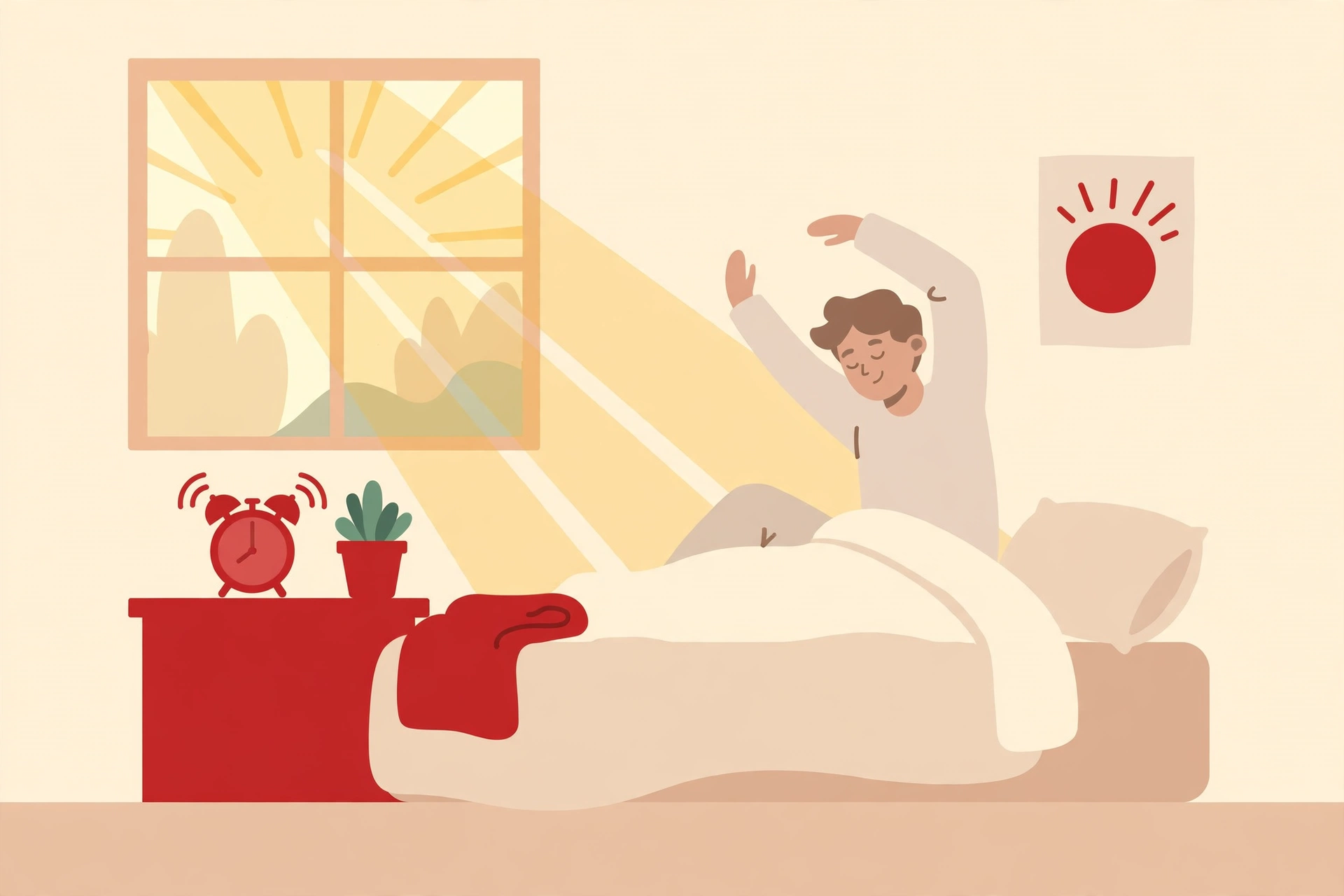
🎧 Have a listen: a morning dialogue
Once you’ve listened, try retelling your own morning in English — just these 5 phrases are plenty. If you can tell it in one go, without looking at the page, you’ve learnt them. Tomorrow, tell it again and add 2–3 afternoon phrases. Keep that up, and within a week you’ll have all 20 phrases without any learning by rote.
The 5 pairs of phrasal verbs people mix up most
Where learning phrasal verbs trips you up is this: two phrases look almost alike, but their meanings are completely different. Get one small word wrong and your sentence falls apart. Below are the 5 pairs my students mix up most — sort them out once, and you’ll remember them for good.
Look up and look for
Look up means to look something up, or to raise your eyes and look up: “I look up new words in the dictionary.” (I look up new words in the dictionary.) Meanwhile, look for means to be searching for something: “I’m looking for my keys.” (I’m looking for my keys.) Here’s a little memory trick: for goes with the thing you are searching for, up goes with the thing you look up — you glance up to find it.
Turn on and turn off
This pair is easy, but lots of people still say them the wrong way round when they’re in a hurry. Turn on means to switch on: “Turn on the light, it’s dark.” Turn off means to switch off: “Turn off the alarm, please!” Memory trick: on means on — there’s light, there’s sound; off means off — all quiet.
Pick up and drop off
Pick up means to collect someone, or to pick up/grab something extra on the way: “I pick him up at 4 in the afternoon.” Drop off is the opposite — you take someone to a place and then carry on your way: “I drop off my son at school at 7.” These two often come as a pair in a parent’s day: in the morning you drop off drop off your child at school, and in the afternoon you pick up pick up them and bring them home.
Wake up and get up
Wake up is just waking — your eyes open, your head clears, but you’re still lying in bed. Get up is when you actually stand up and get out of bed. The sentence in this post makes it clear: “I wake up at 6 but I don’t get up until 6:30.” — awake at 6, but not out of bed until 6:30. We’ve all had mornings like that, haven’t we?
Give up and hurry up
Give up means to quit, to stop trying: “Don’t give up, you’re doing great!” Meanwhile, hurry up means to hurry up, to get a move on: “Hurry up, we’re late!” Both phrases have up at the end, but one is about letting go and the other is about hurrying you along. Don’t let the up fool you — the meaning sits in the verb that comes before it.
Out and about: listen to an afternoon dialogue
The afternoon is when the drop off, pick up, run out of and look for turn up thickest: collecting the kids, running out of milk, looking for keys. The dialogue below packs all four phrases into one very everyday situation — have a listen and see how many of them you can catch.

🎧 Have a listen: an afternoon dialogue
If you don’t catch them all on the first listen, just listen again. Each time, you’ll hear one more phrase clearly — that’s how your ears gradually get used to real native-speaker speed. Don’t try to translate word by word in your head; just notice the phrases you’ve learnt and tick them off mentally.
3 mistakes Vietnamese learners often make with phrasal verbs
Knowing the meanings but still using them wrongly — it usually comes down to the three mistakes below. Fix these three, and your English sentences will sound much more natural.
Mistake 1: putting the object in the wrong place. With a separable phrase like pick up, the pronoun has to squeeze into the middle: “I pick him up at 4″ is the correct form, while “I pick up him” sounds really awkward. A small rule: a noun can go in either place (“pick up the kids” or “pick the kids up” are both correct), but a pronoun (him, her, it, them) absolutely has to squeeze into the middle.
Mistake 2: translating literally, word by word. Run out of translated word by word would come out as “to run out of a place” — meaningless. “We ran out of milk” simply means “we’ve run out of milk at home”. Phrasal verbs have to be learnt as whole phrases; don’t break them into pieces and translate them. When you meet a new phrase, ask: what does this whole phrase mean in this sentence — don’t ask what each word means.
Mistake 3: forgetting to change the tense of the main verb. Ran out of is the past tense of run out of; found out is the past tense of find out. Lots of people say “Yesterday we run out of milk” — wrong tense; the listener still understands, but the sentence loses its natural feel. Remember: only the main verb changes tense; the little word after it stays the same.
In the evening: relax and review the whole day
In the evening, once you’ve cleaned up clean up the kitchen and the whole family has sat down come back together, that’s the best time to review. No need to open a notebook. Just sit down, read a book to wind down, and in your head retell today in English — from the moment you wake up right through to the moment you wind down. If you can get through all 20 phrases, that’s a successful day of learning.
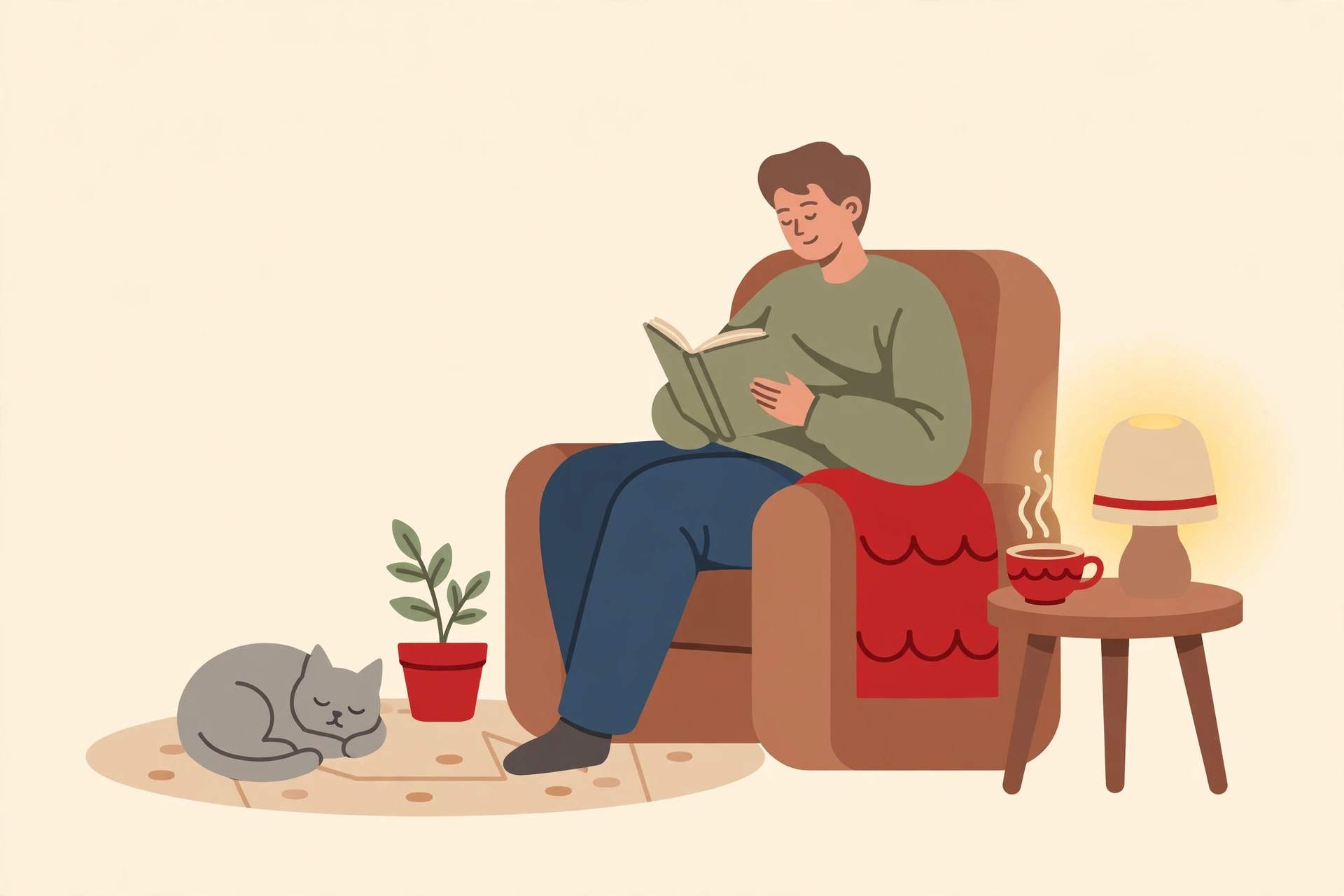
🎧 Have a listen: an evening dialogue
This dialogue contains clean up, hang out, wind down, give up and work out. Once you’ve listened, try answering this question in English: what will you do tonight to wind down? Even managing one sentence means you’re already practising speaking.
Quick summary: all 20 phrases in one table
Save this table so you can look things up quickly when you need to. Each phrase has just one main meaning — the meaning you’ll meet most often in everyday life.
- wake up — to wake up
- get up — to get out of bed
- turn off — to turn off
- put on — to put on
- take off — to take off
- drop off — to take someone to a place, then leave
- pick up — to pick someone up; to grab something extra
- run out of — to run out, to be used up
- look for — to look for
- find out — to find out, to discover
- clean up — to clean up, to tidy up
- look after — to look after
- sit down — to sit down
- turn on — to turn on
- come back — to come back
- hang out — to spend time with friends, to meet up
- work out — to work out, to exercise
- give up — to give up, to quit
- hurry up — to hurry up
- wind down — to relax after a long day
If you’d like to widen your vocabulary for feelings so you can chat more naturally, you can also read the post 20 English words for feelings, and how to say them so they sound real on LingoBubbo. And if you often get tangled up with in, at, on when telling stories about times and places, the post on the prepositions in, at, on in English: get them right, no more mistakes will help you untangle them. Phrasal verbs + feeling words + the right prepositions — those three together and your sentences sound natural straight away.
Once you’ve learnt these 20 phrases, don’t let them sit quietly in a notebook. Tomorrow, retell a day in your life in English, squeezing in as many phrases as you can. Tell your children, tell your friends, or just tell yourself while you’re washing the dishes. Send this post to a friend who is learning English alongside you — learning together is always more fun, and it sticks better than learning alone. And if you have a question, or a phrase you still find hard to remember, leave a comment below and I’ll reply.
Quick Quiz
Answer the 5 questions below to check whether you’ve learnt the 20 phrasal verbs yet! Score: 0/5
Question 1. What does “Look up” mean?
Question 2. What does the sentence “We ran out of milk this morning” mean?
Question 3. How do “Wake up” and “get up” differ?
Question 4. In the sentence “I pick him up at 4 in the afternoon”, what does “pick up” mean?
Question 5. Which sentence uses “give up” correctly?