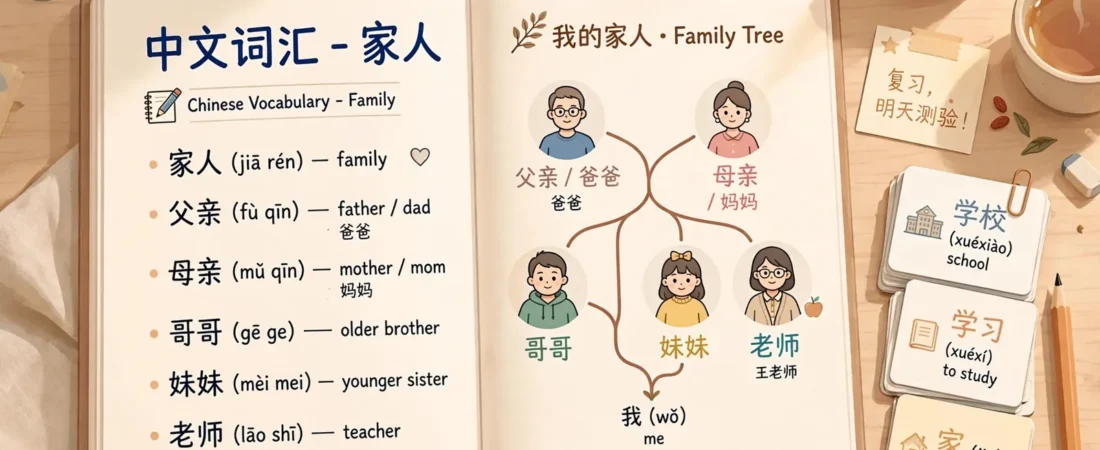
Open any HSK 1 practice test and the first thing you meet is people. Who is this? Is she your teacher? How many brothers do you have? The vocabulary list below answers all of that — every people noun in the official HSK 3.0 Level 1 word list, with pinyin, English meaning, and a real example sentence for each one. Learn these twenty-five words and you can describe your whole family, your classroom, and everyone you meet on a normal day, in Chinese.
One thing to know before you start: this list follows the HSK 3.0 syllabus — the new standard published in the official HSK 考试大纲 (Syllabus for the Chinese Proficiency Test) in November 2025 and in effect from July 2026. Under HSK 3.0, Level 1 has 300 words, double the 150 words of the old HSK 2.0 Level 1. That means some words you remember from an old list have moved to a different level, and a few new ones have joined Level 1. Everything in the tables below is drawn from the official HSK 3.0 Level 1 list, so you can study it with confidence. If you are new to the exam itself, start from the Chinese learning hub on LingoBubbo and then come back here to drill the words.
HSK 2.0 vs HSK 3.0: what changed for people words
The old HSK 2.0 Level 1 list had 150 words. The new HSK 3.0 Level 1 list has 300. For people words, that change cuts both ways, and it catches a lot of self-learners by surprise.
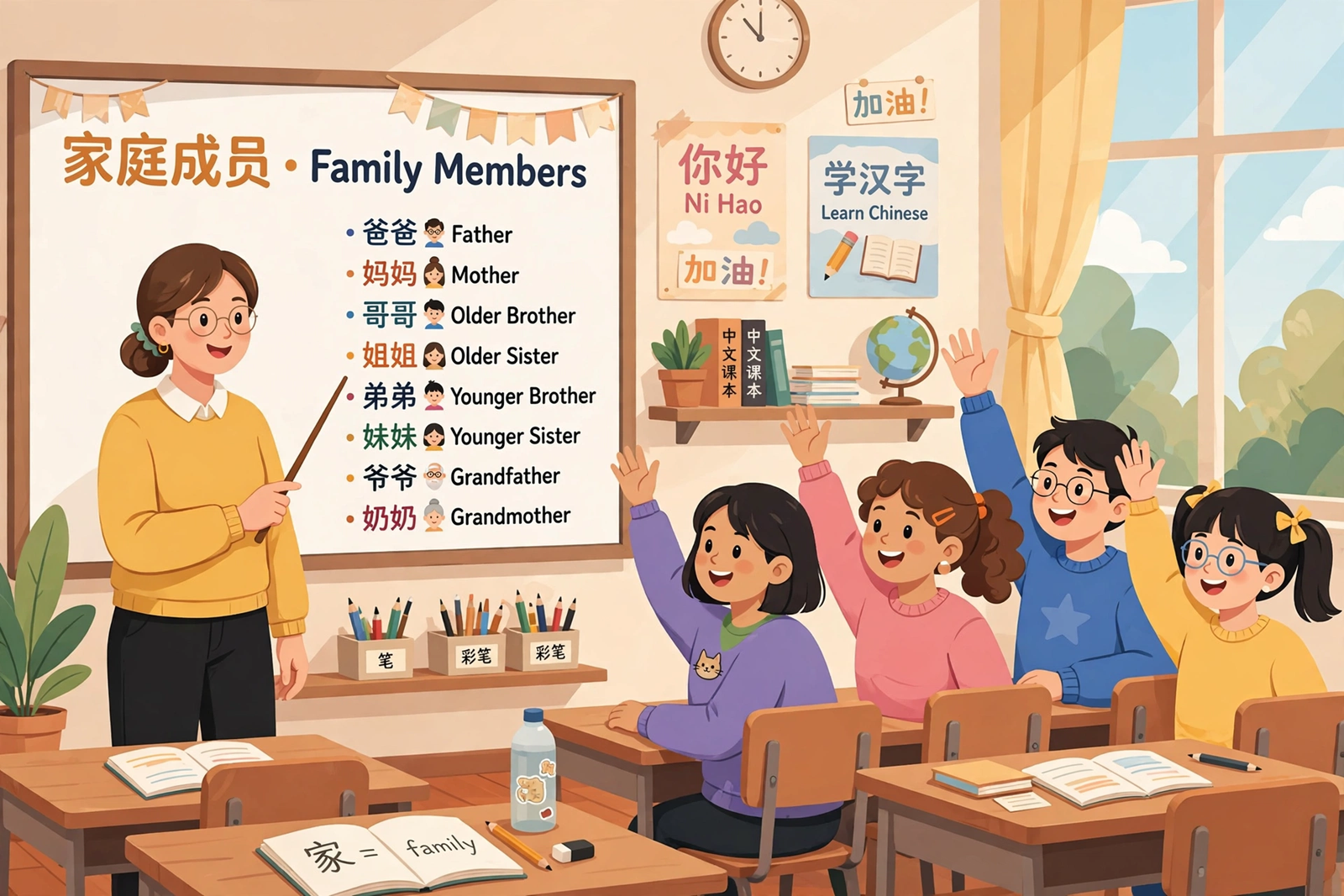
First, the good news: the family words you already know are still there. 爸爸 (dad), 妈妈 (mom), 哥哥 (older brother), 姐姐 (older sister), 弟弟 (younger brother), 妹妹 (younger sister), 儿子 (son), 女儿 (daughter) — all of them are still Level 1 under HSK 3.0. If you studied them under the old syllabus, nothing is wasted.
Second, the surprise: a few words that sat in Level 1 under the old 2.0 list are no longer Level 1 under HSK 3.0. The clearest example is 男人 (nánrén, man) and 女人 (nǚrén, woman) — under HSK 3.0 they appear at a higher level, not Level 1. So if an old flashcard deck tells you 男人 is a Level 1 word, the deck is out of date. Check the level before you drill a word, or you will spend exam week memorizing words the test does not ask for at your level.
Third, HSK 3.0 Level 1 adds words the old list never had at this level, like 大学生 (university student) and 家人 (family member). The exam now expects you to talk about real life — your family, your classmates, your teacher — from the very first level. That is exactly what this list trains.
The complete list: family words first
Family comes first because it is the easiest group to learn and the most useful in real conversation. Every Chinese learner talks about their family in the first month — and every HSK 1 test asks about it. Listen to the words first, then read the table.
Listen to the family words: dad, mom, older brother, older sister, younger brother, younger sister, son, daughter.
| Chinese | Pinyin | English | Example sentence |
|---|---|---|---|
| 爸爸 | bàba | dad, father | 我的爸爸是医生。(Wǒ de bàba shì yīshēng. — My dad is a doctor.) |
| 妈妈 | māma | mom, mother | 我妈妈是老师。(Wǒ māma shì lǎoshī. — My mom is a teacher.) |
| 哥哥 | gēge | older brother | 我有一个哥哥。(Wǒ yǒu yí gè gēge. — I have an older brother.) |
| 姐姐 | jiějie | older sister | 她是我的姐姐。(Tā shì wǒ de jiějie. — She is my older sister.) |
| 弟弟 | dìdi | younger brother | 那个孩子是我的弟弟。(Nà gè háizi shì wǒ de dìdi. — That child is my younger brother.) |
| 妹妹 | mèimei | younger sister | 我妹妹很可爱。(Wǒ mèimei hěn kě’ài. — My younger sister is very cute.) |
| 儿子 | érzi | son | 他有一个儿子。(Tā yǒu yí gè érzi. — He has a son.) |
| 女儿 | nǚ’ér | daughter | 她有一个女儿。(Tā yǒu yí gè nǚ’ér. — She has a daughter.) |
| 家人 | jiārén | family member | 我的家人很多。(Wǒ de jiārén hěn duō. — I have a big family.) |
| 孩子 | háizi | child | 这个孩子是学生。(Zhè gè háizi shì xuésheng. — This child is a student.) |
Two things to notice in this table. First, the pattern for age: 哥哥 and 姐姐 are the older brother and sister, 弟弟 and 妹妹 are the younger ones. Chinese does not have one word for “brother” the way English does — you always say whether the sibling is older or younger than you. Mix them up and you change the meaning completely: 我有一个哥哥 (I have an older brother) is a different person from 我有一个弟弟 (I have a younger brother).
Second, look at 儿子 and 女儿. These are the formal words for son and daughter, and they show up in HSK 1 because test questions love them: 你有儿子吗? (Do you have a son?) is a perfectly normal HSK 1 question. Notice the apostrophe in 女儿 (nǚ’ér) — it separates the two syllables so you do not read them as one blurred sound. Write it with the apostrophe; it is part of the correct pinyin.
School, work, and the people you meet every day
Once you can talk about your family, the next group is the people around you at school and in daily life. These ten words cover your teacher, your classmates, your friends, and the polite forms of address you will use with strangers.
Listen to the school and everyday people words: teacher, student, classmate, friend, child, doctor, Mr., person.
| Chinese | Pinyin | English | Example sentence |
|---|---|---|---|
| 老师 | lǎoshī | teacher | 这是我的老师。(Zhè shì wǒ de lǎoshī. — This is my teacher.) |
| 学生 | xuésheng | student | 他是学生。(Tā shì xuésheng. — He is a student.) |
| 同学 | tóngxué | classmate | 她是我的同学。(Tā shì wǒ de tóngxué. — She is my classmate.) |
| 朋友 | péngyou | friend | 你是我的好朋友。(Nǐ shì wǒ de hǎo péngyou. — You are my good friend.) |
| 医生 | yīshēng | doctor | 我妈妈是医生。(Wǒ māma shì yīshēng. — My mom is a doctor.) |
| 先生 | xiānsheng | Mr., sir | 先生,请问,你叫什么名字?(Xiānsheng, qǐngwèn, nǐ jiào shénme míngzi? — Excuse me, sir, what is your name?) |
| 大学生 | dàxuéshēng | university student | 我是大学生。(Wǒ shì dàxuéshēng. — I am a university student.) |
| 女孩 | nǚhái | girl | 那个女孩是我的妹妹。(Nà gè nǚhái shì wǒ de mèimei. — That girl is my younger sister.) |
| 小朋友 | xiǎopéngyǒu | little friend, young child | 小朋友,你好!(Xiǎopéngyǒu, nǐ hǎo! — Hello, little friend!) |
| 人 | rén | person, people | 这里有很多人。(Zhèli yǒu hěn duō rén. — There are many people here.) |
| 女士 | nǚshì | Ms., madam | 女士,请问,你叫什么名字?(Nǚshì, qǐngwèn, nǐ jiào shénme míngzi? — Excuse me, ma’am, what is your name?) |
| 大家 | dàjiā | everyone | 大家好!(Dàjiā hǎo! — Hello, everyone!) |
| 男朋友 | nánpéngyou | boyfriend | 他是我的男朋友。(Tā shì wǒ de nánpéngyou. — He is my boyfriend.) |
| 女朋友 | nǚpéngyou | girlfriend | 她是我的女朋友。(Tā shì wǒ de nǚpéngyou. — She is my girlfriend.) |
| 别人 | biérén | other people, someone else | 别人在那儿。(Biérén zài nàr. — The other people are over there.) |
Three words in this group trip up almost every beginner. The first is 同学 (tóngxué). It does not mean “friend” — it means someone who studies in the same class as you. A 同学 might also be your 朋友, but the words are not interchangeable, and the test knows the difference.
The second is 先生 (xiānsheng). Yes, it means “Mr.” — but it is also the polite way to address any adult man you do not know, the way you would say “sir” in English. You will hear it in shops, in taxis, and at the start of almost every polite question. It is one of the most useful words in the whole HSK 1 list, and it costs you nothing to learn.
The third is 人 (rén), the simplest word on the list and the most powerful. One character, one syllable, and it builds dozens of words: 中国人 (Zhōngguó rén, Chinese person), 美国人 (Měiguó rén, American), 男人 (nánrén, man). Learn 人 properly — second tone, rising, like asking a question — and half the people words in Chinese start to make sense.
Two more words in this group deserve a line of their own. 女士 (nǚshì, Ms.) is the polite form for a woman, matching 先生 for a man — together they cover every polite “excuse me” you will ever need. And 大家 (dàjiā, everyone) is the word that opens every class and every speech: 大家好 (Dàjiā hǎo, hello everyone) is the first thing a teacher says, and one of the first things you will say back. Technically 大家 is a pronoun, not a noun, but you will use it exactly like a people word, so it belongs on this list.
How to use these nouns: three sentence patterns
Knowing a word is not the same as using it. These three patterns turn the whole list into sentences you can say today. They are the only grammar you need for this post, and they appear on every HSK 1 test.
Pattern 1: 这是我的… (Zhè shì wǒ de… — This is my…) Point at someone and introduce them. 这是我的老师。 这是我的朋友。 这是我的哥哥。 One pattern, twenty-five words, and you can introduce anyone in your life.
Pattern 2: 我是… / 他是… / 她是… (Wǒ shì… / Tā shì… / Tā shì… — I am… / He is… / She is…) Say what someone is. 我是学生。 他是医生。 她是我的姐姐。 The verb 是 (shì, to be) does all the work here — no conjugation, no changing form, just 是 every time.
Pattern 3: 我有一个… (Wǒ yǒu yí gè… — I have a…) Talk about your family. 我有一个哥哥。 我有一个妹妹。 我没有弟弟。(Wǒ méiyǒu dìdi. — I do not have a younger brother.) The measure word 个 (gè) sits between the number and the noun — 一个哥哥, 两个朋友 — and forgetting it is the most common mistake in HSK 1 writing.
Listen to the four model sentences below, then say each one out loud twice. Reading silently does not count. Your mouth needs the practice as much as your eyes do.
Listen to the example sentences: This is my teacher. This is my friend. I have an older brother. My mom is a doctor.
Five mistakes that cost points on the HSK 1 test
Mixing up older and younger siblings. 哥哥 is older brother, 弟弟 is younger brother — and the same for 姐姐 and 妹妹. In a listening test, the difference between “my older sister” and “my younger sister” is one syllable, and it is worth a whole question. Drill them in pairs until the pair feels like one word.
Saying 我的朋友们 for “my friends.” In English you add an -s. In Chinese, 朋友 stays 朋友, and you show “many” with a number or a word like 很多 (hěn duō, many): 我有很多朋友 (I have many friends). The suffix 们 (men) exists, but at HSK 1 level you almost never need it with these nouns — and using it wrong is a classic beginner error.
Forgetting 个 after a number. 一个老师, 两个学生, 三个朋友 — the measure word 个 belongs there every time. “我有一哥哥” is wrong; “我有一个哥哥” is right. Say it with the 个 from the very first day so it becomes automatic.
Using 儿子 and 女儿 for your own children in casual talk. They are correct words, but in everyday speech Chinese parents usually say 我的孩子 (my child) or use the child’s name. Save 儿子 and 女儿 for the test and for formal situations — and know them cold, because the test will use them.
Studying from an old 2.0 list. If your flashcard app still says Level 1 has 150 words, it is teaching HSK 2.0. Under HSK 3.0, Level 1 has 300 words, and words like 男人 and 女人 have moved up a level. Before you trust any list, check which syllabus version it follows — the same advice our post on what changed in HSK 3.0 gives in detail.
Practice: use the words, then check yourself
Do these five exercises now, out loud if you can. The answers are right after each one, with an explanation — but try first, then look.
Exercise 1 — Fill in the blank. 这是我的___。(This is my teacher.) Answer: 老师 (lǎoshī). The sentence pattern 这是我的… needs a person noun, and 老师 fits the meaning.
Exercise 2 — Choose the right sibling. Your older sister is visiting. You say: 这是我的___. (a) 妹妹 (b) 姐姐. Answer: (b) 姐姐 — older sister. 妹妹 is the younger sister.
Exercise 3 — Translate into Chinese. “I have a younger brother.” Answer: 我有一个弟弟。(Wǒ yǒu yí gè dìdi.) Remember the measure word 个 after 一.
Exercise 4 — Fix the mistake. A student writes: 我有二个朋友。 What is wrong? Answer: 二 (èr) is wrong here — with a measure word you say 两 (liǎng), not 二: 我有两个朋友。(Wǒ yǒu liǎng gè péngyou. — I have two friends.)
Exercise 5 — Say it in Chinese. “She is my classmate.” Answer: 她是我的同学。(Tā shì wǒ de tóngxué.) Use 她 for “she” and 同学, not 朋友, for classmate.
Listen to these practice sentences one more time and repeat them. Hearing your own voice say them correctly is the last step before they stick.
Listen to the practice sentences: He is a student. She is my older sister. My dad is a doctor. You are my good friend.
Summary table: all 25 HSK 3.0 Level 1 people nouns
Screenshot this table or copy it into your notebook. Twenty-five words, three groups, one exam level — HSK 3.0 Level 1.
| Group | Words |
|---|---|
| Family (10) | 爸爸 bàba, 妈妈 māma, 哥哥 gēge, 姐姐 jiějie, 弟弟 dìdi, 妹妹 mèimei, 儿子 érzi, 女儿 nǚ’ér, 家人 jiārén, 孩子 háizi |
| School & everyday life (10) | 老师 lǎoshī, 学生 xuésheng, 同学 tóngxué, 朋友 péngyou, 医生 yīshēng, 先生 xiānsheng, 大学生 dàxuéshēng, 女孩 nǚhái, 小朋友 xiǎopéngyǒu, 人 rén |
| More people words (5) | 女士 nǚshì, 大家 dàjiā, 男朋友 nánpéngyou, 女朋友 nǚpéngyou, 别人 biérén |
| Not Level 1 in HSK 3.0 — learn later | 男人 nánrén (man), 女人 nǚrén (woman) — they appear at a higher level under HSK 3.0 |
Want the next group in the same format? The HSK 1 pronouns list with example sentences pairs perfectly with this post — pronouns and people nouns are the two halves of every “who is this?” question on the test. And if you are building a full study plan, our guide to what changed in HSK 3.0 explains the 150-to-300-word jump and what it means for your timeline.
Quick Quiz: HSK 1 nouns about people
Tap the answer you think is right — you will know instantly if it is correct.
Your score: 0/5 — tap an answer to check it right away.
Question 1. Which word means “older brother”?
Question 2. How many words are in the HSK 3.0 Level 1 list?
Question 3. “我是学生” means…
Question 4. Which sentence is correct?
Question 5. What does 同学 mean?
Frequently asked questions about HSK 1 nouns about people
Is this list HSK 2.0 or HSK 3.0? HSK 3.0. Every word in the two tables comes from the official HSK 3.0 Level 1 word list (300 words) in the HSK 考试大纲 published in November 2025 and in effect from July 2026. The old HSK 2.0 Level 1 list had only 150 words, so always check which version a list follows before you study it.
Why are 男人 and 女人 not in the Level 1 list? Under HSK 3.0 they appear at a higher level, even though many old HSK 2.0 materials put them at Level 1. They are still worth learning — just do not count them as Level 1 words when you plan your exam preparation.
Do I need to write all these characters by hand? For HSK 1, recognition matters more than handwriting. You need to read 爸爸 and 妈妈 when you see them and match them to the right pinyin and meaning. Writing practice helps memory, but the test at this level is mostly reading and listening.
How should I memorize twenty-five words? In groups, not in a row. Learn the six siblings as one set (哥哥,姐姐,弟弟,妹妹,儿子,女儿), the school words as a second set (老师,学生,同学,朋友), and the rest as a third. Then test yourself with the three sentence patterns — 这是我的…, 我是…, 我有一个… — instead of staring at the list.
What should I learn after people nouns? Pronouns, because every people sentence needs one: 我,你,他,她,我们. The HSK 1 pronouns list with example sentences is the natural next step, and it uses the same format as this post.
Twenty-five words. That is the whole list — every people noun HSK 3.0 expects you to know at Level 1, with an example sentence for each and the three patterns that turn them into real speech. Learn the family set today, the school set tomorrow, and by the weekend you will be able to introduce everyone in your life in Chinese. Tell us in the comments which group was hardest for you — the siblings, or the school words? And if this list saved you from studying an out-of-date deck, share it with a friend who is preparing for HSK 1 too. Ready for the next step? Start from the Chinese learning hub on LingoBubbo and keep going — one word group at a time.