Your eight-year-old has just finished her first Chinese workbook. She can say hello and count to ten, and now the tutor wants to know: HSK 1 or HSK 2? Pick wrong and she either yawns through months of review or drowns in sentences she was never taught. The good news is that the choice in HSK 1 vs HSK 2 is simpler than it looks, and a five-minute check at home will settle it.
The HSK is the official Chinese proficiency test, with six levels from beginner to advanced. Levels 1 and 2 are the first two steps: HSK 1 covers the basics, and HSK 2 builds on it with everyday sentences and a little more grammar. Neither is “better” — the right one matches where your child is today.
HSK 1 vs HSK 2 at a Glance
Here is the whole comparison in one table.
| HSK 1 | HSK 2 | |
|---|---|---|
| Vocabulary | 150 words | 300 words (cumulative, includes HSK 1) |
| What they can do | Greetings, numbers, family words, short phrases | Everyday sentences: shopping, weather, yesterday |
| Listening | 20 questions | 35 questions |
| Reading | 20 questions | 25 questions |
| Total questions | 40 | 60 |
| Test time | About 40 minutes | About 55 minutes |
| Pass mark | 120 out of 200 | 120 out of 200 |
| Best for | True beginners | Children who handle simple sentences |
Note two things: HSK 2 adds about 150 new words on top of the first 150, and neither test asks your child to write characters from memory — both test listening and reading only.
What Your Child Can Actually Do at Each Level
At HSK 1, your child can greet people — 你好 (nǐ hǎo, hello) and 谢谢 (xièxie, thank you) — introduce herself, 我叫安娜 (wǒ jiào Ānnà, my name is Anna), count 一二三四五 (yī èr sān sì wǔ, one two three four five), and name family: 这是我的妈妈 (zhè shì wǒ de māma, this is my mom). It is the language of the dinner table and the playground.
At HSK 2, she joins words into real sentences. She can say what she likes, 我喜欢苹果 (wǒ xǐhuan píngguǒ, I like apples), talk about yesterday, 我昨天去商店买东西 (wǒ zuótiān qù shāngdiàn mǎi dōngxi, yesterday I went to the shop to buy things), and even compare things, 他比我高 (tā bǐ wǒ gāo, he is taller than me). Which paragraph sounds like your child? That is your answer.
The 5-Minute Test: Which Level Fits Your Child?
Forget the word lists for a moment. Sit with your child tonight and try these five quick checks. No books, no pressure — just a chat.
- Can they greet you and say their name in Chinese without help?
- Can they count to 10 and say their age?
- Can they make a full sentence, like “I like apples” or “This is my dad”?
- Can they answer 现在几点? (xiànzài jǐ diǎn, what time is it now?)
- Can they talk about yesterday in two or three sentences?
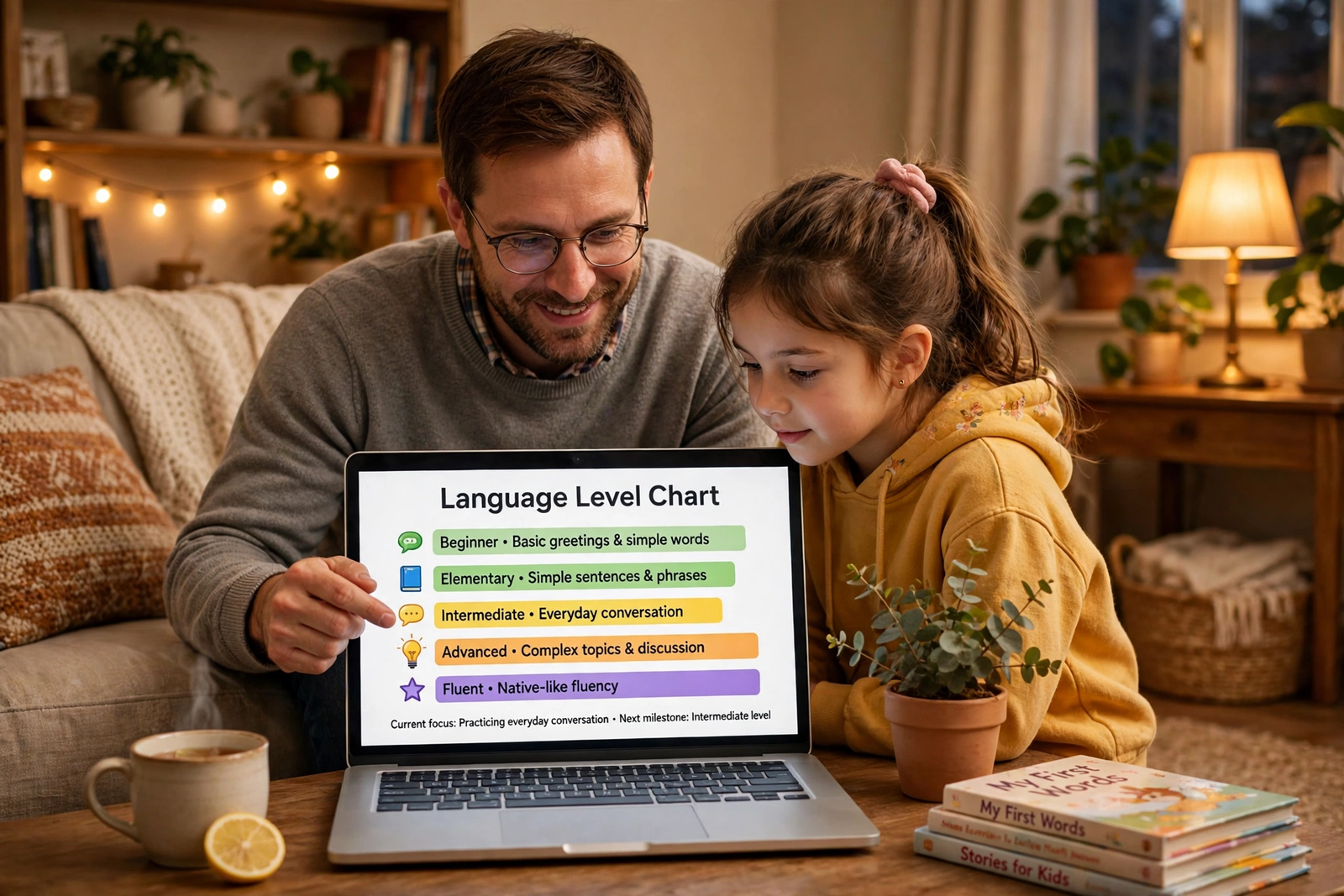
Stalls at number three? Start at HSK 1. Handles three and four? HSK 2 is the right challenge. And if number five comes easily, they may already be ready to look past HSK 2 — our guide to moving from HSK 2 to HSK 3 shows what comes next.
What the Tests Themselves Look Like
Both tests have two parts: listening and reading. In listening, your child hears a short phrase and picks the matching picture or answer. In reading, they match sentences to pictures or choose the right word to finish a sentence. There is no speaking or writing test at these levels, so a shy child is not penalised for nerves.
HSK 1 has 40 questions in about 40 minutes; HSK 2 has 60 in about 55 minutes. Both are scored out of 200, and 120 is a pass. For a full walkthrough, see our HSK 1 test format guide — the structure is nearly identical at HSK 2, just with longer sentences.
The Mistake Most Families Make
The most common mistake is skipping HSK 1 to “save time.” It feels efficient. It usually backfires. Those first 150 words are the foundation everything else stands on: the numbers, the family words, the little grammar words like 的 (de, the possessive particle) that hold sentences together. A child who jumps ahead often memorises HSK 2 phrases without understanding them.
The opposite mistake is staying at HSK 1 too long. If your child already chats in simple sentences, another six months of greetings and counting will bore them — and a bored child quits. If your child gets about 80 percent of a practice test right, they are ready to move up.
A Simple Plan: From First Words to HSK 2
Whatever level you choose, the routine is the same. Fifteen minutes a day beats two hours on a Sunday, every single time.
Step 1 — Start where they are. Use the five-minute test above, not a guess and not what the neighbour’s child is doing. For the bigger picture, see our overview of all the HSK levels explained.
Step 2 — Learn words in sentences, not in lists. “Apple” alone is forgettable. 我喜欢苹果 (wǒ xǐhuan píngguǒ, I like apples) is a sentence your child can use at the dinner table — and again tomorrow.
Step 3 — Practise listening every day. Both tests are half listening, so play short Chinese audio during the school run or while tidying up. Five minutes a day builds real test confidence.
Step 4 — Take a practice test first. Sit the full test at home once, with a timer. It turns the exam room from something scary into something familiar.

Step 5 — Celebrate the win. A pass at HSK 1 or HSK 2 is a real achievement. Mark it — ice cream, a sticker chart, a phone call to grandma in Chinese — then set the next small goal.
Quick Quiz
Test yourself on HSK 1 vs HSK 2. Click an answer to see if you are right — your score is at the top.
Score: 0/5
1. How many words does HSK 1 cover?
2. What is the pass mark for both HSK 1 and HSK 2?
3. Which skills do HSK 1 and HSK 2 test?
4. In the 5-minute test, if your child stalls at making a full sentence (check 3), what should you do?
5. What daily routine does the plan recommend?
Frequently Asked Questions
Can my child skip HSK 1 and take HSK 2 directly?
Yes. There is no rule that you must pass HSK 1 before HSK 2. If your child handles the five-minute test above, going straight to HSK 2 is fine — just make sure the HSK 1 vocabulary is solid first, since HSK 2 assumes it.
How long does it take to prepare for each level?
For a child studying about 15 minutes a day, HSK 1 typically takes three to six months from zero, and HSK 2 about another four to six months after that. Children who hear Chinese at home often move faster.
What if my child fails?
Then they learned exactly what to practise. Both tests can be retaken as often as you like, and a near-miss usually means one weak area — most often listening — rather than a general problem.
Still unsure about HSK 1 vs HSK 2? Start with HSK 1. It is the kinder first step, it builds real confidence, and nothing you learn there is ever wasted — every word carries straight into HSK 2. When your child is ready, try our free HSK 1 trial lesson: a gentle first class that shows you how we teach, before you commit to anything.