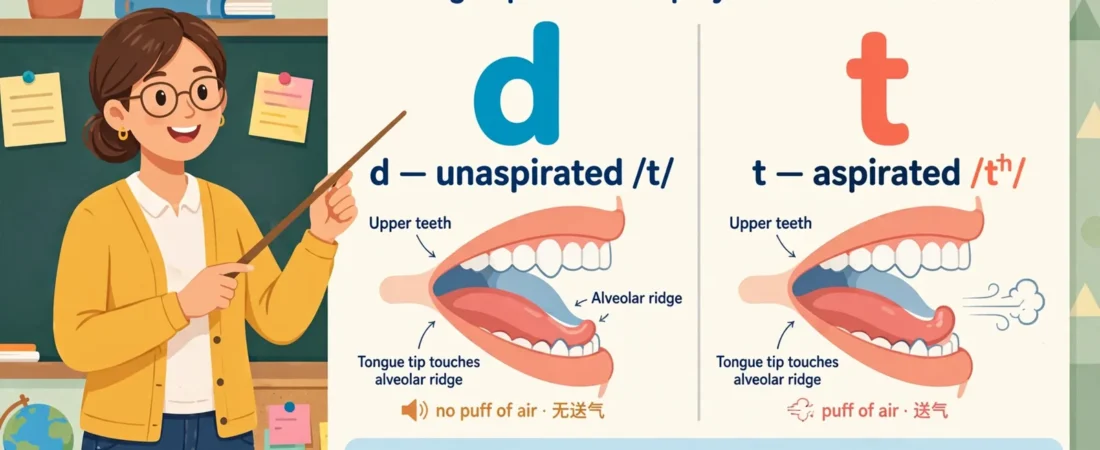
You read 大 (dà) and Chinese listeners hear 他 (tā)? Or you say 他 and they think you said 大? The d and t pair in Pinyin is one of the most confusing pairs for Vietnamese learners of Chinese — not because it is hard, but because both sound close to the Vietnamese “t”. This post separates d and t in Chinese for Vietnamese speakers with exactly one trick: aspiration — a puff of air or no puff of air. Get this one trick and you will pronounce both sounds correctly from today.
In short, before we go into the details, so you remember it even if you only read this far: d is read like a Vietnamese “t” with no puff of air — your mouth opens slightly, very little air escapes, and the sound comes out low and clipped. t is read like a Vietnamese “th”, with a strong puff of air — a clear stream of air bursts out; hold your palm in front of your mouth and you will feel it at once. Every example in this post revolves around this one difference.
Where d and t differ: aspiration is everything
In Pinyin, d and t are both stops: the tip of your tongue touches the upper gum ridge and then releases. The only difference is the air: for d, you block the air and release it gently, with almost no puff coming out; for t, you release it strongly along with a stream of air. Chinese speakers tell these two sounds apart by ear very quickly — to them, 大 (dà, big) and 他 (tā, he) are as different as day and night, even though new Vietnamese learners hear both of them as “ta”.
Try it right now: hold your palm about 5 cm from your mouth, say 大 (dà), then say 他 (tā). When you say 他, you will feel air puffing cool onto your hand. When you say 大, your hand feels almost nothing. If your hand feels air both times, you are reading d as t — soften it, read lighter and shorter. If your hand feels nothing either time, you are reading t as d — push the air out more strongly when you read t.
A way to remember it through Vietnamese: d is like the letter “t” in “tay”, “tìm” when you speak quickly, clipped, without pushing air. And t is like the letters “th” in “thơm”, “thấy” — with an “h” breath riding along. This mapping is not 100% accurate in phonetic terms, but it is enough for a beginner to pronounce correctly and be understood by Chinese speakers straight away. Later, once your ear is used to it, you will adjust towards native pronunciation on your own, without needing the trick any more.
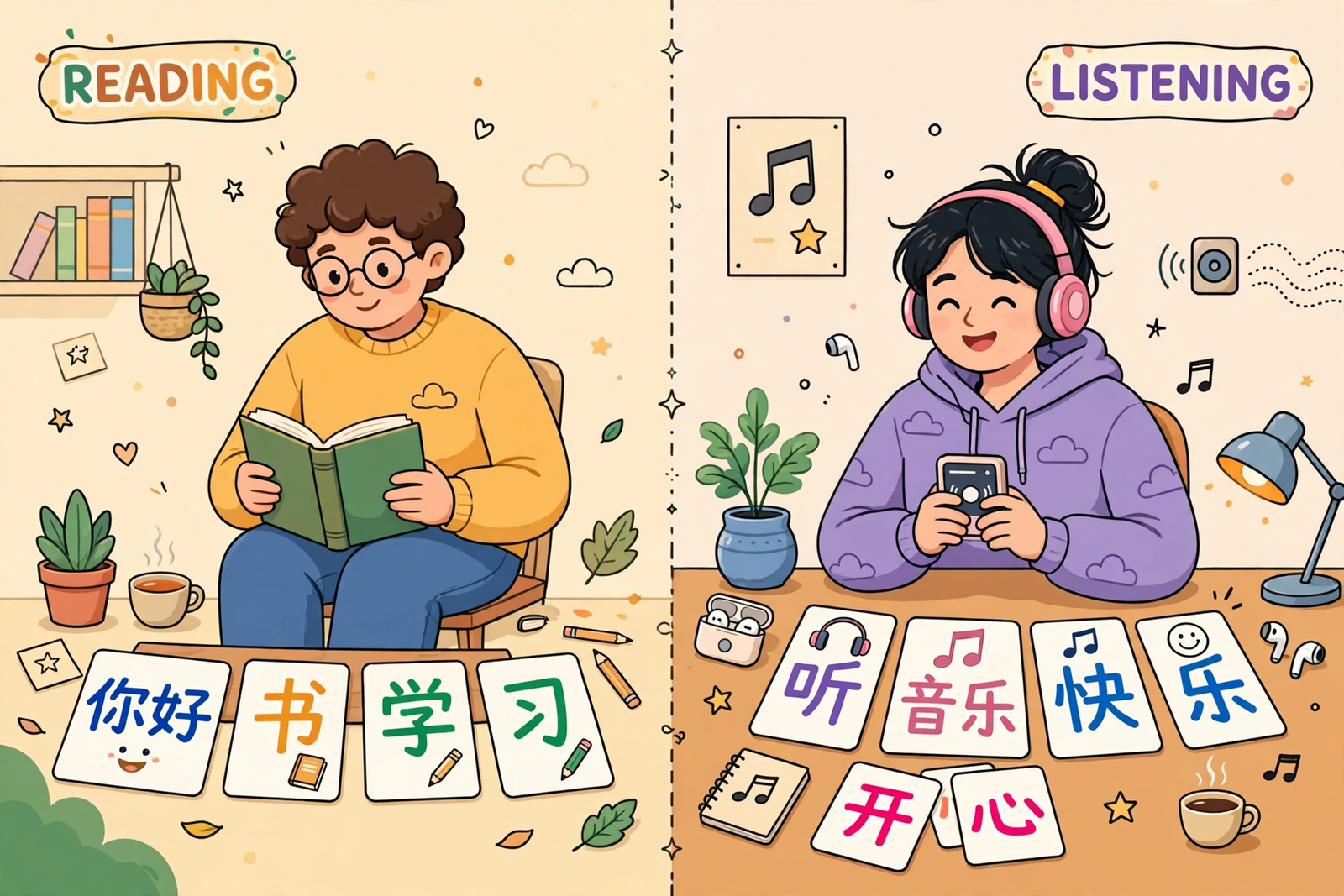
Example table: pairs of characters that sound nearly alike but mean completely different things
Read this table out loud, one pair at a time. Note: within each pair, the tones may differ — what you need to listen for is the initial consonant, d light and clipped, t with a strong puff of air. Don’t worry about the tones for now; focus on d and t first.
| The d sound (no puff of air) | The t sound (strong puff of air) | What the pair means |
|---|---|---|
| 大 dà | 他 tā | big — he |
| 读 dú | 图 tú | to read — a picture, an image |
| 打 dǎ | 塔 tǎ | to hit, to phone — a tower |
| 地 dì | 替 tì | earth, ground — to replace |
| 都 dōu | 偷 tōu | all, both — sneaky, to steal |
| 弟 dì | 踢 tī | younger brother — to kick (a ball) |
| 到 dào | 掏 tāo | to arrive — to dig out |
| 等 děng | 疼 téng | to wait — to ache |
Look at the meanings column and you will see why mixing d up with t is dangerous: say “他很大” (Tā hěn dà — He is very big) but misread it as “大很他” and the sentence falls apart completely — the listener cannot guess what you mean. Read the initial consonants right, on the other hand, and even if your tones are not quite there yet, listeners can still work out your meaning from the context. So for beginners, fixing d and t matters one notch more than fixing tones.
Listen and tell them apart: 3 audio clips to train your ear
Listen to this clip first, and focus only on the d sound. The sentences are all packed with d characters: 请大声读课文。(Qǐng dàshēng dú kèwén.) — Please read the text out loud. 大家都到学校了。(Dàjiā dōu dào xuéxiào le.) — Everyone has arrived at school. 弟弟打电话给他的朋友。(Dìdi dǎ diànhuà gěi tā de péngyou.) — The younger brother is phoning his friend. Can you hear that every d is clipped, with no air puffing out? Listen once more, hand held in front of your mouth, and read along.
Now listen to a clip full of t sounds: 他在听音乐。(Tā zài tīng yīnyuè.) — He is listening to music. 天气很好。(Tiānqì hěn hǎo.) — The weather is lovely. 她喜欢踢球,也喜欢跳舞。(Tā xǐhuan tī qiú, yě xǐhuan tiàowǔ.) — She likes playing football, and she likes dancing too. This time the air puffs out much more clearly, doesn’t it? That is the signature of t. Play the two clips back to back a few times, and your ear will start telling them apart by itself, without you having to think about it.
This clip places d and t side by side in the same sentence so you can hear the contrast clearly: 他很大,他爱读书。(Tā hěn dà, tā ài dúshū.) — He is very big, he loves reading. 她在听音乐,天气很好,他们一起去踢球。(Tā zài tīng yīnyuè, tiānqì hěn hǎo, tāmen yìqǐ qù tī qiú.) — She is listening to music, the weather is lovely, and they go off to play football together. In the first sentence, 大 and 读 are d, and 他 is t. In the second sentence, 听, 天 and 踢 are t. Once you can hear the switch between the two sounds inside a single sentence, you are halfway there.
5 short exercises: from listening to speaking
Exercise 1 — Listen and tell them apart. Play audio clip 3 again; every time you hear a t, tap the table once, and when you hear a d, don’t tap. Do 3 rounds, each round faster than the one before. This exercise trains your ear, not your mouth.
Exercise 2 — Choose the right character. Which character fills the blank in the sentence “___在听音乐” (___ is listening to music): A. 大 (dà) or B. 他 (tā)? Answer: B — the subject referring to a person is 他, while 大 means “big” and cannot serve as a person subject.
Exercise 3 — Read the pairs out loud. Read each pair 5 times, d first and t second, with your hand in front of your mouth: 大 — 他, 读 — 图, 打 — 塔, 地 — 替, 都 — 偷. Read slowly on the first round and faster on the later rounds, but keep the puff of air for t clear.
Exercise 4 — Make a sentence. Use one d character and one t character to build a sentence. Sample: 他打电话给我。(Tā dǎ diànhuà gěi wǒ.) — He phones me. In this sentence, 他 is t and 打 is d — both sounds appear, and the sentence means something real.
Exercise 5 — Record yourself and check.
Listen to this clip first: 弟弟打电话给他的同学,他们一起踢球,听音乐,然后回家吃饭。(Dìdi dǎ diànhuà gěi tā de tóngxué, tāmen yìqǐ tī qiú, tīng yīnyuè, ránhòu huí jiā chī fàn.) — The younger brother phones his classmate; they play football together, listen to music, and then go home to have dinner. Then record yourself reading this passage, listen back and compare: anywhere you read a t with no puff of air needs fixing, and anywhere you read a d with a strong puff needs fixing too.

Mistakes Vietnamese learners often make with d and t
Mistake 1: reading d as “đ”. Vietnamese has the letter “đ”, which vibrates the vocal cords, while d in Pinyin does not vibrate — it is a “t” with no puff of air, and the vocal cords stay still. Reading 大 as “đà” is completely wrong, and it sounds very odd to Chinese ears. Remember: Pinyin d = a light t, not đ.
Mistake 2: reading t as a Vietnamese “t”. The Vietnamese letter “t” is usually not aspirated as strongly as the Pinyin t. If you read 他 like an ordinary “ta”, Chinese listeners may well hear 大. The Pinyin t must carry a clear “th” puff of air — it is closer to “tha” than to “ta”.
Mistake 3: right when reading slowly, wrong when reading fast. Read each character on its own and you get it right, but inside a fast sentence d and t get mixed up. The cure: slow the sentence down, and keep your hand in front of your mouth during your first week of practice. Slow and correct beats fast and wrong, because your mouth will remember a wrong habit for a very long time.
Mistake 4: fixing the mouth only, not the ear. Many learners practise speaking for a whole week without practising listening at all, so when someone else speaks they still cannot tell the sounds apart. Listening practice and speaking practice must go together — listen to the audio in this post for 5 minutes every day, then read along.
Summary table: how to tell d and t apart in Chinese for Vietnamese speakers
d: no puff of air, read like a Vietnamese “t”, light and clipped, for example 大 dà, 读 dú, 打 dǎ, 地 dì, 都 dōu. t: a strong puff of air, read like a Vietnamese “th”, air puffing onto your hand, for example 他 tā, 图 tú, 塔 tǎ, 替 tì, 偷 tōu. Quick check: hand in front of your mouth — when you read t you feel air, when you read d you don’t. Practise every day: listen for 5 minutes, read the pairs 5 times, record 1 passage. After a week, you will find you no longer have to think “is this character d or t?” — your mouth will get it right on its own.
Quick quiz: can you tell d and t apart yet?
Tap the answer you choose — you will know straight away whether you are right or wrong.
Your score: 0/5 — click an answer to check it right away.
Question 1. Which Vietnamese sound is the Pinyin d most similar to?
Question 2. What is characteristic of the Pinyin t sound?
Question 3. What does 他 (tā) mean?
Question 4. In the sentence “他在听音乐”, which characters carry the aspirated t sound?
Question 5. What is the quickest check when practising d and t on your own?
To wrap up: from today, d is a light t, and t is th with a puff of air
A single trick fixes a whole pair of sounds: d read lightly with no air, t read strongly with air. Tonight, before you go to sleep, spend 5 minutes reading the pair table in this post out loud, hand in front of your mouth, then record a short passage and listen back. Read it again tomorrow and you will find your mouth remembers faster than you thought. To keep practising Pinyin pronunciation, drop by LingoBubbo's Pinyin chart, read more in telling b and p apart in Pinyin with aspiration exercises and Pinyin: initials, finals and how to pronounce each sound correctly. Do you mix d up into t more, or t into d? Try reading the pair 大 — 他 out loud, then tell us in the comments — and send this post to the friend who is learning Pinyin along with you.